Sustainable use of marine resources around Tsugaru Strait
單元大綱
-
-


In order to use fishery resources sustainably, it is necessary to know the lives of the fishery species and to understand their abundance. Then we can determine how and how much we can catch. I would like to contribute to the SDGs (2 ZERO HUNGER and 14 LIFE BELOW WATER) by establishing and promoting this type of method.
The United Nations has designated the decade starting in 2021 as the "Decade of Ocean Science," with the aim of contributing to SDGs. Ocean science, as defined by the UN, includes the field of fisheries.
-
-
-
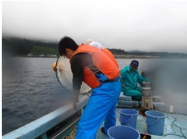
Declining fish numbers in recent years have become a problem for many fish species. Recovering stocks requires an understanding of the amount of food resources required for each fish species as well as the current state of the stock of those fish species. There is also a need for collecting ecological information during the egg and larva stages, which are prone to mass mortality, and managing resources appropriately, such as preventing overfishing, when resources are declining.
In our laboratory, we are exploring methods for predicting resource fluctuations by collecting information on the ecology and marine environments of aquatic organisms. We are trying to achieve the sustainable use of marine resources around Tsugaru Strait through these methods. We are currently studying Pleurogrammus azonus, Lophius litulon, and Todarodes pacificus.
-
-
-
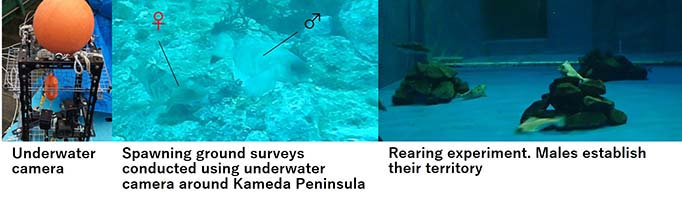
We are conducting field surveys and breeding experiments in order to determine what kinds of environments and parent-born larvae are advantageous for survival.
-
The copyright of this paper belongs to the Japanese Society for Aquaculture Science.
-
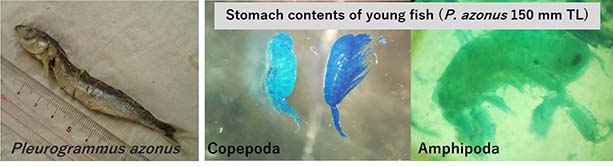
We investigate their stomach contents to observe whether the amount of food and differences in quality are the causes of fluctuations in the quantity of resources.
-
The time of birth and growth rate can be estimated and the characteristics of surviving individuals are determined by observing the fine ring patterns in the otolith.
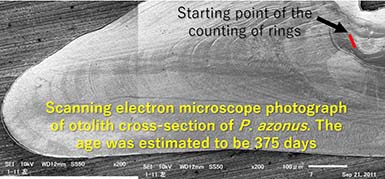
-
-
-
This is a well-known squid. However, the nutrient source of the larvae that have just hatched remains a mystery. We are currently raising larvae hatched from naturally-laid eggs in an aquarium and conducting experiments to identify the nutrient sources necessary for growth.
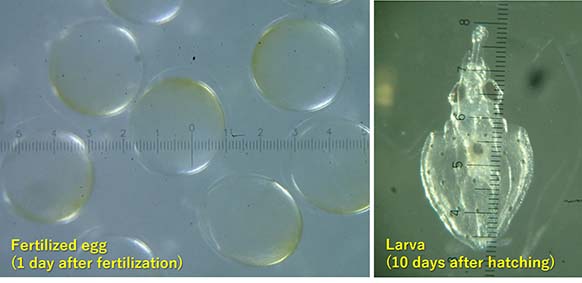
-
-
-
Parent fish and eggs just before spawning are collected in the Tsugaru Strait, but it is unknown how they live after hatching. We are currently investigating an environment suitable for the survival of larvae by combining field surveys and breeding experiments.
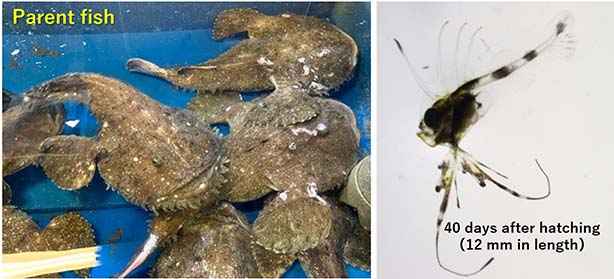
-
The copyright of this paper belongs to the Japanese Society for Aquaculture Science.
-
-
-
By facilitating learning about local resources at elementary schools in fishing villages, we are engaged in activities to develop leaders in marine conservation through lessons about local resources at elementary schools in fishing villages.
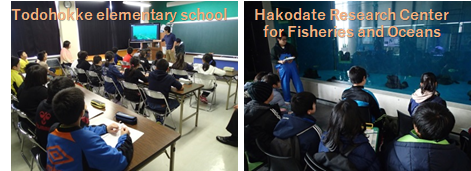
-