
High-resolution observation of oceanic mesoscale eddies: In the Western Subarctic North Pacific
섹션 개요
-
-
The subarctic North Pacific is an area with a counterclockwise circulation called the North Pacific subarctic gyre (Figure 1). While this region is rich in nutrients such as nitrate and phosphate, phytoplankton production is known to be limited due to low iron concentrations. In coastal areas, iron can be supplied by inflows from rivers, but in the open ocean, iron is in short supply, and the oceanic mesoscale eddies*1 is considered to contribute significantly to iron supply. In the Alaska Current in the subarctic North Pacific, it is known that oceanic mesoscale eddies formed in coastal areas transport iron and phytoplankton from coastal areas to the open ocean (Crawford 2002; Mackas and Galbraith 2002; Johnson et al. 2005). In the western subarctic North Pacific, however, the impact of the oceanic mesoscale eddies on material circulation and biological production has not been clarified.
This course will present studies that have investigated the impact of oceanic mesoscale eddies on biological production in the open ocean region of the western subarctic North Pacific.
*1 The oceanic mesoscale eddies are explained in detail in another course: "The Oceanic Mesoscale Eddies: High and Low Pressures in the Ocean".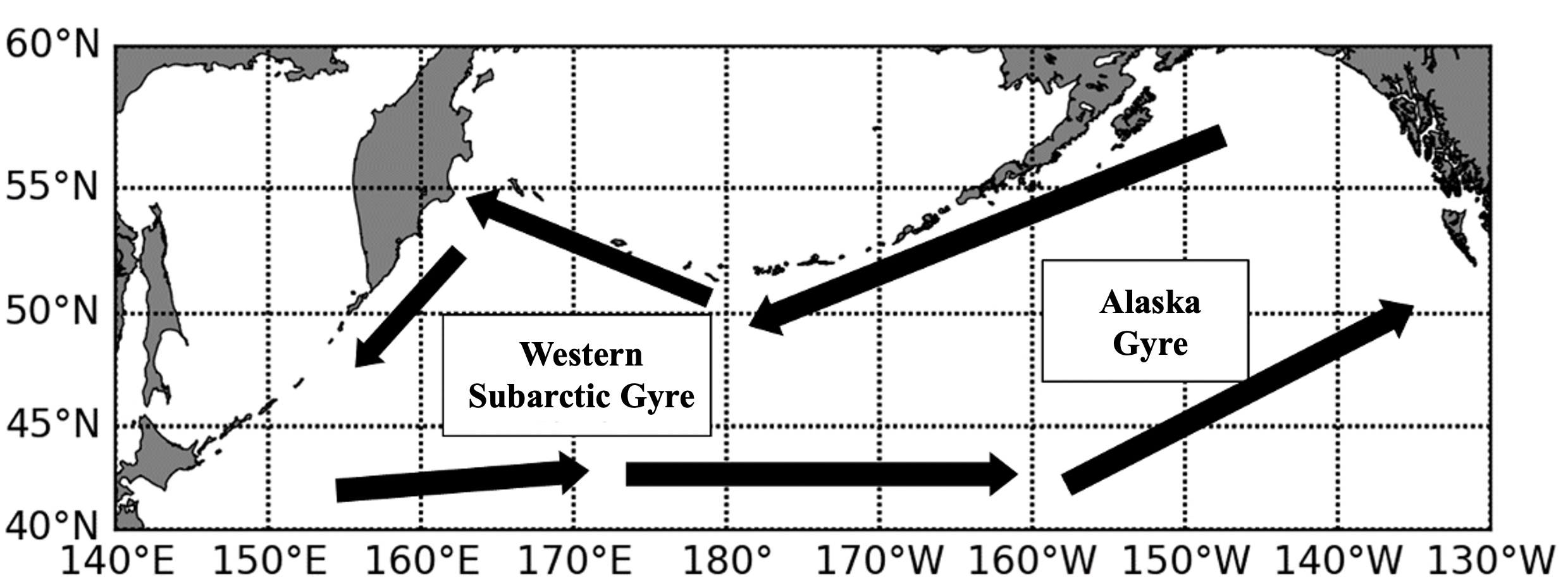
Figure 1: Circulation in the North Pacific subarctic region ("Alaska Gyre" should be "Alaskan Gyre".)
-
-
-
In this study, we mainly used data observed from June to July 2016 by Oshoro maru, a training ship of the Faculty of Fisheries Sciences, Hokkaido University. The ship observations allowed us to capture two eddies ("eddy A" and "eddy B") in the open ocean in the western subarctic region (Figure 2).
In the interior of eddy A and B, downward deflection of isotherms, a structure characteristic of anticyclonic eddies, was observed (Fig. 2b). On the other hand, the chlorophyll concentration showed no significant difference between the inside and outside of the eddies. Therefore, it is suggested that the influence of the observed oceanic mesoscale eddies on the chlorophyll concentration was small.
We examined the distribution of nutrients in the surface layers inside and outside the eddy, and found that while the concentration of macro nutrients such as nitrate was high, the concentration of dissolved iron was low, suggesting that biological production was limited by the low concentration of iron both inside and outside the eddy (Figure 3).
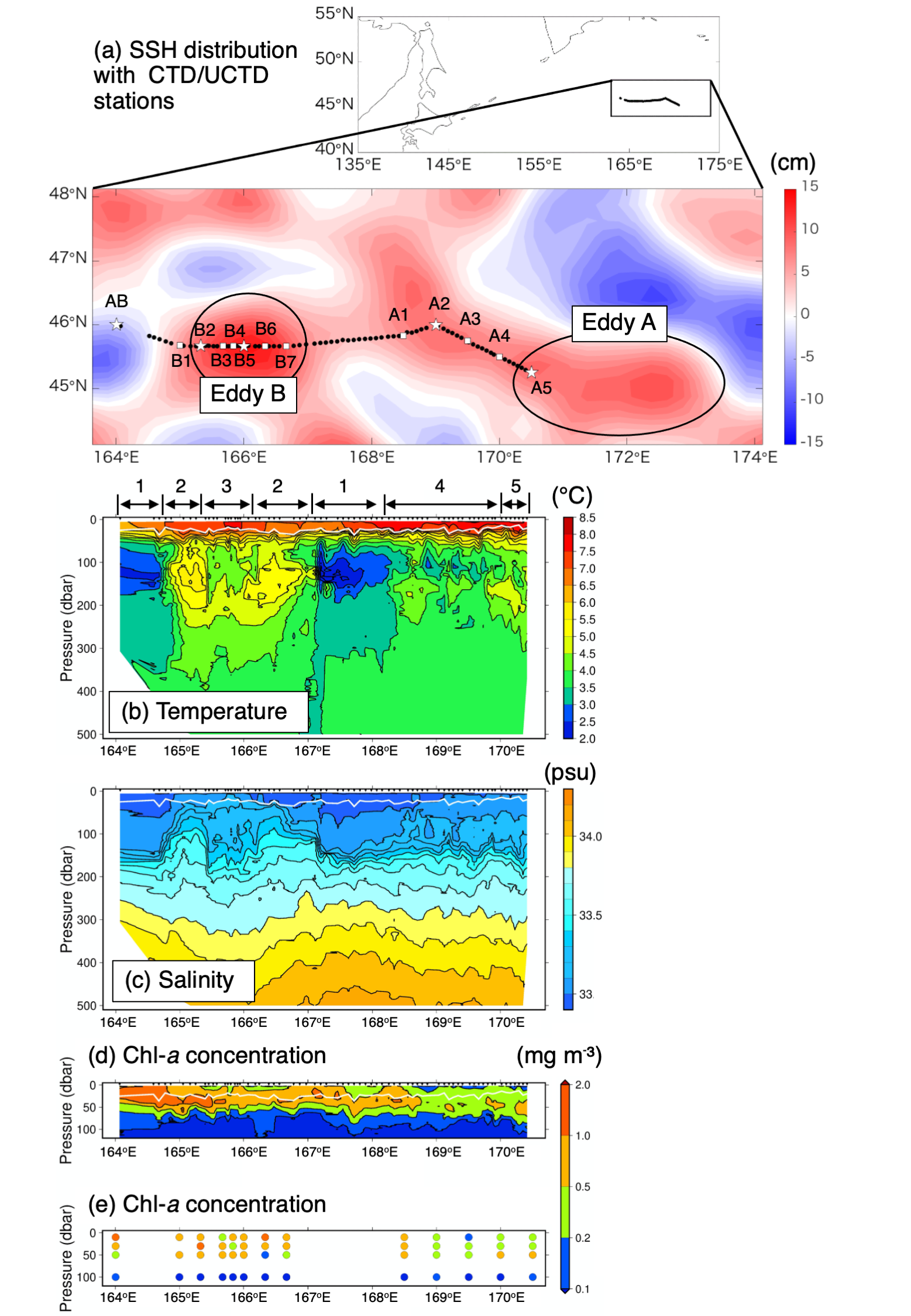
Figure 2. (a) CTD stations (without iron observations: ○), CTD stations (with iron observations: ☆), and UCTD stations (●). Colors indicate sea surface height on July 1, 2016. Eddy A and Eddy B are eddies observed in this observation. (b) Water temperatures observed by UCTD (unit: °C); Area 1 indicates open ocean water found in the North Pacific subarctic region, Area 2 indicates the Eddy B fringe, Area 3 indicates the Eddy B center, Area 4 indicates the area of high sea level but not eddy, and Area 5 indicates the Eddy A fringe. (c) Salinity observed by UCTD (unit: psu) (d) Chlorophyll concentration observed by UCTD (unit: mg m-3). (d) Chlorophyll concentration observed by water sampling (unit: mg m-3). White lines in (b), (c) and (d) indicate the depth of the mixed layer*2.
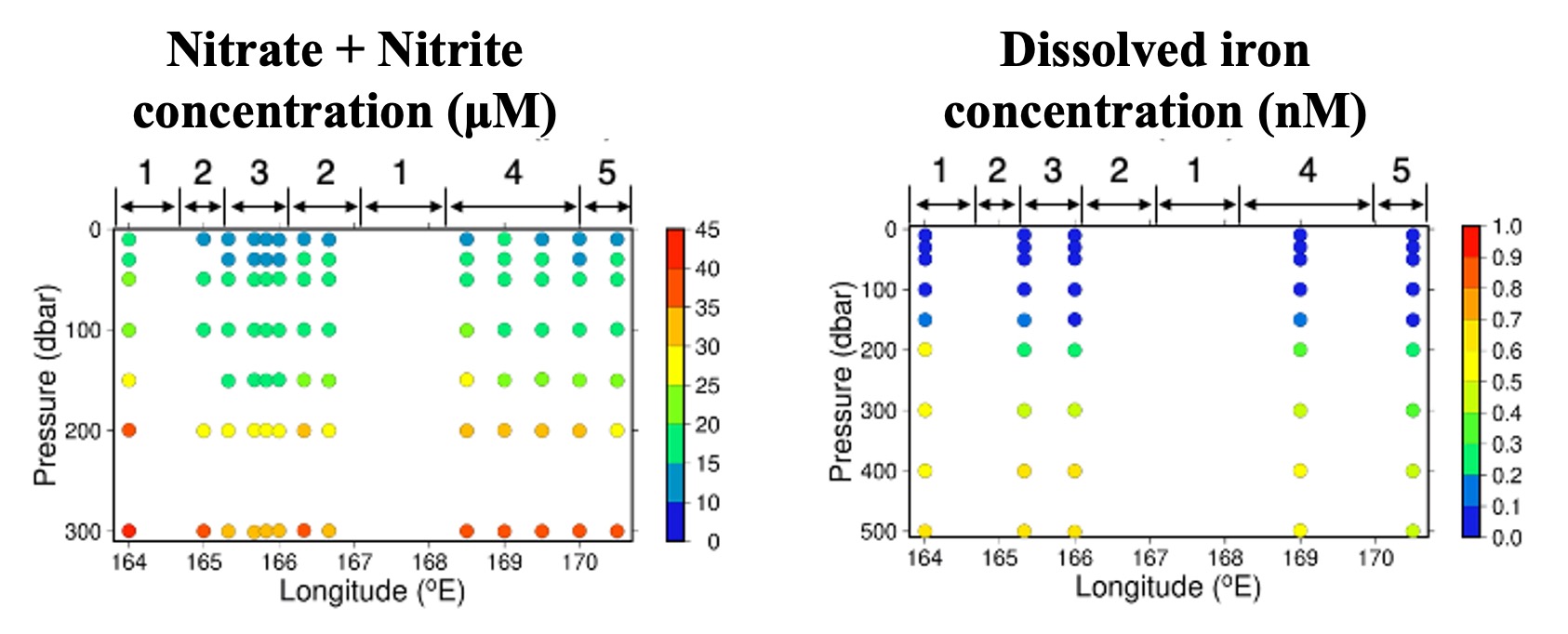
Figure 3 (a) Nitrate + nitrite concentration (unit: μM) and dissolved iron concentration (unit: nM). Areas 1 to 5 are the same as Areas 1 to 5 in Figure 2b.
*2 The mixed layer depth differs from the figure in the paper. In the paper, the mixed layer depth was defined as the depth where the in-situ density is the in-situ density of the surface layer + 0.03 kg m-3, but in this figure, it is defined as the depth where the potential density is the potential density of the surface layer + 0.03 kg m-3.
-
-
-
Inside the observed eddies, dissolved iron concentrations were low, indicating that the impact on biological production was small. This differs from the observations in the eastern subarctic region. Therefore, we investigated the horizontal and vertical iron transport by the eddy observed in this study. Satellite data analysis revealed that eddy A formed in the southern part of the Alaska Peninsula in the eastern subarctic region, propagated along the coast, and then propagated in the open ocean to the observation area over a period of two years after leaving the coast. Therefore, it was considered that iron inside the eddy was consumed during the two years after leaving the coastal area. Eddy B was found to have formed in the open ocean during the winter of the year before the observation period. Therefore, it was considered that there was no transport of iron from the coastal area.
Next, we analyzed the results of turbulence observations of vertical transport within the observed oceanic mesoscale eddies. We found that the vertical transport of iron by diffusion inside and outside the eddy was weak (Figure 4), and that the amount of highly concentrated iron distributed in the middle layer (Figure 3) that was transported to the surface by diffusion was small.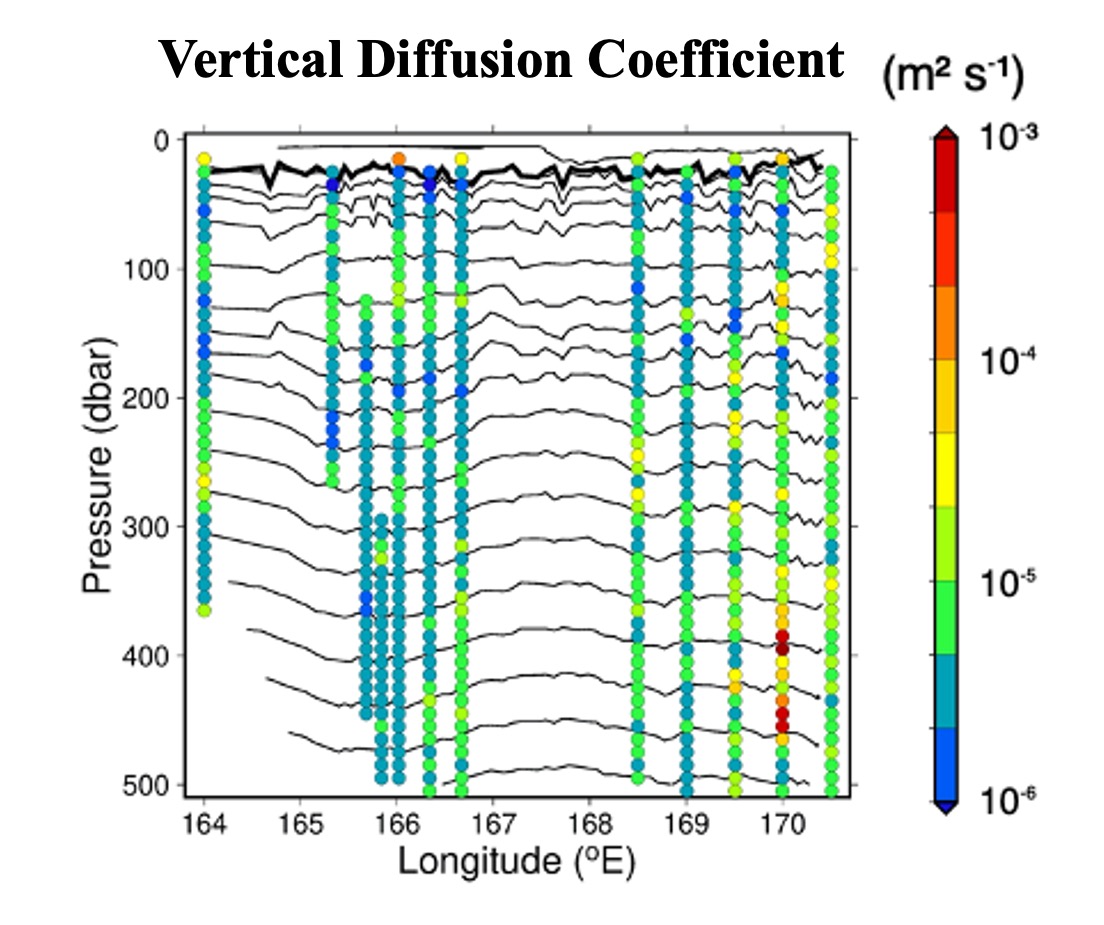
Figure 4 Vertical diffusivity (color) and in situ density (contour lines, 0.2 kg m-3 intervals) averaged at 10 m intervals. Black bold lines indicate mixed layer depth*2.
-