

Iron transport by the observed eddies
セクションアウトライン
-
-
Inside the observed eddies, dissolved iron concentrations were low, indicating that the impact on biological production was small. This differs from the observations in the eastern subarctic region. Therefore, we investigated the horizontal and vertical iron transport by the eddy observed in this study. Satellite data analysis revealed that eddy A formed in the southern part of the Alaska Peninsula in the eastern subarctic region, propagated along the coast, and then propagated in the open ocean to the observation area over a period of two years after leaving the coast. Therefore, it was considered that iron inside the eddy was consumed during the two years after leaving the coastal area. Eddy B was found to have formed in the open ocean during the winter of the year before the observation period. Therefore, it was considered that there was no transport of iron from the coastal area.
Next, we analyzed the results of turbulence observations of vertical transport within the observed oceanic mesoscale eddies. We found that the vertical transport of iron by diffusion inside and outside the eddy was weak (Figure 4), and that the amount of highly concentrated iron distributed in the middle layer (Figure 3) that was transported to the surface by diffusion was small.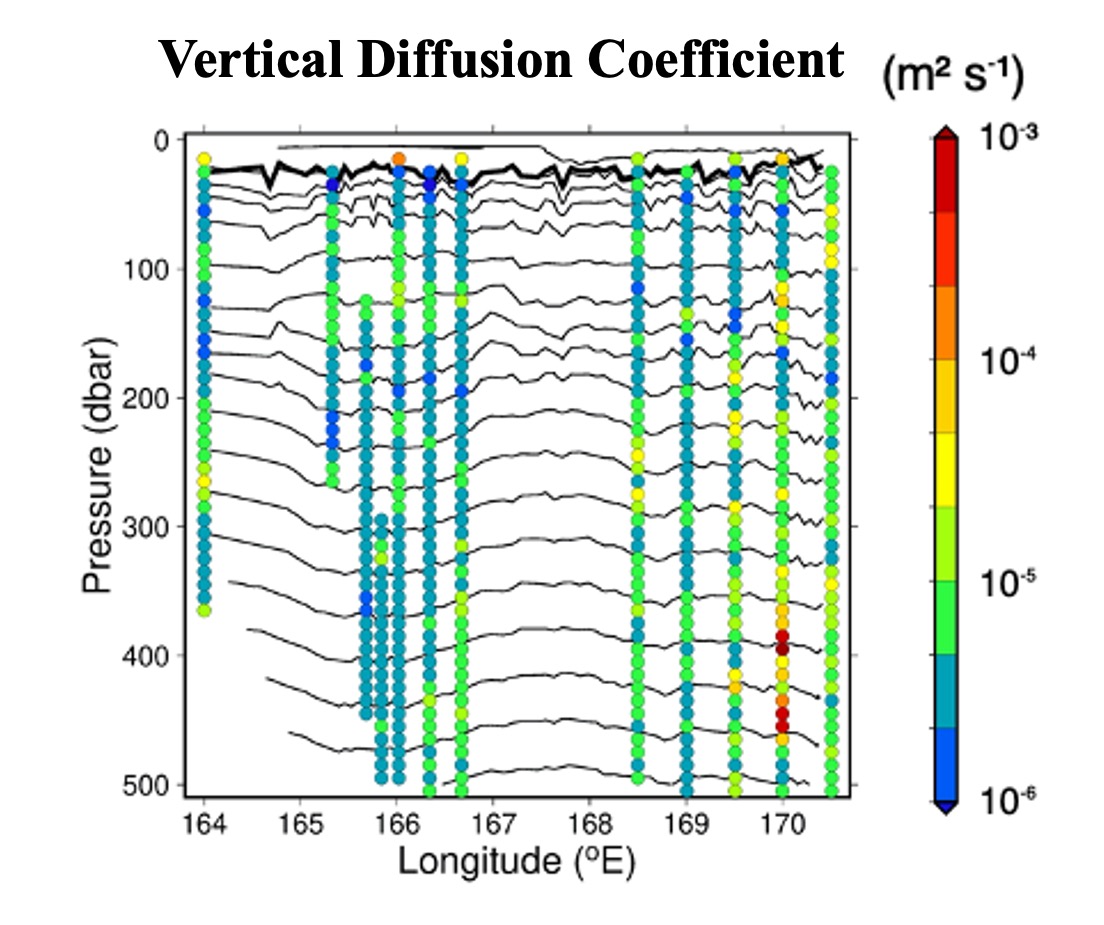
Figure 4 Vertical diffusivity (color) and in situ density (contour lines, 0.2 kg m-3 intervals) averaged at 10 m intervals. Black bold lines indicate mixed layer depth*2.
-