Section outline


    • Hokkaido University School of Fisheries Sciences Oshoro-maru Marine Science Department   Imai Keiri, Koguma Kenji, Sawada Kouki 


    •  Plankton are collected using plankton nets. Various plankton nets have been developed to study the species composition of plankton communities in the ocean, their ecology, and material circulation through the plankton community. The basic structure of a plankton net is similar to a "tamo net" with a nylon mesh (net) attached to a frame, which is simply moved in the ocean to filter plankton communities from the seawater. The original plankton net instrument was already in use during the adventures of the Challenger (1872-1876). Over time, as the species composition and ecology of marine plankton communities have been elucidated, plankton net structures and towing methods have been modified. Here, (1) plankton net structure and collection principles and (2) towing methods are described, as well as (3) how to determine net depth and (4) how to measure filter water volume to improve the quantification of plankton net sample collection. In addition, (5) typical plankton nets that are commonly used today will be introduced.


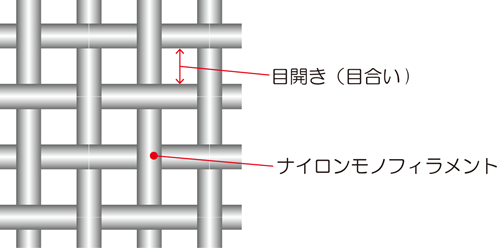
    •  The basic structure of a plankton net is simple, with the netting attached to a frame that serves as the opening (net mouth). The frame is made of metal in most cases, and its shape is either circular or rectangular, depending on the type of net. Nylon mesh (Figure 1) is often used as the mesh material, and the size and shape of the mesh allows for sorting of the plankton community to be collected. Nylon mesh itself is widely used industrially by flour millers and other companies to adjust the particle size of powders, remove foreign matter, and for various types of filters. Nylon mesh is made by weaving nylon threads (nylon monofilaments), and there are various standards depending on the thickness of the threads, the gap (distance between threads), and the weaving method. Among these, the most commonly used are NYTAL XX13 (100 μm mesh) and NYTAL 52GG (335 μm mesh), which are used for phytoplankton and zooplankton, respectively. This mesh is sewn together into conical, cylindrical, or square pyramidal shapes, depending on the shape of the opening and the type of net. A metal or device (cotton end) is also attached to the tail of the net to remove the collected plankton community.


    • ナイロンメッシュ

      1 Nylon mesh (NYTAL) structure

                目開き(目合い):aperture (mesh size of a net)
                ナイロンモノフィラメント:nylon monofilament

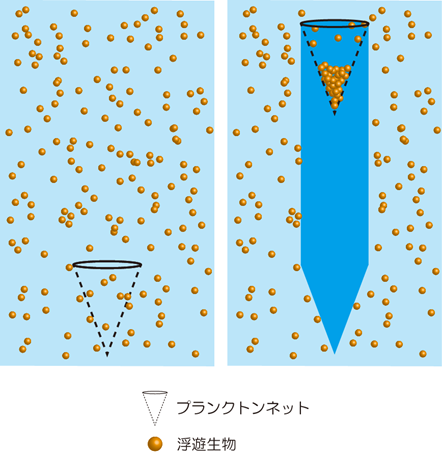
    •  The principle of plankton net collection is shown in Figure 2. By moving the net in the water with the net mouth in front of it (towing the net), seawater entering through the net mouth passes through the net, leaving particles larger than the gap (mesh size) of the nylon mesh. In other words, by filtering the seawater, the plankton net concentrates the plankton community present in the moving water column.


    • プランクトンネット採集原理

      2 Principle of plankton net collection

                        プランクトンネット:plankton net
                             浮遊生物:plankton

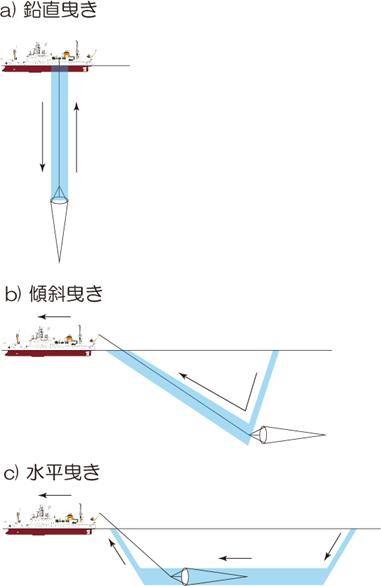
    •  There are three types of plankton net seine methods: vertical tow, oblique tow, and horizontal tow (Figure 3).


       Vertical tow is the simplest seine method, in which the net is lowered into the sea from a stationary vessel and then pulled up. The plankton net is connected to the end of a wire rope that is wound into a winch, and the net is pulled by uncoiling the rope for the same length as the desired depth and then rewinding the rope again. Because the amount of seawater that can be filtered in a single haul is limited, this method is suitable for collecting organisms with relatively high population densities. Vertical tows are also used to collect samples for zooplankton community breeding experiments, which require "live" samples, since the towing time (distance) is relatively short and damage to samples during the towing process is minimized.


       In the "oblique tow" and "horizontal tow," a large volume of seawater is concentrated by towing the net while the vessel is moving forward, making them suitable for collecting organisms with low population densities or scattered (patchy) aggregations. In the "oblique tow" method, the net is sunk to the desired depth and then immediately hauled up, so that samples are collected evenly from all layers from the depth at which the net is sunk to the water's surface. Normally, the net reaches the target depth in a short time by speeding up the unrolling speed of the wire rope to minimize the number of samples that enter the net during the sinking process, while the wire rope is slowly reeled up to set a longer towing distance when the net is pulled up. The trajectory of the net is therefore asymmetrical and V-shaped. Horizontal tow is a method of filtering a large amount of seawater at a specific depth by submerging the net at the desired depth and then keeping the net at that depth while the vessel continues to move forward. This method is used when the habitat depth of the target organisms is known, or when the biomass and composition of the community inhabiting a particular depth layer is being investigated.


    • プランクトンネット曳網方法

      3 How to tow a plankton net

      a)Vertical tow: After the net is sunk vertically (directly below) from a stationary vessel, it is pulled up with a winch.

      b)Oblique tow: The net is lowered into the water from the forward moving vessel, and when the desired depth is reached, the net is pulled up to the surface with a winch.

      c)Horizontal tow: After lowering the net to the desired depth, do not pull it up immediately, but keep the net submerged at that depth and move the boat forward.


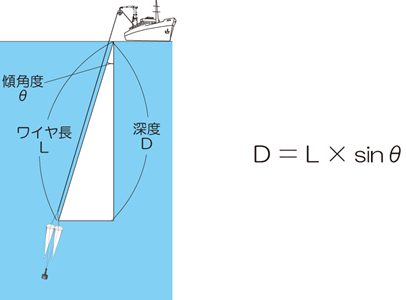
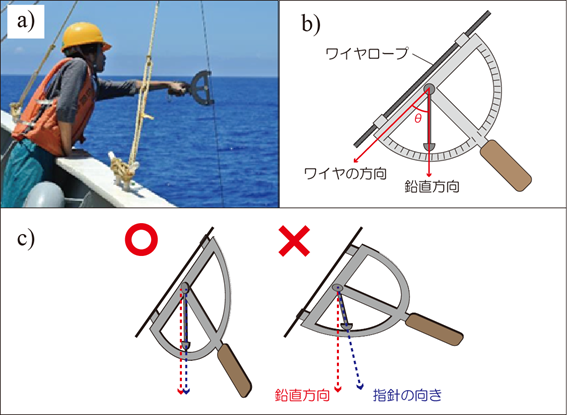
    •  Information on the depth at which plankton communities are sampled is necessary to study their ecology. When a plankton net is "towed vertically," if the net can be lowered straight down to the target depth (with the wire rope entering the water at right angles to the water surface), the net depth is the length of the wire rope unrolled from the winch. On the other hand, a vessel is always subject to wind and currents, so it cannot maintain its position. Also, the net itself is similarly affected by currents in the water, so it is possible for the net to move away from directly under the vessel. When the ship and the net are separated and the wire rope is tilted, the length of the unrolled wire rope is no longer equal to the net depth. Therefore, assuming that the wire rope is straight (not sagging) in the sea, the net depth can be obtained by adding up the sine (sinθ) of the length of the unrolled wire rope and the tilt angle (θ) shown in Figure 4. If the tilt angle (θ) is known, the wire length required to reach the desired target depth can also be determined. The instrument used to measure the inclination of the wire rope is called a tilt angle plate (Figure 5-a). The tilt angle plate consists of a semicircular protractor-like surface and a weighted pointer that points in a vertical downward direction. Care must be taken to tilt the tilt angle plate so that the pointer points vertically downward (Figure 5-c).


    • プランクトンネット 傾角度

      4  Relationship between wire rope length and inclination and net depth

                                                                傾角度:Tilt angle ワイヤ長:Wire length 深度:Depth

    • プランクトンネット 傾角度板

      5  How to use the tilt plate

      ワイヤロープ:wire rope ワイヤの方向:wire Direction 鉛直方向:vertical direction 指針の向き:line of sight


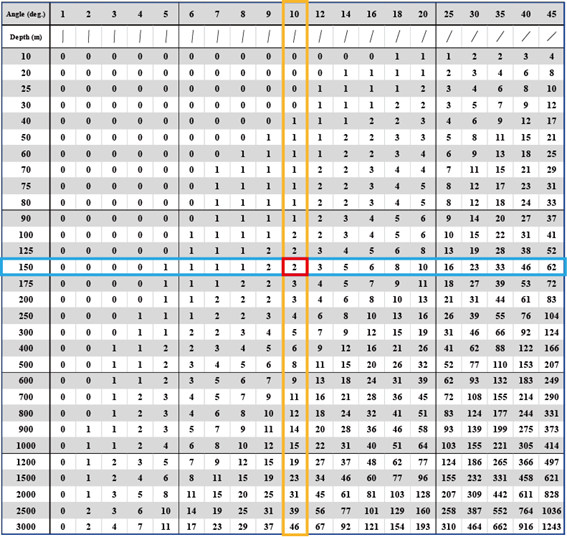
    •  At the observation site, the net depth is determined using a list (Figure 6: Tilt Angle Correction Table) that shows the relationship between tilt angle, wire length, and depth, in order to save time and effort in performing the calculations shown in Figure 4. In this correction table, the wire tilt angle (Angle) is taken in the "columns" and the desired depth (Depth) in the "rows," and the wire length to be added to reach that depth is indicated at the intersection of each. In the example in Figure 6, if the desired depth is 150 m (blue box) and the wire tilt angle is 10° (yellow box), the net can reach the desired depth by extending the wire rope 150 m + 2 m (red box) = 152 m. The tilt correction table also shows the relationship between wire length and actual net depth for a given wire tilt angle.

      Reference: Tilt angle correction table (Excel file)

    • プランクトンネット 傾角補正表

      6 Tilt Angle Correction Table


    •  Today, depth sensors are attached to nets to record the depth reached by the net after sampling. If the net is connected to an armored cable, the information from the depth sensor can be monitored on board in real time. Systems that can monitor the depth of nets in real time using acoustic communication technology are also in use.


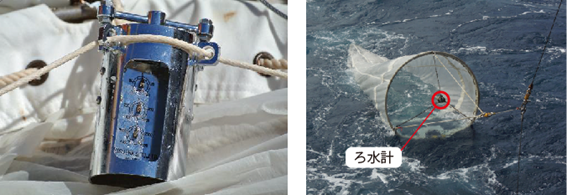
    •  The amount of seawater that passed through the net opening of the plankton net, that is to say the amount of seawater filtered out by the net, is called the "filtrate volume. Assuming that the plankton community was uniformly distributed in the sea, the plankton community biomass in the study area can be estimated from the "volume of filtered water. Therefore, a water filter meter (Figure 7) is used to measure the filtrate volume. The filter waterer is attached to the opening of the net.


    • プランクトンネット ろ水計

      7  Appearance of the water filter meter (made by RIAI Co., Ltd.) and example of installation on a net 

      ろ水計water filter meter


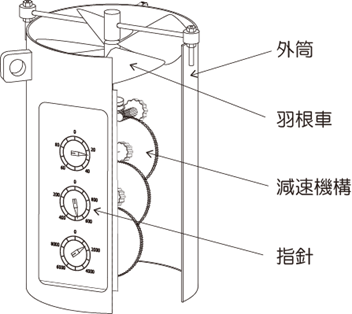
    •  Figure 8 shows the structure of a water filter meter. The impeller is turned by seawater passing through the outer casing, and the rotation of the impeller is converted to rotation of the dial pointer by a reduction mechanism consisting of several gears. The amount of seawater that has passed through the mesh opening (filtration volume) is calculated from the number of rotations of the impeller.


    • プランクトンネット 濾水計 構造

      図8 Structure of water filter meter

             外筒:outer tube 羽根車:turbine's impeller 減速機構:reduction gear 指針:guideline

    •  The water filter meter has three or four pointers, each of which corresponds to one hundred, one thousand, ten thousand, or one hundred thousand revolutions of the impeller. In the example shown in Figure 9, "How to Read the Rotation Speed of a Water Filter Meter," the bottom pointer points between the 1000 and 2000 scales, indicating that the number of impeller revolutions is between 1000 and 2000 (the thousands digit is "1"). Similarly, if we read the middle pointer, the hundredth digit is "5," if we read the top pointer, the tens digit is "2," and if we read 1/10th of the smallest scale on the top pointer, the ones digit is "5. As a result, the number of revolutions is obtained as "1525".


    • プランクトンネット ろ水計 読み方

      9  How to read the rotational speed of a water filter meter

                                                     千の桁:thousands digit 百の桁:hundreds digit 十の桁:tens digit 一の桁:first digit 
                                                         回転:revolution

    •  The value of the water filter meter changes in proportion to the distance the net is towed. If the value of the filter water meter decreases despite towing the same distance, it indicates that the net has become clogged and its seawater filtration capacity has decreased. In this case, it is assumed that the seawater that cannot pass through the net flows backward, not only reducing the amount of filtered water, but also causing the plankton community that has passed through the net mouth to be expelled.


    •  There are many types of plankton nets, but here we will introduce some typical nets commonly used on observation and research vessels in Japan.


    • ①NORPACNET(North Pacific Standard net: NORPAC net

       NORPAC-Net is a plankton net for vertical tow for quantitative collection, invented by Dr. Motoda Shigeru, former professor emeritus of Hokkaido University,School of Fisheries Sciences , Plankton Research Laboratory, Hokkaido University. This plankton net has a circular net opening of 45 cm in diameter and a conical net of 180 cm in length, and is widely used for plankton collection.

       It would be very useful to be able to compare plankton samples collected in different areas, at different times of the year, or by different researchers, and their data, in order to study and investigate changes in plankton communities over the course of global environmental change. In other words, plankton samples must be collected in the same manner (net shape and towing method) to allow for such comparisons. Therefore, at an international conference (a Meeting on Oceanography of the North Pacific, Honolulu) held in 1956, it was proposed that plankton sampling methods be standardized internationally, and Dr. Motoda's Dr. Motoda's NORPAC net was adopted as the North Pacific standard net. At this time, it was also decided that nylon mesh with a mesh size of 330 μm should be used for collecting zooplankton communities.


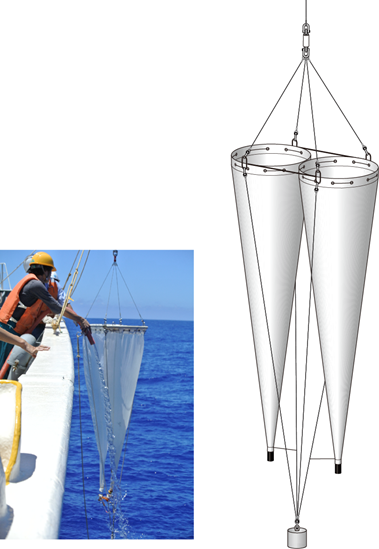
       The "twin-type Nordpac net" (Fig. 10), which consists of two Nordpac nets connected together, can obtain two samples with different compositions by simultaneously towing nets with different mesh sizes. In the common method, a coarse mesh called "animal mesh" (Nytal GG54, mesh: 335 μm) and a fine mesh called "plant mesh" (Nytal XX13, mesh: 100 μm) are used in combination.
      ノルパックネット 双子型

      10 Twin Norpak nets(NORPAC Twin Net

      [Open Access]  Motoda et al., 1957, Hokkaido University, School of Fisheries Sciences, Research Compendium


    • ②ORI Net

       It is a large diameter (diameter: 160 cm, net opening area: 2 m2) cylindrical cone-shaped net for horizontal and inclined towing, developed to efficiently collect low population density zooplankton and juvenile fish. The name "Ocean Research Institute" is an acronym for the Ocean Research Institute of the University of Tokyo (currently the Atmosphere and Ocean Research Institute of the University of Tokyo). The large net mouth filters a large volume of seawater, and a weight suspended in the middle of the towing line makes the net assume a stream-like posture (the net mouth is perpendicular to the direction of the tow), resulting in excellent collection efficiency.
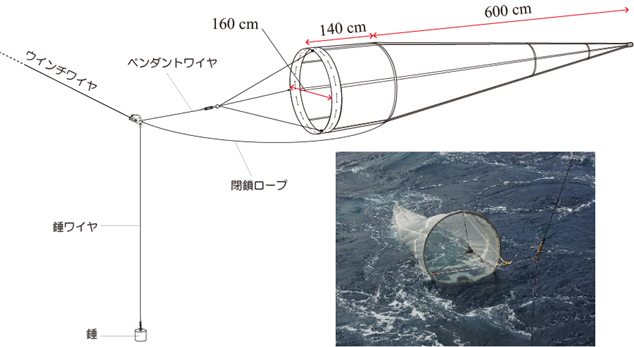
      ORIネット

      11 ORI Net

      ウインチワイヤ:winch wire ペンダントワイヤ:pendant wire 閉鎖ロープ:closing rope 錘ワイヤ:weight wire 

      錘:weight

       The plankton net uses a close-open-close mechanism with a two-stage breakaway to close the net outside of the target depth layer so as not to filter seawater (i.e., not to collect plankton.) Figure 12 shows how the ORI net's close-open-close mechanism works. First, the net is submerged to the desired depth with the closing wire keeping the net drawn down (Figure 12-a). Once the net has reached the desired depth, a messenger (a weight to be lowered along the towline) is dropped from the vessel. When the messenger strikes the trigger of the breakaway, the pin1 holding the connection between the closure wire and the closure rope is released and the net is opened (Figure 12-b). After completing the tow, a second messenger is dropped from the vessel. When the messenger strikes the trigger of the breakaway, pin 2 holding the pendant wire is released and the net is once again pulled open (Figure 12-c).
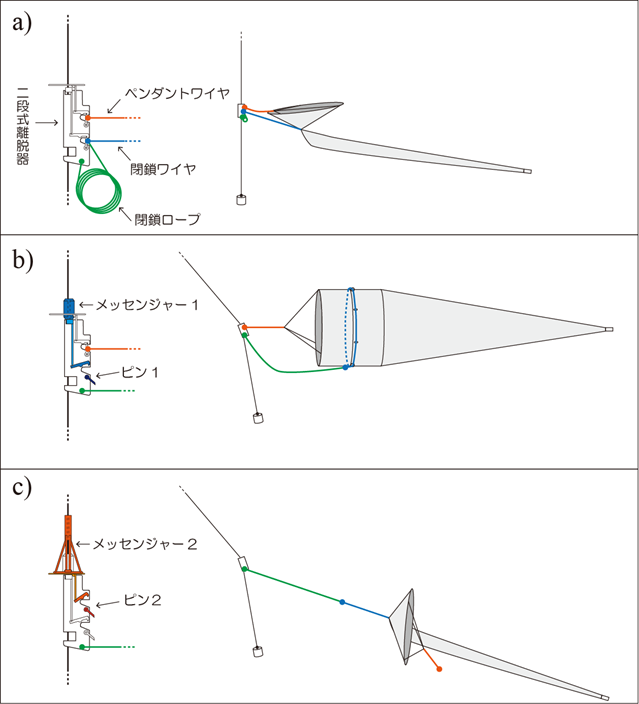
      ORIネット 開閉開機構

      12 ORI net closing-opening-closing mechanism (based on Omori, 1965)

                                            ペンダントワイヤ:pendant wire 閉鎖ワイヤ:closed Wire 閉鎖ロープ:closing Rope 

                                          メッセンジャー1:messenger 1 ピン1:pin 1  メッセンジャー2:messenger 2 ピン2:pin 2

      [Open Access] Omori, 1965, J. Oceanogr. Soc. Japan


    • Motoda Horizontal Net

       This plankton net is used for simultaneous collection of zooplankton communities at different depths. By attaching the net to a wire rope with a suspended weight at several desired depths and towing the net horizontally, it is possible to collect samples in several layers simultaneously (Figure 13-a). At the end of the tow, a weight (messenger) is dropped along the wire rope to close the mouth of the net, preventing the inclusion of communities living at other depths while the net is being hauled up. The net closing mechanism is shown in Figure 13-b. To close the net, a weight called a messenger is dropped from the vessel along the wire rope of the winch. When the messenger drops along the wire rope and hits the top of the frame, the wire rope securing the net opening is released from the latch, and the net is squeezed by the wire wound around the body. If the messenger is hung from the bottom of the frame, it can be sent out to the net attached to the lower layer at the same time as the net is closed.
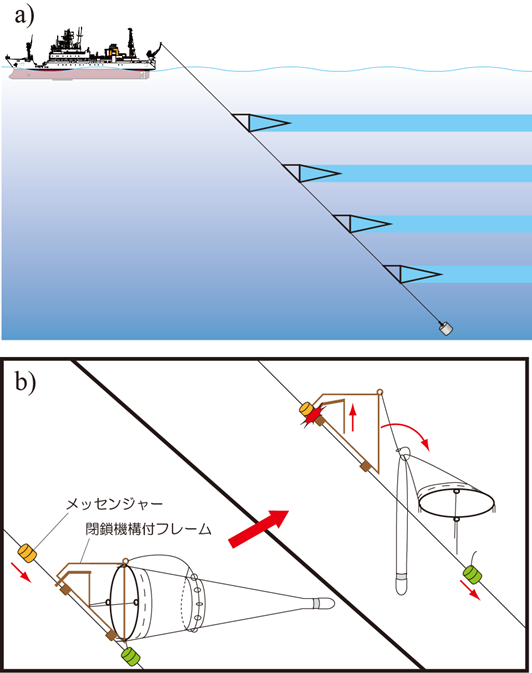
      元田式水平ネット MTDネット

      13 Motoda Horizontal Net

      メッセンジャー:messenger 閉鎖機構付フレーム:frame with closing mechanism


      [Open Access]  Motoda, 1971, Hokkaido University, School of Fisheries Sciences, Research Report


    • ④bongo net

       This cylindrical conical net for horizontal and inclined towing was developed for the purpose of collecting ichthyoplankton (eggs and fry). The net consists of two cylindrical frames connected to each other, and the net is towed by connecting a towline and a weight to the connection. Since there are no obstacles such as towing cables in front of the net mouth, the escape of organisms is suppressed, and the shape of the net allows water to escape easily, making it a highly efficient plankton collector.
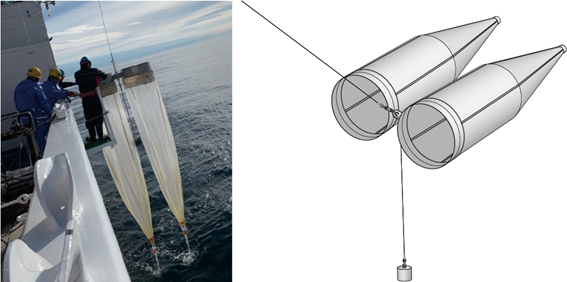
      ボンゴネット

      14 bongo net


      [Open Access] Posgay & Marak, 1980, J. Northw. Atl. Fish. Sci.


    • Multiple Opening/Closing net

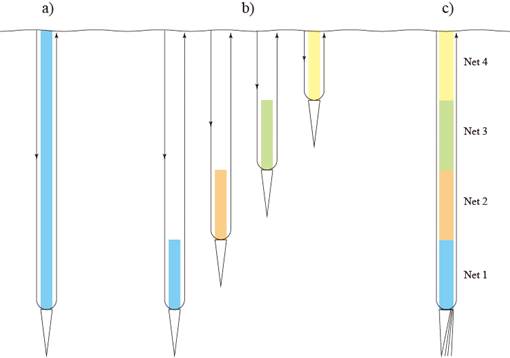
       In order to elucidate the role of zooplankton communities in the oceanic material cycle, it is now required to capture plankton dynamics in greater spatio-temporal detail. To achieve this, a Multiple Opening/Closing net was developed.

      Figure 15 shows an image of the so-called sampling range of the water column sampled using a) an unclosed net, b) a closed net, and c)Multiple Opening/Closing net , respectively. When a plankton net such as the NORPAK net is used for vertical tow sampling, samples are collected from the water column from the depth at which the net is submerged to the water surface. Therefore, it is impossible to know at what depth the plankton collected was distributed (Figure 15-a). A net with a closure mechanism has been developed so far, and it is possible to collect plankton living in one layer in a single operation, as shown in Figure 15-b. If this net is used to collect plankton in a narrower range of towing layers, the depth of plankton communities can be more precisely determined. However, if the number of tows is increased, not only would the continuity of information obtained from the samples be lost, but time and labor would also be expended. Therefore, as shown in Figure 15-c, a plankton net with multiple nets and a mechanism to open and close the net openings is used to collect samples from several different areas in a single tow.
      プランクトンネット 多段開閉式

      15 Image of the extent of water column collection by form of plankton net.

      a)Unenclosed nets b)Closed net )Multiple Opening/Closing net


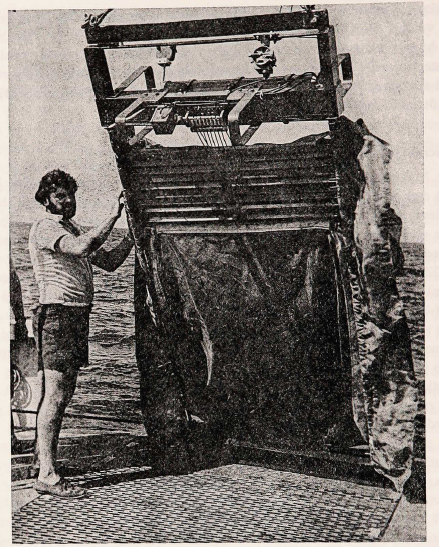
      We have developed MOCNESS (Multiple Opening/Closing Net Sampling System) for Oblique and horizontal tows (Wiebe et al., 1976), RMT 1+8M (Multiple Rectangular Midwater Trawl) (Roe & Shale, 1979), BIONESS (Bedford Institute of Oceanography Net and Environmental Sampling System) for vertical tows (Sameoto, 1980), and VMESS (Bedford Institute of Oceanography Net and Environmental Sampling System) for horizontal tows. Shale, 1979), BIONESS (Bedford Institute of Oceanography Net and Environmental Sampling System) (Sameoto, 1980), and VMPS ( Vertical Multiple Opening and Closing Plankton Sampler ) (Terazaki & Tomatsu, 1997) for vertical towing, and many other types of Multiple Opening/Closing nets have been developed and are in use. These nets are equipped with underwater sensors for water temperature, salinity, depth, etc., so that not only plankton can be collected, but also their habitat can be determined at the same time. As with the CTD water sampling system, the nets (underwater stations) are connected to the onboard control unit (onboard station) by a special cable called an armored cable, allowing the nets to open and close their mouths at any time while monitoring in real time the measured values of the underwater sensors, the amount of filtered water, and the state of opening and closing the mouths.
      16 MOCNESS          sourceWiebe et al. (1976)

      VMPS

      17 VMPS


      [Open Access] Wiebe et al., 1976, J. mar. Res.

      Roe & Shale, 1979, Mar. Biol.

      Sameoto, 1980, Can. J. Fish. Aquat. Sci.

      [Open Access] Terazaki & Tomatsu, 1997,  J. Adv. Mar. Sci. Tech. Soci.


      For more information about VMPS, click here.→ Link to "VMPS


  • Reseach Methods Red tides Trainig Ship