章节大纲

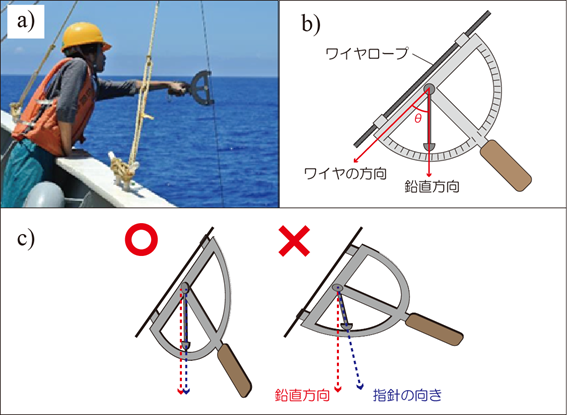
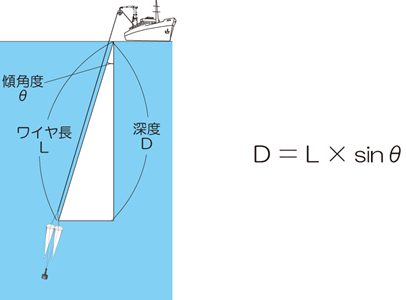
    •  Information on the depth at which plankton communities are sampled is necessary to study their ecology. When a plankton net is "towed vertically," if the net can be lowered straight down to the target depth (with the wire rope entering the water at right angles to the water surface), the net depth is the length of the wire rope unrolled from the winch. On the other hand, a vessel is always subject to wind and currents, so it cannot maintain its position. Also, the net itself is similarly affected by currents in the water, so it is possible for the net to move away from directly under the vessel. When the ship and the net are separated and the wire rope is tilted, the length of the unrolled wire rope is no longer equal to the net depth. Therefore, assuming that the wire rope is straight (not sagging) in the sea, the net depth can be obtained by adding up the sine (sinθ) of the length of the unrolled wire rope and the tilt angle (θ) shown in Figure 4. If the tilt angle (θ) is known, the wire length required to reach the desired target depth can also be determined. The instrument used to measure the inclination of the wire rope is called a tilt angle plate (Figure 5-a). The tilt angle plate consists of a semicircular protractor-like surface and a weighted pointer that points in a vertical downward direction. Care must be taken to tilt the tilt angle plate so that the pointer points vertically downward (Figure 5-c).


    • プランクトンネット 傾角度

      4  Relationship between wire rope length and inclination and net depth

                                                                傾角度:Tilt angle ワイヤ長:Wire length 深度:Depth

    • プランクトンネット 傾角度板

      5  How to use the tilt plate

      ワイヤロープ:wire rope ワイヤの方向:wire Direction 鉛直方向:vertical direction 指針の向き:line of sight


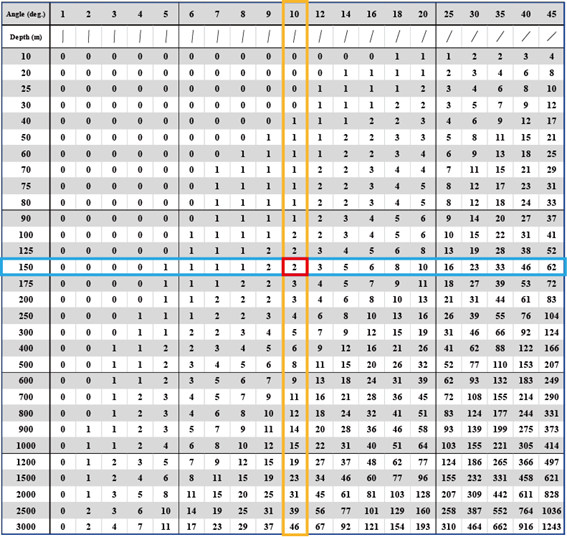
    •  At the observation site, the net depth is determined using a list (Figure 6: Tilt Angle Correction Table) that shows the relationship between tilt angle, wire length, and depth, in order to save time and effort in performing the calculations shown in Figure 4. In this correction table, the wire tilt angle (Angle) is taken in the "columns" and the desired depth (Depth) in the "rows," and the wire length to be added to reach that depth is indicated at the intersection of each. In the example in Figure 6, if the desired depth is 150 m (blue box) and the wire tilt angle is 10° (yellow box), the net can reach the desired depth by extending the wire rope 150 m + 2 m (red box) = 152 m. The tilt correction table also shows the relationship between wire length and actual net depth for a given wire tilt angle.

      Reference: Tilt angle correction table (Excel file)

    • プランクトンネット 傾角補正表

      6 Tilt Angle Correction Table


    •  Today, depth sensors are attached to nets to record the depth reached by the net after sampling. If the net is connected to an armored cable, the information from the depth sensor can be monitored on board in real time. Systems that can monitor the depth of nets in real time using acoustic communication technology are also in use.