
(5) Typical plankton net
セクションアウトライン
-
-
①NORPACNET(North Pacific Standard net: NORPAC net)
NORPAC-Net is a plankton net for vertical tow for quantitative collection, invented by Dr. Motoda Shigeru, former professor emeritus of Hokkaido University,School of Fisheries Sciences , Plankton Research Laboratory, Hokkaido University. This plankton net has a circular net opening of 45 cm in diameter and a conical net of 180 cm in length, and is widely used for plankton collection.
It would be very useful to be able to compare plankton samples collected in different areas, at different times of the year, or by different researchers, and their data, in order to study and investigate changes in plankton communities over the course of global environmental change. In other words, plankton samples must be collected in the same manner (net shape and towing method) to allow for such comparisons. Therefore, at an international conference (a Meeting on Oceanography of the North Pacific, Honolulu) held in 1956, it was proposed that plankton sampling methods be standardized internationally, and Dr. Motoda's Dr. Motoda's NORPAC net was adopted as the North Pacific standard net. At this time, it was also decided that nylon mesh with a mesh size of 330 μm should be used for collecting zooplankton communities.
The "twin-type Nordpac net" (Fig. 10), which consists of two Nordpac nets connected together, can obtain two samples with different compositions by simultaneously towing nets with different mesh sizes. In the common method, a coarse mesh called "animal mesh" (Nytal GG54, mesh: 335 μm) and a fine mesh called "plant mesh" (Nytal XX13, mesh: 100 μm) are used in combination.
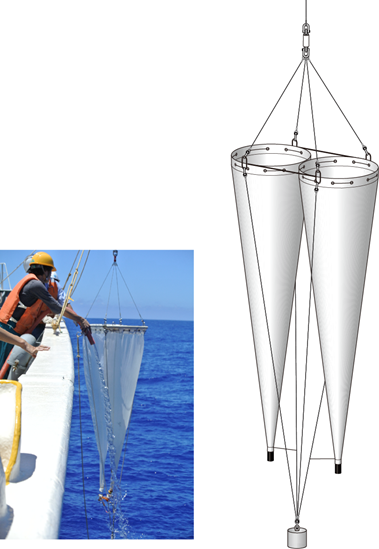
図10 Twin Norpak nets(NORPAC Twin Net)
[Open Access] Motoda et al., 1957, Hokkaido University, School of Fisheries Sciences, Research Compendium
-
②ORI Net
It is a large diameter (diameter: 160 cm, net opening area: 2 m2) cylindrical cone-shaped net for horizontal and inclined towing, developed to efficiently collect low population density zooplankton and juvenile fish. The name "Ocean Research Institute" is an acronym for the Ocean Research Institute of the University of Tokyo (currently the Atmosphere and Ocean Research Institute of the University of Tokyo). The large net mouth filters a large volume of seawater, and a weight suspended in the middle of the towing line makes the net assume a stream-like posture (the net mouth is perpendicular to the direction of the tow), resulting in excellent collection efficiency.
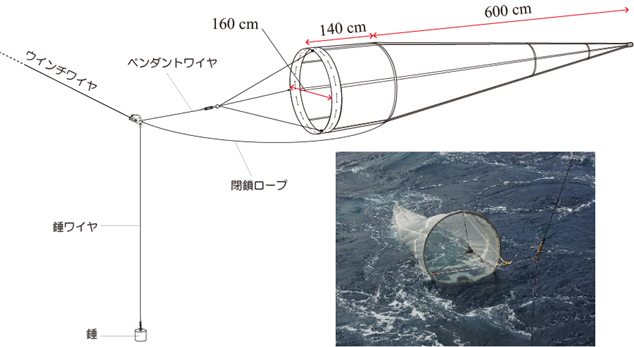
図11 ORI Net
ウインチワイヤ:winch wire ペンダントワイヤ:pendant wire 閉鎖ロープ:closing rope 錘ワイヤ:weight wire
錘:weight
The plankton net uses a close-open-close mechanism with a two-stage breakaway to close the net outside of the target depth layer so as not to filter seawater (i.e., not to collect plankton.) Figure 12 shows how the ORI net's close-open-close mechanism works. First, the net is submerged to the desired depth with the closing wire keeping the net drawn down (Figure 12-a). Once the net has reached the desired depth, a messenger (a weight to be lowered along the towline) is dropped from the vessel. When the messenger strikes the trigger of the breakaway, the pin1 holding the connection between the closure wire and the closure rope is released and the net is opened (Figure 12-b). After completing the tow, a second messenger is dropped from the vessel. When the messenger strikes the trigger of the breakaway, pin 2 holding the pendant wire is released and the net is once again pulled open (Figure 12-c).
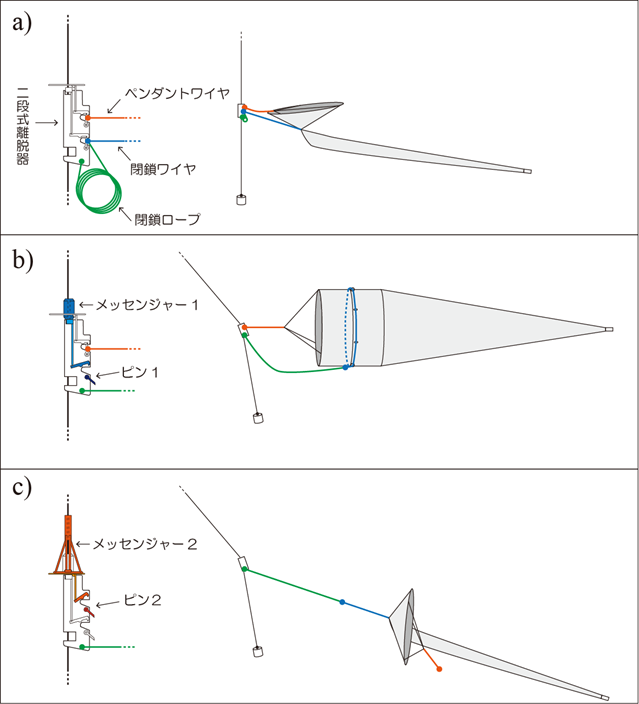
図12 ORI net closing-opening-closing mechanism (based on Omori, 1965)
ペンダントワイヤ:pendant wire 閉鎖ワイヤ:closed Wire 閉鎖ロープ:closing Rope
メッセンジャー1:messenger 1 ピン1:pin 1 メッセンジャー2:messenger 2 ピン2:pin 2
[Open Access] Omori, 1965, J. Oceanogr. Soc. Japan
-
③Motoda Horizontal Net
This plankton net is used for simultaneous collection of zooplankton communities at different depths. By attaching the net to a wire rope with a suspended weight at several desired depths and towing the net horizontally, it is possible to collect samples in several layers simultaneously (Figure 13-a). At the end of the tow, a weight (messenger) is dropped along the wire rope to close the mouth of the net, preventing the inclusion of communities living at other depths while the net is being hauled up. The net closing mechanism is shown in Figure 13-b. To close the net, a weight called a messenger is dropped from the vessel along the wire rope of the winch. When the messenger drops along the wire rope and hits the top of the frame, the wire rope securing the net opening is released from the latch, and the net is squeezed by the wire wound around the body. If the messenger is hung from the bottom of the frame, it can be sent out to the net attached to the lower layer at the same time as the net is closed.
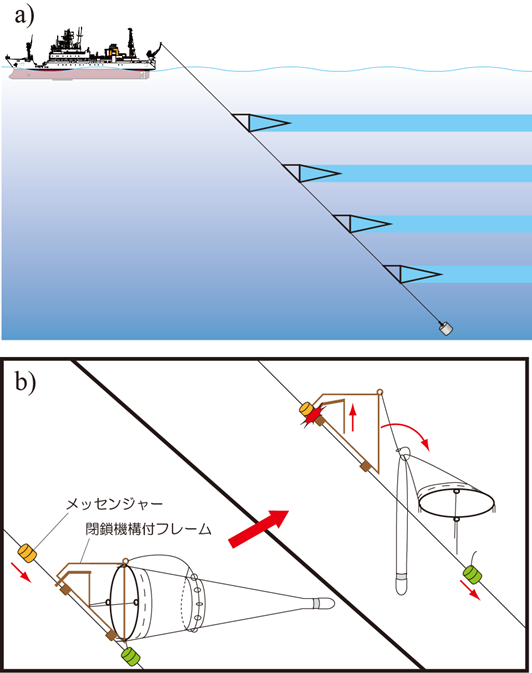
図13 Motoda Horizontal Net
メッセンジャー:messenger 閉鎖機構付フレーム:frame with closing mechanism
[Open Access] Motoda, 1971, Hokkaido University, School of Fisheries Sciences, Research Report
-
④bongo net
This cylindrical conical net for horizontal and inclined towing was developed for the purpose of collecting ichthyoplankton (eggs and fry). The net consists of two cylindrical frames connected to each other, and the net is towed by connecting a towline and a weight to the connection. Since there are no obstacles such as towing cables in front of the net mouth, the escape of organisms is suppressed, and the shape of the net allows water to escape easily, making it a highly efficient plankton collector.
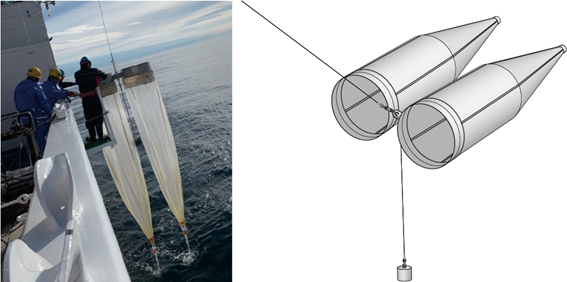
図14 bongo net
[Open Access] Posgay & Marak, 1980, J. Northw. Atl. Fish. Sci.
-
⑤Multiple Opening/Closing net
In order to elucidate the role of zooplankton communities in the oceanic material cycle, it is now required to capture plankton dynamics in greater spatio-temporal detail. To achieve this, a Multiple Opening/Closing net was developed.
Figure 15 shows an image of the so-called sampling range of the water column sampled using a) an unclosed net, b) a closed net, and c)Multiple Opening/Closing net , respectively. When a plankton net such as the NORPAK net is used for vertical tow sampling, samples are collected from the water column from the depth at which the net is submerged to the water surface. Therefore, it is impossible to know at what depth the plankton collected was distributed (Figure 15-a). A net with a closure mechanism has been developed so far, and it is possible to collect plankton living in one layer in a single operation, as shown in Figure 15-b. If this net is used to collect plankton in a narrower range of towing layers, the depth of plankton communities can be more precisely determined. However, if the number of tows is increased, not only would the continuity of information obtained from the samples be lost, but time and labor would also be expended. Therefore, as shown in Figure 15-c, a plankton net with multiple nets and a mechanism to open and close the net openings is used to collect samples from several different areas in a single tow.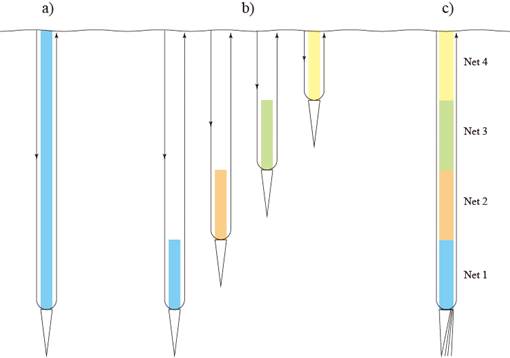
図15 Image of the extent of water column collection by form of plankton net.
a)Unenclosed nets b)Closed net c)Multiple Opening/Closing net
We have developed MOCNESS (Multiple Opening/Closing Net Sampling System) for Oblique and horizontal tows (Wiebe et al., 1976), RMT 1+8M (Multiple Rectangular Midwater Trawl) (Roe & Shale, 1979), BIONESS (Bedford Institute of Oceanography Net and Environmental Sampling System) for vertical tows (Sameoto, 1980), and VMESS (Bedford Institute of Oceanography Net and Environmental Sampling System) for horizontal tows. Shale, 1979), BIONESS (Bedford Institute of Oceanography Net and Environmental Sampling System) (Sameoto, 1980), and VMPS ( Vertical Multiple Opening and Closing Plankton Sampler ) (Terazaki & Tomatsu, 1997) for vertical towing, and many other types of Multiple Opening/Closing nets have been developed and are in use. These nets are equipped with underwater sensors for water temperature, salinity, depth, etc., so that not only plankton can be collected, but also their habitat can be determined at the same time. As with the CTD water sampling system, the nets (underwater stations) are connected to the onboard control unit (onboard station) by a special cable called an armored cable, allowing the nets to open and close their mouths at any time while monitoring in real time the measured values of the underwater sensors, the amount of filtered water, and the state of opening and closing the mouths.
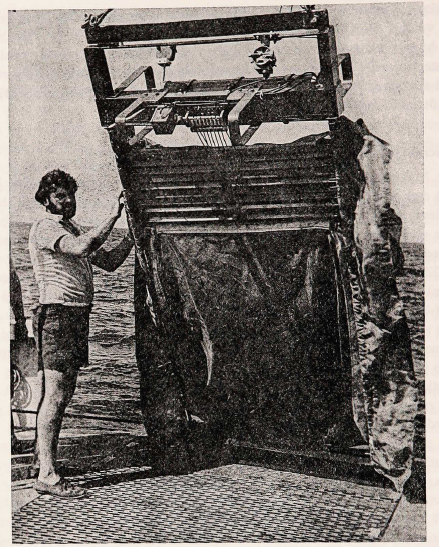
図16 MOCNESS source:Wiebe et al. (1976)
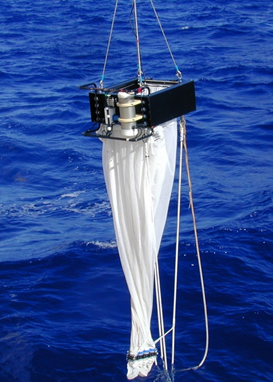
図17 VMPS
[Open Access] Wiebe et al., 1976, J. mar. Res.
Sameoto, 1980, Can. J. Fish. Aquat. Sci.
[Open Access] Terazaki & Tomatsu, 1997, J. Adv. Mar. Sci. Tech. Soci.
For more information about VMPS, click here.→ Link to "VMPS