セクションアウトライン

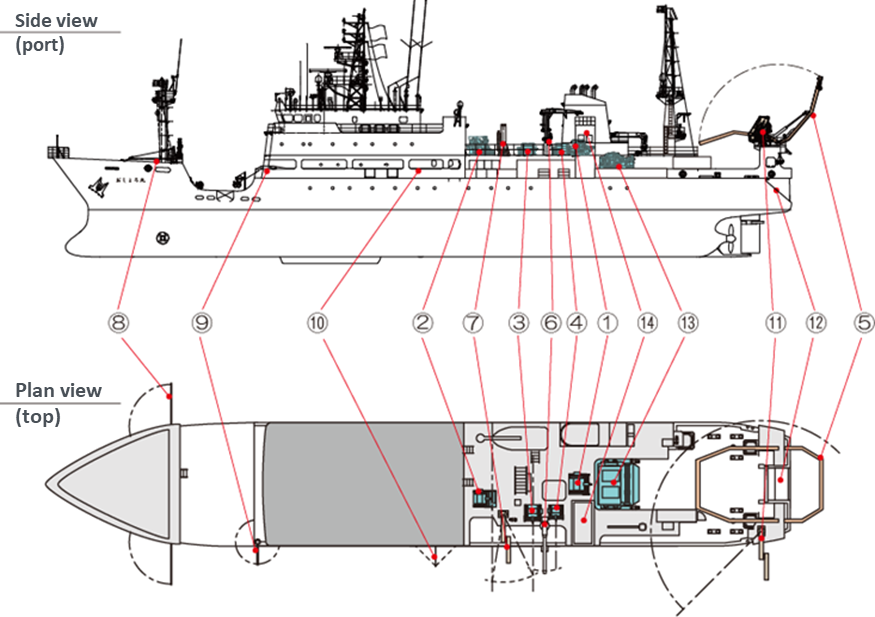
    •  The equipment required for oceanographic observation includes a "crane" for lifting equipment, a "winch" for raising and lowering equipment in the sea, and a "davit" and "boom" for swinging and towing equipment above the sea surface. Figure 1 shows the layout of the observation and fishing equipment on the Oshoro-Maru.

    • Figure 1 「Oshoro-Maru」 observation equipment layout

      ①No.1 winch (multi-purpose)

      ②No.2 winch (8,000m for CTD)

      ③No.3 winch (7,000m for CTD)

      ④No.4 winch (for observation)

      ⑤Stern A-frame (gantry crane)

      ⑥Dabbit for observation winch

      ⑦Articulated crane for CTD

      ⑧Bow net towing boom

      ⑨Auxiliary davits for well deck

      ⑩Towing boom

      ⑪Articulated crane for fishing

      ⑫Inverted Slipway

      ⑬trawl winch

      ⑭Winch control room


    • Figure 2: Port working deck (VR animation)


    • Figure 3 Stern working deck (VR animation)


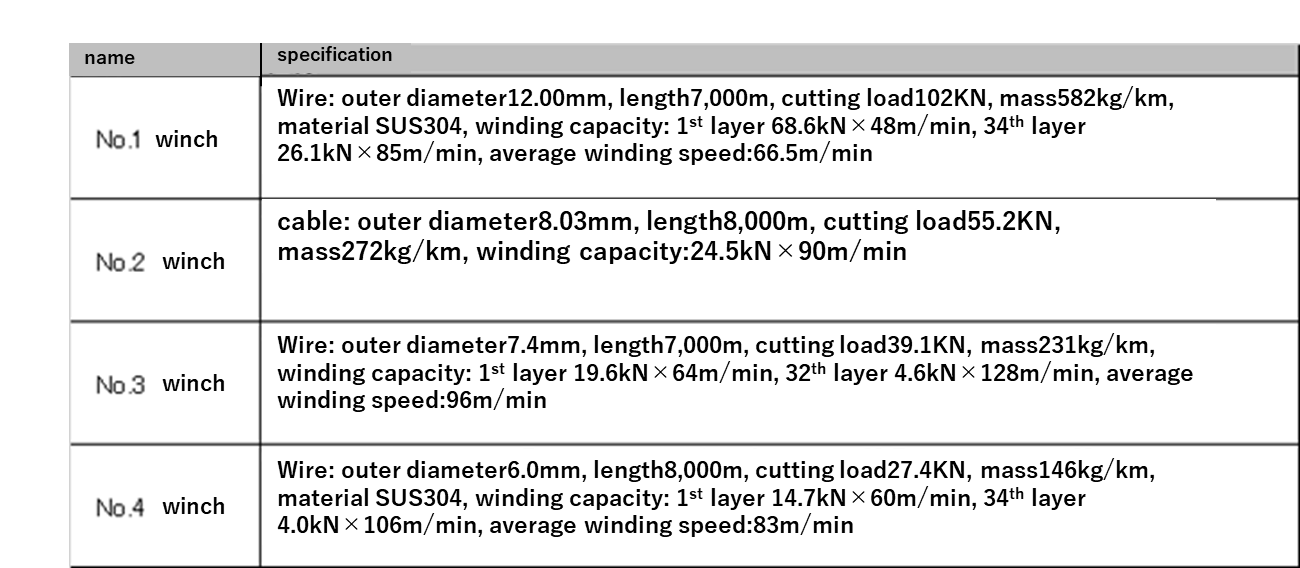
    • 「 Oshoro-Maru」 is equipped with four observation winches, each of which is designated by a number from No. 1 to No. 4 (Table 1). All winches can be operated remotely from the winch control room (Fig. 1-⑭) located at the rear of the end deck. No.2 winch (Fig. 1-2) and No.3 winch (Fig. 1-3) are both wound with armored cable (coaxial cable covered with steel wire) and are mainly used for observations with the CTD water sampling system. The equipment connected to the armored cable is lifted by an articulated crane (Figure 1-7), which is located right next to the armored cable, and is placed into the sea from the port side.No. 4 winch (Fig. 1-4) is a general-purpose observation winch used for sampling with plankton nets and small mud samplers.

       Both winches are equipped with a wire rope (or armored cable) of 7,000 to 8,000 m in length, allowing the instruments to reach the seafloor in all areas of the North Pacific Ocean except for some trench areas.


    • Table 1 Winch Specifications for 「Oshoro-Maru」 Observation


    •  

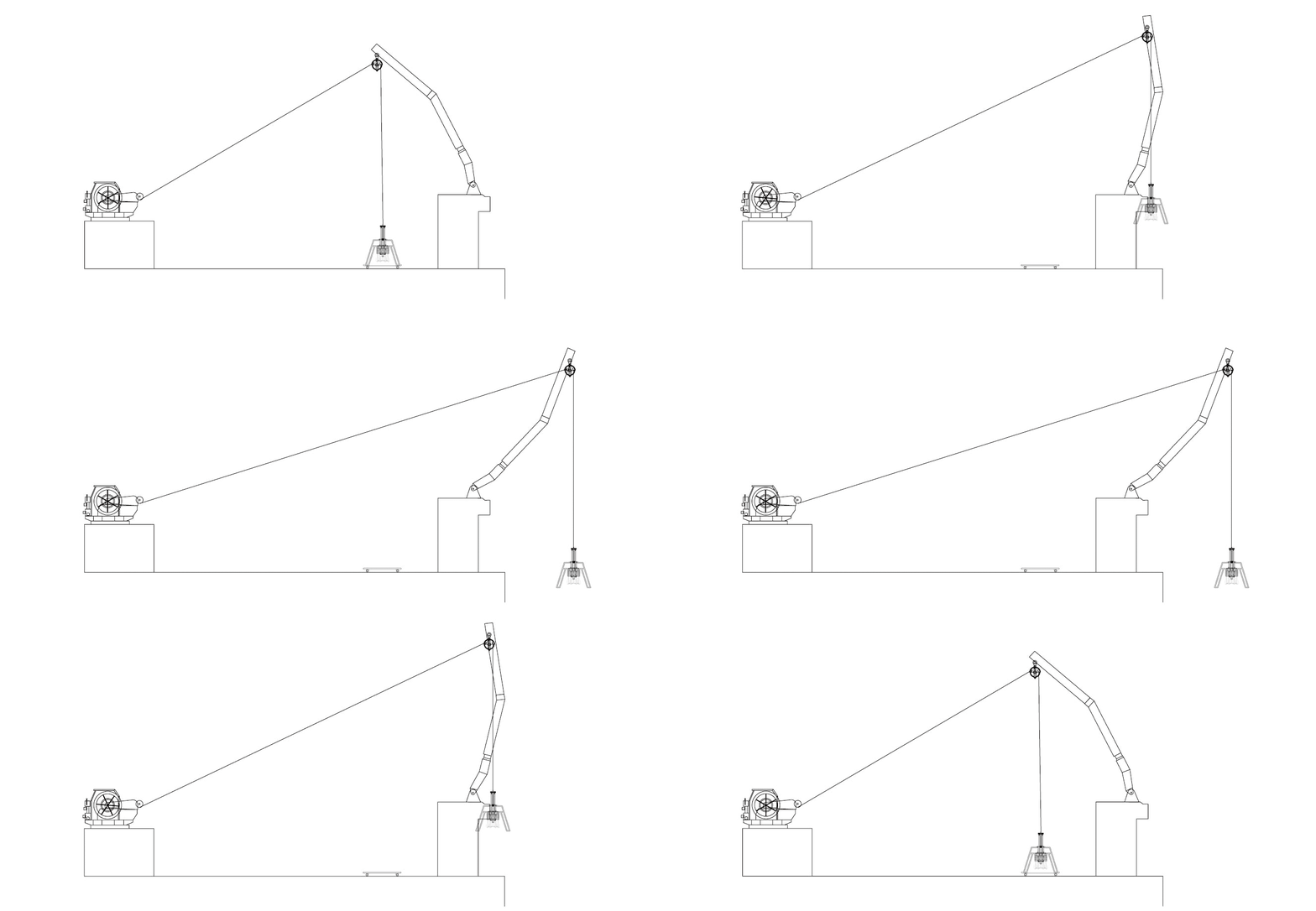
      On the aft working deck is a large gantry-type crane, the "A-frame," which is used to lift large, heavy observation equipment such as multiple corers, piston corers, solinets, and MOHTs, and to swing them out over the sea. The A-frame is used to lift large and heavy equipment such as multicorers, piston corers, solinets, and MOHTs, and to swing them out over the sea surface. The A-frame can fine-tune the speed of movement, making deck work safer than the method of lifting with a winch, which is difficult to adjust the speed at low speeds. Another feature of the A-frame is that it can move a suspended load in a straight line, whereas a conventional crane moves a suspended load in an arc by slewing.

    • Aフレームの動作

      Figure 4 A-frame operation


    • Booms installed on the port side (Figure 1-⑧, ⑩) are used when towing a neuston net or fry net near the water's surface. The use of these booms reduces the effects of vessel navigation (e.g., bow waves and propeller agitation, contamination from the vessel's hull, etc.) compared to towing from the stern.


       To accommodate sampling by fishing methods, 「Oshoro-Maru」 is also equipped with fishing equipment such as a trawl winch (Figure 1-⑬), an up-and-down slipway (Figure 1-12), an automatic squid fishing machine, and fish collecting lights.