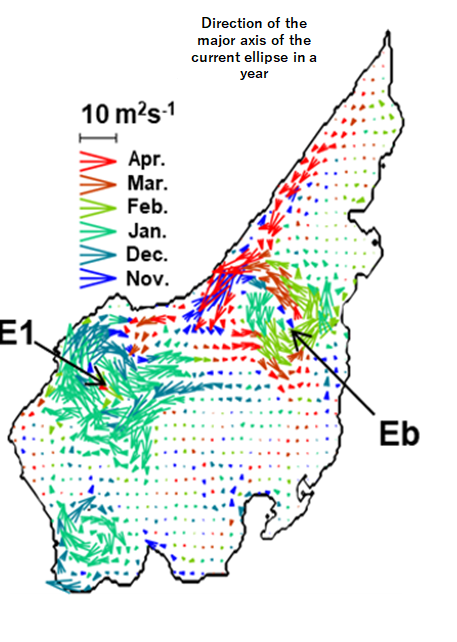
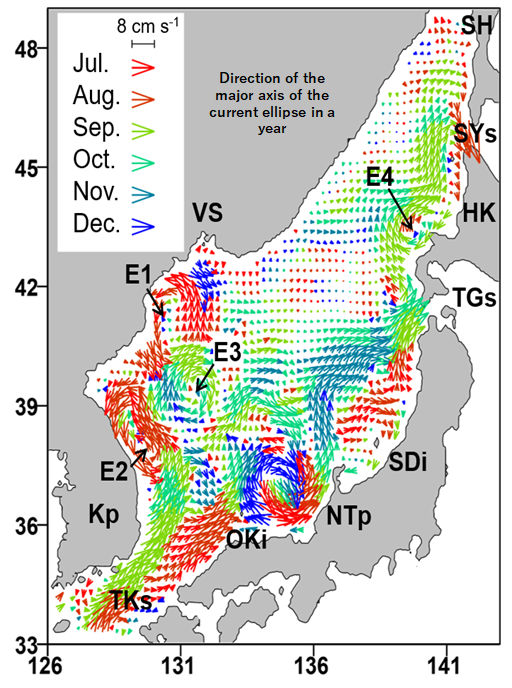
“Seasonal change” component of sea
surface geostrophic current (surface current) calculated from long-term mean satellite
sea surface height anomaly data
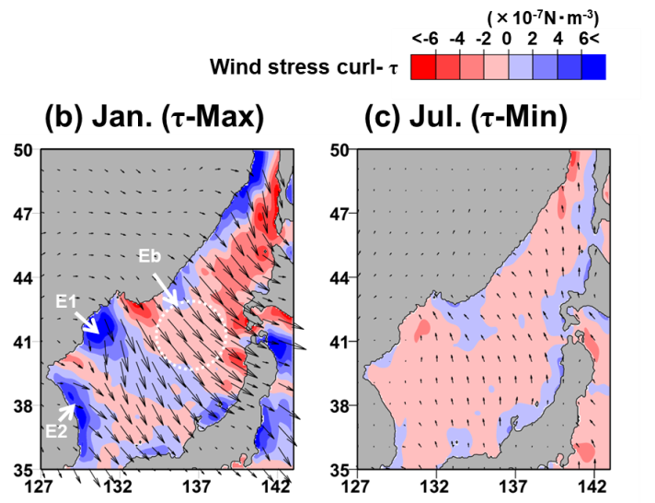
Wind stress vectors τ and
their curl τ for the long-term mean in January and July (positive
values indicate a counterclockwise current, while negative values indicate a clockwise current)
The E1 and E2 swirling currents in the northern sea area (Research example 1) are
excited by the winter monsoon (Research example 2). The coastal branch current
of the Tsushima Warm Current is strengthened in summer, and the offshore
meandering current is strengthened from autumn to winter. Based on numerical
experiments (Research example 3), it was speculated that the seasonal change in
deep current would be synchronized with wind forcing, generating the E1 and Eb swirling
currents in the northern sea area.