

Sources of Artificial Radionuclides
Section outline
-
-
Release of 137Cs into the ocean due to atmospheric nuclear testing
Since 1945, about 500 atmospheric nuclear tests have been conducted. A partial nuclear test ban treaty was signed in 1963 because nuclear tests in the atmosphere would disperse large amounts of radionuclides into the environment. Primarily, atmospheric nuclear testing, conducted between 1945 and 1963, is the largest source of artificial radionuclides in the ocean.
The graph below shows the radiation dose of radioactive cesium (137Cs) in the oceans (North and South Pacific, North and South Atlantic, and North and South Indian Oceans).
The unit is PBq (petabecquerel). Peta stands for 1015. Becquerel is a unit that expresses the number of atoms (radioactivity) that a radioactive substance decays in one second.
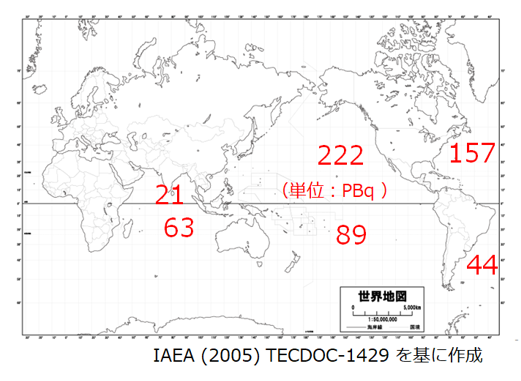
IAEA(2005) TECDOC-1429を基に作成Created based on IAEA (2005) TECDOC-1429
単位Unit 世界地図World map
-
-
-
Below is a summary of past accidents at nuclear facilities.
1957,Mayak Nuclear Technology Facility (Soviet Union)
1957, Windscale Reactor (UK)
1979, Three Mile Island Nuclear Power Plant (U.S.)
1986, Chernobyl Nuclear Power Plant (Soviet Union)
2011, TEPCO Fukushima Daiichi Nuclear Power Station (Japan)
In the past accidents, the Chernobyl nuclear power plant accident and the TEPCO Fukushima Daiichi nuclear power plant accident have known the amount of artificial radionuclides released into the environment (the red part in the table below).
In the Chernobyl nuclear power plant accident, you can see that the amount of radioactive iodine 131I released is outstanding.
The Fukushima Daiichi Nuclear Power Plant accident also accounted for a large proportion of the release of radioactive iodine, but it is characterized by a high proportion of radioactive cesium 137Cs.
In addition, since the Fukushima Daiichi Nuclear Power Plant accident released contaminated water containing radionuclides into the ocean, a certain amount of radioactive nuclides were also released into seawater.
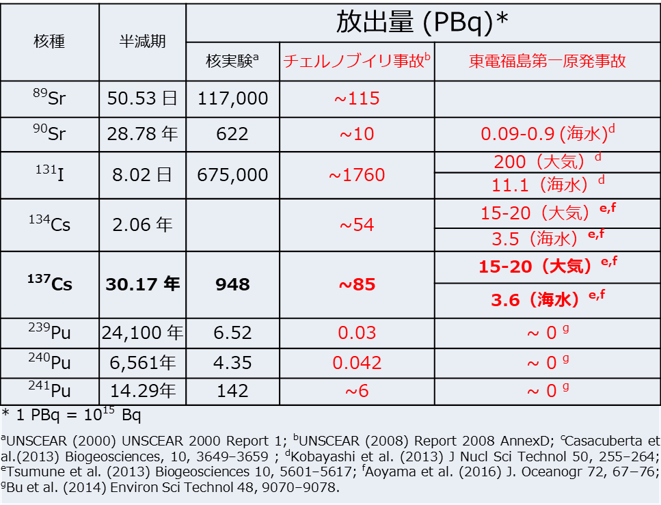
核種nuclide 半減期half-life 放出量Emission amount 核実験Nuclear test チェルノブイリ事故Chernobyl accident 東電福島第一原発事故TEPCO Fukushima Daiichi Nuclear Power Plant Accident 日Day 年Year 海水sea water 大気atmosphere
-
These nuclides (137Cs and 131I) are derived from fission product elements created during the extraction of nuclear energy at nuclear power plants. These nuclides are easily produced in nuclear reactors and accumulate in the human body, so they are also the nuclides of greatest concern with regard to their effects on humans.
The rate at which a particular material is produced (fission yield) when the uranium-235 in nuclear fuel fissions is shown below.
131I:2.878%
137Cs :6.2%(Together with beta-decay origin from other nuclides)
Although 137Cs appears to be more abundant in terms of fission yield, the higher radioactivity (Becquerel number) released by 131Iis due to the difference in half-life. (Becquerel is the number of atoms that fission in one second. Half-life is the time it takes for fission to reduce the number of atoms to half of their original number). The shorter the half-life, the higher the Becquerel number. Compared with the amount produced and accumulated in a nuclear reactor, the following is a comparison.
Amount of 131Iproduced :Approx. 50g
Amount of 137Cs produced: approx. 7,000 g
Thus, when compared in terms of the amount produced and accumulated, 137Cs, which has a longer half-life, is more abundant. In addition, the proportion of 137Cs with a long half-life increases with the number of years a nuclear power plant has been in operation.
The Chernobyl nuclear accident shows that the amount of radioactive iodine 131I released is outstandingly high.
This is due to the difference in the operating life of nuclear reactors. Nuclear power plants obtain energy by burning large amounts of nuclear fuel (causing nuclear fission), and the longer the fission period, the more radioactive products accumulate.
131I has a half-life of 8 days, so even if it is produced, it decays quickly and accumulates little over a long period of operation.
On the other hand, 137Cs has a half-life of 30 years, so the longer a nuclear reactor is in operation, the more it accumulates.
In other words, the ratio of cesium to iodine gradually rises in a nuclear reactor as it is operated for a longer period of time. The accident at the Chernobyl nuclear power plant occurred when the plant was in operation for a relatively short period of time. Therefore, the amount of 137Cs accumulated in the reactor was low, and when radionuclides in the reactor were released into the atmosphere due to the accident, the amount of 131I released was significantly higher than that of 137Cs.
Look at the other table. The release of a radionuclide called xenon (Xe) 133 is also included. In fact, 133Xe is the most common radionuclide released in nuclear accidents. Comparing the total amount of radionuclides listed in the table below, including 133Xe, we can see that the Fukushima Daiichi accident released much more radionuclides than the Chernobyl accident. However, the release of 133Xe has not been regarded as a major problem. Why is this?
This is because xenon (Xe) is a noble gas and does not accumulate in the bodies of living organisms or in certain places in the environment. What adversely affects the human body is when radionuclides accumulate in the human body and undergo radioactive decay in the body (internal exposure). Another is the exposure to radiation that accumulates in a certain location in the environment and is then exposed to a person in the vicinity (external exposure). 133Xe is ignored because these effects are likely to be very small.
Also, the same nuclides are released in different amounts in different nuclear power plant accidents: in the Chernobyl accident, the fuel blew away with each fuel, whereas in the Fukushima Daiichi accident, a steam explosion and radioactive nuclides dissolved in the cooling water that came into contact with the nuclear fuel, and some of that contaminated water flowed underground and into the ocean. Since no nuclear fuel was blown up at Fukushima, the amount of 137Cs and 131I released is thought to be less than at Chernobyl.
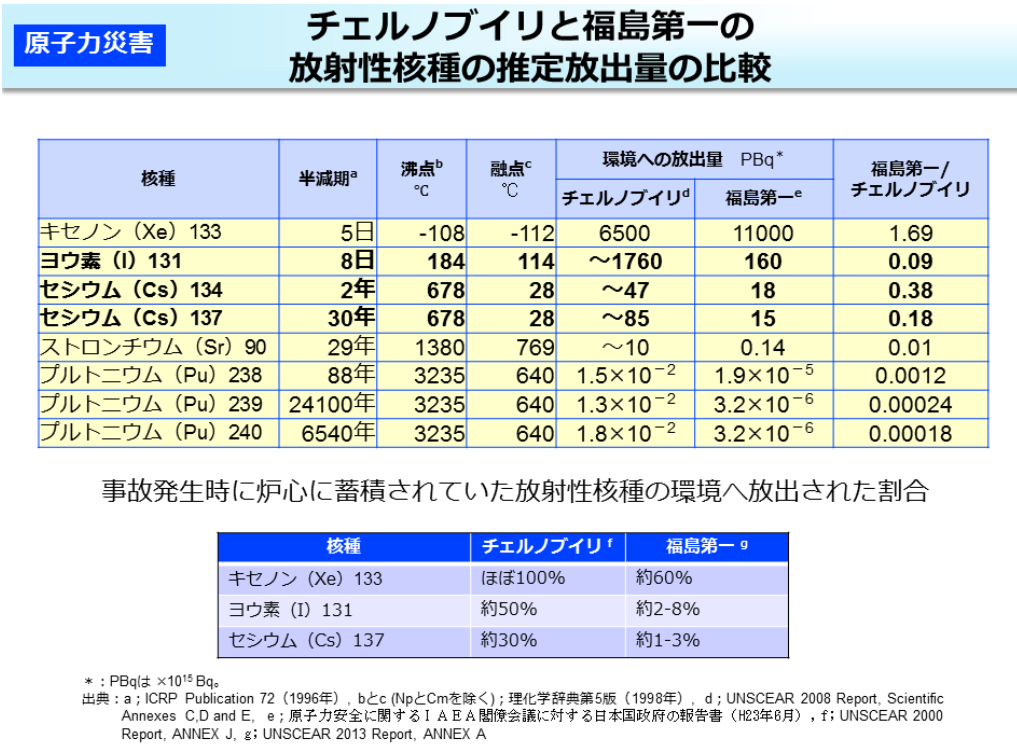
核種nuclide 半減期half life 沸点boiling point 融点melting point 環境への放出量Amount released to the environment チェルノブイリChernobyl 福島第一Fukushima Daiichi キセノンxenon (Xe) ヨウ素iodine (I) セシウムcaesium ストロンチウムstrontium (Sr) プルトニウムplutonium (Pu) 日day 年year 事故発生時に炉心に蓄積されていた放射性核種の環境へ放出された割合Percentage of radionuclides accumulated in the reactor core at the time of the accident that were released into the environment 約approximately
Source: Ministry of the Environment HP(https://www.env.go.jp/chemi/rhm/h28kisoshiryo/h28kiso-02-02-05.html)2020.8.12 reprinting
-
-
-
What is a nuclear fuel reprocessing facility?
Nuclear power plants use fuel rods containing uranium dioxide fuel pellets (equivalent to coal in thermal power plants) to evaporate water (boil water) using the heat energy emitted when uranium 235 fission occurs, and use the steam to turn a turbine to generate electricity.

火力発電thermal power generation 原子力発電nuclear power generation (of electricity) 燃料fuel 石炭coal 核燃料atomic fuel 熱エネルギー源Heat energy source 石炭を燃やすBurning coal 核分裂nuclear fission 電力源Power Source お湯を沸かして発電タービンを回すBoils water and turns power turbine
In nuclear power generation, fuel rods are replaced with new fuel rods when they are used up. Used fuel is called "spent fuel rods".Unlike thermal power generation, however, spent fuel rods contain a large amount of unburned plutonium, which is produced from unreacted uranium-235 and uranium-238. In other words, there is a considerable amount of unreacted uranium-235 and plutonium produced from uranium-238 in the spent fuel rods, so a "reprocessing plant" is a place to extract them and make fuel rods again.
*For more information, please visit the Federation of Electric Power Companies of Japan HP:https://www.fepc.or.jp/nuclear/cycle/recycle/index.html
-
In Europe, nuclear fuel reprocessing facilities are in operation, and artificial radionuclides are being systematically (and controlled) released from these facilities.
The two reprocessing facilities are located in La Argues, France and Sellafield, England.
The figure below shows the annual releases (1970-1998) of a typical reprocessing plant in Europe (shown on the right).
During this period, Sellafield released approximately 40 PBq of 137Cs into the ocean. In 1976, the maximum amount reached 5.2 PBq/year (1.4 times higher than the direct leakage immediately after the Fukushima Daiichi Nuclear Power Plant accident), but this amount decreased to 0.008 PBq/year in 1998.
The amount of 137Cs released from La Argues is less than 3% of that from Sellafield when compared to the total amount of 137Cs released, but this is also due to the difference in the amount of spent fuel processed annually.
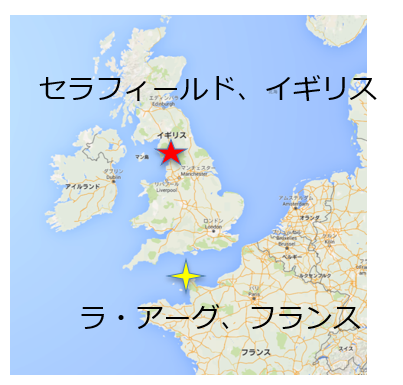 セラフィールド、イギリスSellafield, United Kingdom
ラアーグ、フランスLa Argues, France
Below we show the year-to-year changes in the amount of radioactive cesium released from nuclear fuel reprocessing plants in Europe.
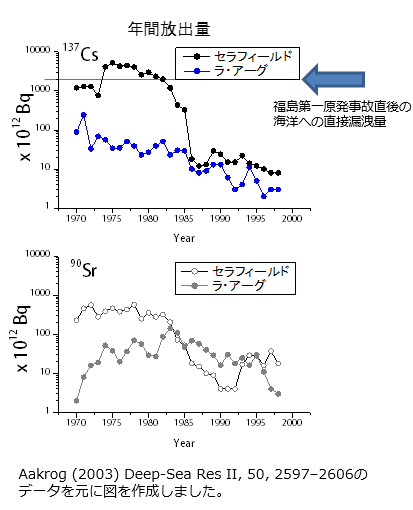
年間放出量Annual emission 福島第一原発事故直後の海洋への直接漏洩量Amount of direct leakage to the ocean immediately after the Fukushima Daiichi Nuclear Power Plant accident
-