

③ Planned releases from nuclear facilities
セクションアウトライン
-
-
What is a nuclear fuel reprocessing facility?
Nuclear power plants use fuel rods containing uranium dioxide fuel pellets (equivalent to coal in thermal power plants) to evaporate water (boil water) using the heat energy emitted when uranium 235 fission occurs, and use the steam to turn a turbine to generate electricity.

火力発電thermal power generation 原子力発電nuclear power generation (of electricity) 燃料fuel 石炭coal 核燃料atomic fuel 熱エネルギー源Heat energy source 石炭を燃やすBurning coal 核分裂nuclear fission 電力源Power Source お湯を沸かして発電タービンを回すBoils water and turns power turbine
In nuclear power generation, fuel rods are replaced with new fuel rods when they are used up. Used fuel is called "spent fuel rods".Unlike thermal power generation, however, spent fuel rods contain a large amount of unburned plutonium, which is produced from unreacted uranium-235 and uranium-238. In other words, there is a considerable amount of unreacted uranium-235 and plutonium produced from uranium-238 in the spent fuel rods, so a "reprocessing plant" is a place to extract them and make fuel rods again.
*For more information, please visit the Federation of Electric Power Companies of Japan HP:https://www.fepc.or.jp/nuclear/cycle/recycle/index.html
-
In Europe, nuclear fuel reprocessing facilities are in operation, and artificial radionuclides are being systematically (and controlled) released from these facilities.
The two reprocessing facilities are located in La Argues, France and Sellafield, England.
The figure below shows the annual releases (1970-1998) of a typical reprocessing plant in Europe (shown on the right).
During this period, Sellafield released approximately 40 PBq of 137Cs into the ocean. In 1976, the maximum amount reached 5.2 PBq/year (1.4 times higher than the direct leakage immediately after the Fukushima Daiichi Nuclear Power Plant accident), but this amount decreased to 0.008 PBq/year in 1998.
The amount of 137Cs released from La Argues is less than 3% of that from Sellafield when compared to the total amount of 137Cs released, but this is also due to the difference in the amount of spent fuel processed annually.
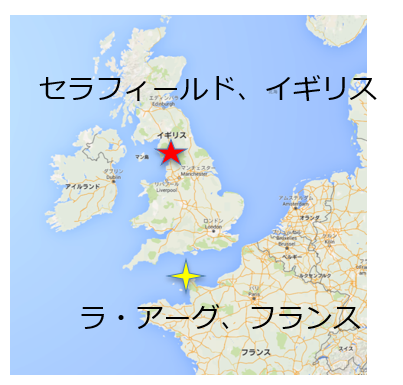 セラフィールド、イギリスSellafield, United Kingdom
ラアーグ、フランスLa Argues, France
Below we show the year-to-year changes in the amount of radioactive cesium released from nuclear fuel reprocessing plants in Europe.
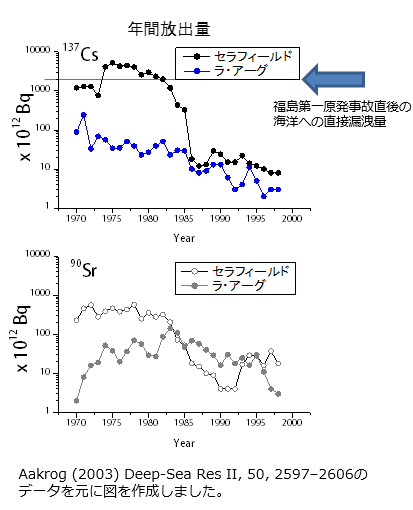
年間放出量Annual emission 福島第一原発事故直後の海洋への直接漏洩量Amount of direct leakage to the ocean immediately after the Fukushima Daiichi Nuclear Power Plant accident
-