
(1) Atmospheric nuclear test
セクションアウトライン
-
-
Release of 137Cs into the ocean due to atmospheric nuclear testing
Since 1945, about 500 atmospheric nuclear tests have been conducted. A partial nuclear test ban treaty was signed in 1963 because nuclear tests in the atmosphere would disperse large amounts of radionuclides into the environment. Primarily, atmospheric nuclear testing, conducted between 1945 and 1963, is the largest source of artificial radionuclides in the ocean.
The graph below shows the radiation dose of radioactive cesium (137Cs) in the oceans (North and South Pacific, North and South Atlantic, and North and South Indian Oceans).
The unit is PBq (petabecquerel). Peta stands for 1015. Becquerel is a unit that expresses the number of atoms (radioactivity) that a radioactive substance decays in one second.
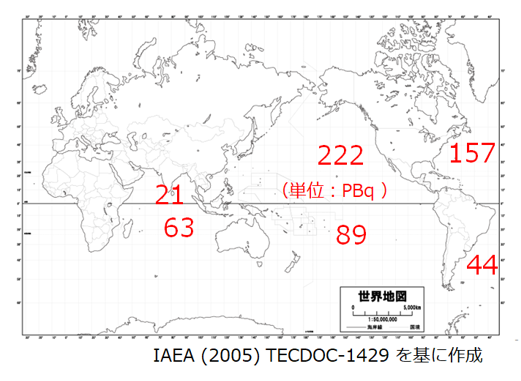
IAEA(2005) TECDOC-1429を基に作成Created based on IAEA (2005) TECDOC-1429
単位Unit 世界地図World map
-