섹션 개요

    • ・Samples collected from fixed points on the ice in the Arctic Ocean, where sea ice makes year-round sampling difficult, were analyzed.

      ・Established identification methods and analyzed life histories of five species of Aetideid copepods that dominate the deep waters of the Arctic Ocean.

      ・It was found that in the polar night, when food is scarce, each species changes its distribution depth to reduce competition for food and reproduce.

    •  Associate Professor YAMAGUCHI Atsushi of the Graduate School of Fisheries Sciences, Hokkaido University, and his research group at Woods Hole Oceanographic Institution and the University of Rhode Island analyzed time series of plankton net samples collected at fixed stations on ice in the Arctic Ocean during 1997 and 1998, and established an identification method to distinguish the early developmental stages of five species of particle-eating zooplankton, Aetideid copepods, and clarified their life history. 

       The Arctic Ocean is frozen over in winter, making it difficult to collect zooplankton samples throughout the year, and knowledge of zooplankton life histories is scarce. In this study, using samples from the SHEBA, the most successful ice station time-series plankton collection in history, we analyzed five species of Aetideid copepods that occur at depths deeper than 200 m, which had not been analyzed previously. The results showed that the five particle-feeding species of the family were all distributed at the same depth during the midnight sun when food was abundant, whereas during the polar night when food was scarce, they reproduced while mitigating competition for food by changing the depth of distribution for each species.

       The results of this study are expected to be important knowledge for future polar biological oceanography, as it shows that biological production is active even at polar nights when there is no sunlight, and it establishes a method for species identification of five species belonging to the same family of copepods that dominate the deep-sea zooplankton fauna in the Arctic Ocean and clarifies their life history.

       The results of this research were published online in Frontiers in Marine Science on Friday, August 19, 2022.

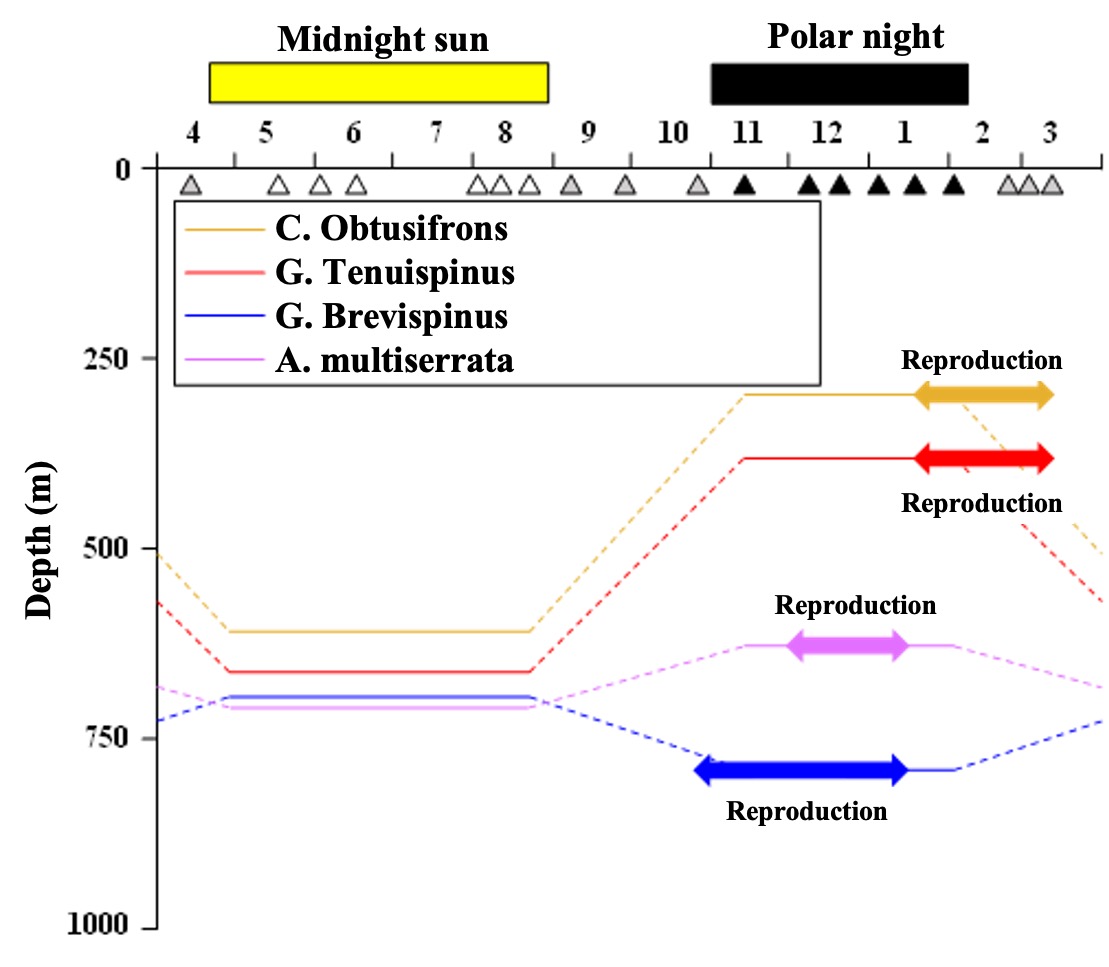
    • Fig. 1

       Distribution depths and timing of reproduction during midnight sun and polar night of four Aetideid copepods as assessed by time-series sampling at fixed stations on ice in the Arctic Ocean.

       The solid lines indicate the distribution depths during the midnight sun and polar night, and the dotted lines indicate the distribution depth shifts during the conversion periods between the two periods. Arrows in both directions indicate the time of reproduction for each species, as inferred from population structure. The upper triangle indicates the date of sampling. Of the five Aetideid copepods for which species identification was possible, the species with the deepest depth of distribution (A. rostrata) is not included in the figure because the population density was too low to determine the time of reproduction.

    •  In recent years, changes in the marine environment have been observed in the Arctic Ocean, such as earlier melting of sea ice and a decrease in sea ice extent, which are thought to be caused by climate change. There is concern about the impact of these changes on marine ecosystems, but knowledge on the life history of zooplankton, the main organisms that make up the Arctic marine ecosystem, is still scarce. One reason for this is that the Arctic Ocean freezes over during the winter, making it difficult to collect samples throughout the year. The time-series sampling at ice fixed stations on the sea ice overcomes this problem. The most successful time-series plankton sampling at a fixed station on ice in history was conducted by the U.S. and Canadian research project SHEBA, which used a Canadian icebreaker moored on ice in the western Arctic Ocean from October 1997 to October 1998 as an observation station, and time-series plankton samples were collected.

       Using zooplankton samples collected at SHEBA, several analyses had been conducted by researchers at the Woods Hole Oceanographic Institution in the United States, but the life history of species distributed in the deep sea remained unresolved.

    •  Samples collected at SHEBA between October 1997 and October 1998 were used in this study; zooplankton stratified collections were conducted at SHEBA approximately once every two weeks, and the samples were fixed in 4% formalin seawater.

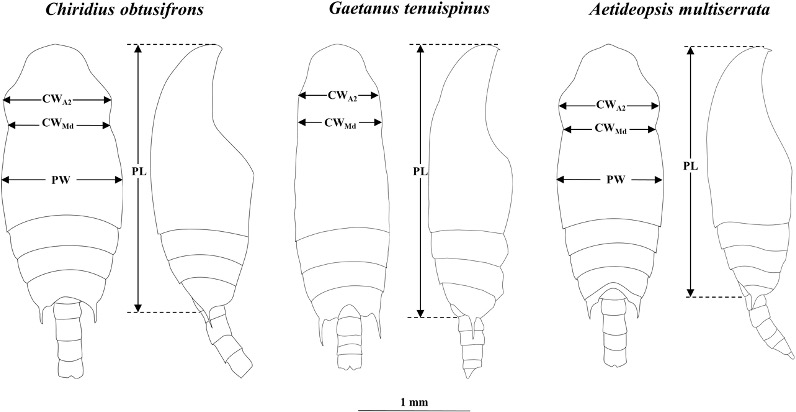
       Among the zooplankton species dominant in the sample, we were able to identify all developmental stages, including the youngest, by measuring the length of each body part of five species of particle-feeding Aetideid copepods that are dominant in the deep sea, which had not been analyzed previously (Figure 1, 2). We also determined the depth distribution of each developmental stage and seasonal changes in population structure to assess when reproduction occurs (Figure 3).

    • 【Reference diagram】

      Fig. 2

      Figure 1. The measurement sites used for species identification of the larvae of Aetideid copepods
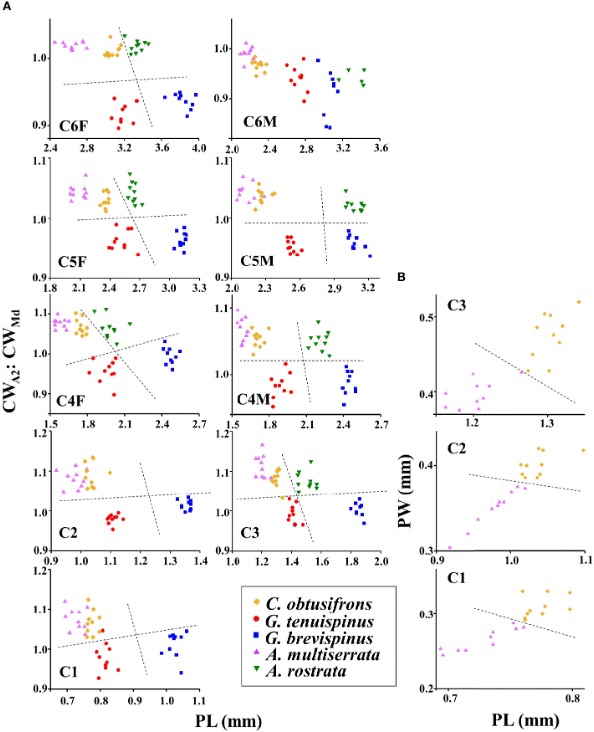
      Fig. 3

      Figure 2. Scatterplot of measured site lengths at each developmental stage of Aetideid copepods. The plotted locations differ by species and can be used for species identification.
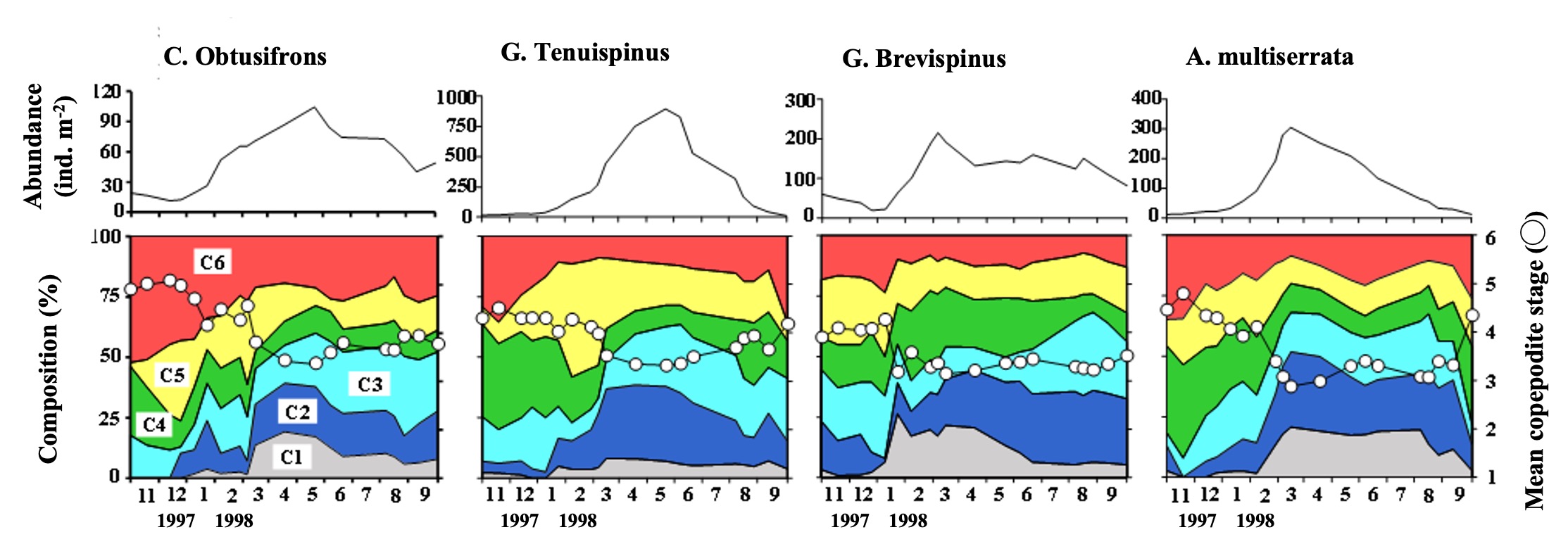
      Fig. 4

      Figure 3. Seasonal changes in the number of emergent individuals (top), developmental stage composition and mean copepodite stage (bottom) of four shallow-distribution Aetideid copepods that appeared in the SHEBA sample.

    •  One of the five Aetideid copepods was distributed at depths greater than 1,000 m throughout the year and had a low population density, while the remaining four species were concentrated at depths of 600-700 m during the midnight sun (May-August). On the other hand, during the polar night (November-January), the depth of distribution varied among species, with two species becoming shallower to 300-400 m, one species remaining at around 600 m, and one species becoming deeper to 800 m (see figure below). The different depths of distribution in the polar night for each species of the same family were interpreted to reduce competition for food during the season when light is scarce, the amount of particles settling in the deep sea is low, and food is scarce.

       The timing of reproduction, inferred from seasonal changes in population structure, differed among species with different distribution depths. The reproduction of the two species whose distribution depths become shallower during the polar night was found to be in the late polar night, while the reproduction of the two species that remain in deep water even during the polar night was found to be in the early polar night.

    •  Traditionally, the polar night was thought to be a time of poor biological production due to the lack of sunlight. However, the reproductive periods of five species of Aetideid copepods were all located during the polar night. The results of this study indicate that biological activity in the deep Arctic Ocean during the polar night is more active than previously thought.

       By measuring the body parts of five sympatrically occurring Aetideid copepods, a method was established to identify species from their young developmental stages. Aetideid copepods are important species in the material cycle, as they are estimated to consume 40% of the sedimentary particles in the deep Arctic Ocean. It is expected that the method established in this study will be used to further develop ecological research on copepods of this family.

    • ・Paper title

      Inter-species comparison of the copepodite stage morphology,vertical distribution, and seasonal population structure of five sympatric mesopelagic aetideid copepods in the western Arctic Ocean

      ・Author

      KOGUCHI Yunosuke1,  TOKUHIRO Koki2, Carin Ashjian3, Robert Campbell4, YAMAGUCHI Atsushi1,5

      (1Graduate School of Fisheries Sciences, Hokkaido University, 2The National Institute of Advanced Industrial Science and Technology (AIST), 3Biology Department, Woods Hole Oceanographic Institution, 4Graduate School of Oceanography, University of Rhode Island, 5Arctic Research Center, Hokkaido University)

      ・Journal

      Frontier in Marine Science (Journal of Oceanography)

      ・DOI 

      10.3389/fmars.2022.943100

      ・Date of Publication

      Friday, August 19, 2022 (online publication)


  • Research Introduction Marine Biology The Arctic Ocean