Perfilado de sección

    • ・The world's first time-series observation of organic gas components in marine sediments.

      ・High concentrations of methyl iodide and ethyl iodide were found on the surface of marine sediments.

      ・The phytoplankton produced in the surface layer settles on the seafloor surface, causing these compounds to occur.


    • A research team led by Associate Professor OOKI Atsushi of the Faculty of Fisheries Sciences, Hokkaido University has conducted oceanographic observations to investigate the spatio-temporal distribution of organic iodine gas species in Funka-Bay in Hokkaido and the northern Bering Sea. In Funka-Bay, they found that the concentrations of ethyl iodide (C2H5I) and methyl iodide (CH3I), a type of organic iodine gas, increase on the surface of marine sediments after spring, when phytoplankton blooms occur. High concentrations were also observed on the surface of sediments in the northern Bering Sea and in the shelf areas of the southern Chukchi Sea. Diatoms (a type of phytoplankton) were found to produce these compounds after several days in the dark. It was found that diatoms produced on the ocean surface settled on the seafloor surface and generated ethyl iodide and methyl iodide.

      The results of this research were published online in the international journal Communications Earth & Environment on August 12, 2022(https://www.nature.com/articles/s43247-022-00513-7)。


    • Picture 1(Left)Seafloor surface of the northern Bering Sea shelf,(Right)Seafloor surface of Funka-Bay, Hokkaido, Japan


    • Videos of the seafloor surface at the observation site and videos of the observation landscape are provided as supplemental information (https://www.nature.com/articles/s43247-022-00513-7#Sec14) to this paper.


    • The ocean surface is the dominant source of atmospheric iodine. Volatile organic iodine compounds (VOIs) such as methyl iodide (CH3I) contribute to 20–40% of supply of the reactive iodine in the upper troposphere and lower stratosphere. In the ocean the dominant producers of VOIs have been thought to be marine plants such as macro algae, micro algae(phytoplankton). Most previous studies have focused on the production of VOIs in the upper euphotic zone, where marine plants grow. Recent studies have shown high concentrations of C2H5I in bottom water of the polar Chukchi Sea and northern Bering Sea, and subpolar Funka Bay, Japan. Therefore, we inferred that there is a source of organic iodine gas on the seafloor surface. Therefore, to elucidate the phenomenon of high C2H5I concentrations near the seafloor, we conducted time-series oceanographic observations of seawater and sediment samples in Funka-Bay, Hokkaido, and single oceanographic observations in the northern Bering Sea and southern Chukchi Sea. We also conducted laboratory incubations to test the hypothesis that diatom aggregates settled on the sea floor emit VOIs in darkness.
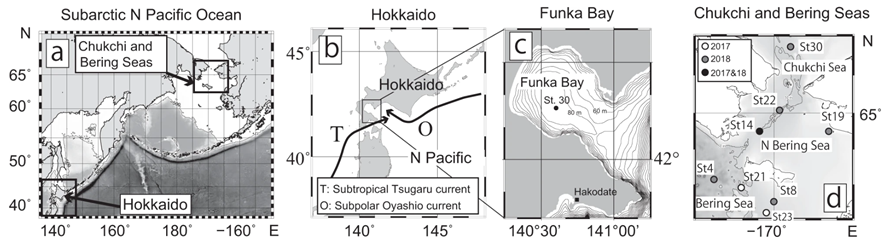
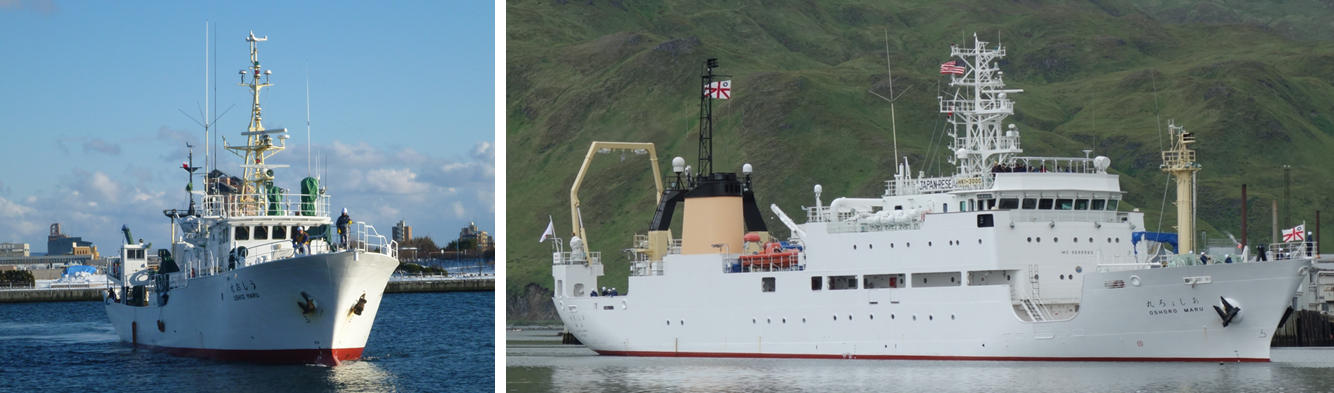
    • Oceanographic observations were conducted in Funka-Bay, Hokkaido (2018-2019) and in the northern Bering Sea and southern Chukchi Sea (July 2017 and July 2018) (Figure 1). The training ship Ushio-Maru (Picture 2 left) and the training ship Oshoro-Maru (Picture 2 right) were used for the research cruises.


    • Figure 1 Observation sites a: Map of the North Pacific Ocean including observation sites, b: Location of Funka-Bay, Hokkaido、c: Observation station in Funka-Bay (St30), d: Observation stations in the northern Bering Sea and southern Chukchi Sea


    • Picture 2 (Left) Training Ship Ushio-Maru, (Right) Training Ship Oshoro-Maru

    • [Sediment sampling]

      We used an Ashura-sampler for the Ushio-Maru and a multiple core sampler for the Oshoro-Maru. We collected water directly above the sediment and pore water in the sediment section with a Mizutol by cutting the sediment into 1 cm thick sections.
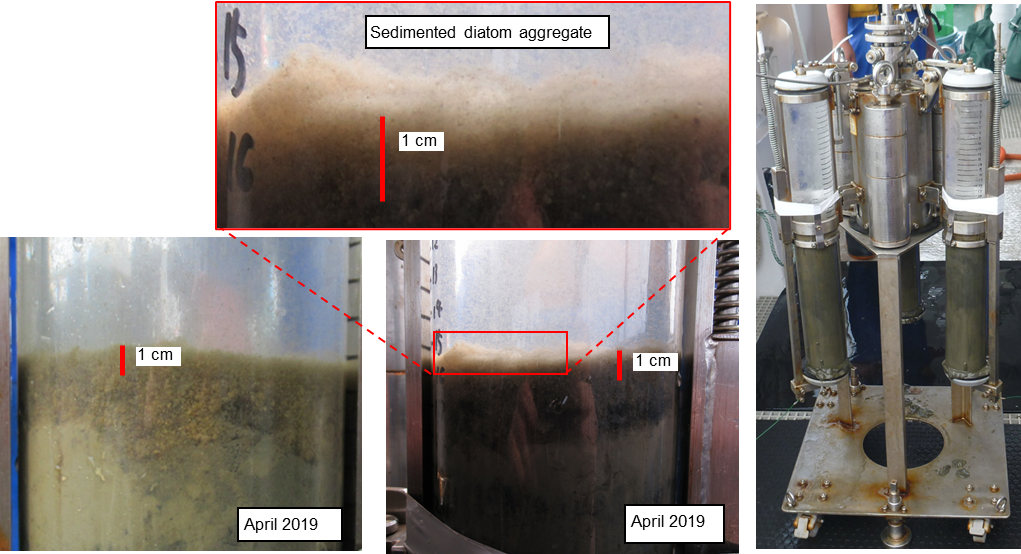


      Picture 3 Sediment samples from Funka-Bay (April, just after the diatom bloom) and the Ashura sampler (right), Diatom aggregates are deposited on the sediment surface.


      Picture 4 (Left) Multiple core sampler observations in the northern Bering Sea, (Right) Sediment Sample

    • [Seawater sampling]

      Seawater was sampled vertically with CTD water sampling equipment (Picture 5).
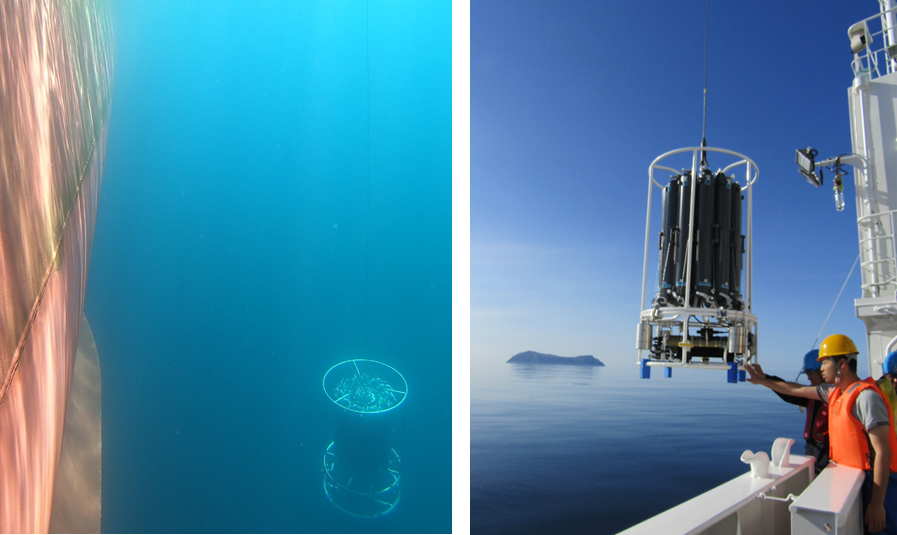


      Picture 5 (Left) CTD observation at Ushio-Maru, (Right) CTD observation at Oshoro-Maru

    • A graph of the vertical time-series cross section in Funka-Bay is shown in Figure 2. In both years, high chlorophyll concentrations were observed in March (Fig. 2a) and diatom blooms were identified. Immediately after that, the concentration of ethyl iodide (C2H5I) in the sediment became high (Figure 2b), and the following month, the concentration in the bottom water became high (top of Figure 2b). Methyl iodide (CH3I) shows a similar trend. Results for the Chukchi Sea, Bering Sea, and Funka-Bay for the ratio of each compound to total organic iodine compounds in water and sediment are shown in Figure 3. In all areas, a high percentage of ethyl iodide was found on the sediment surface. Assuming that these compounds are generated from diatom aggregates sedimented on the seafloor, we conducted a dark culture experiment in which diatom aggregates collected during the bloom in Funka-Bay were sealed and stored in glass bottles (Figure 4). When diatom aggregates were placed in the dark, ethyl iodide and methyl iodide were observed to be generated after a few days.


      https://www.nature.com/articles/s43247-022-00513-7/figures/2
      Figure 2 Vertical time series in the Funka-Bay (a) chlorophyll, (b) ethyl iodide (C2H5I), (c) methyl iodide (CH3I)


      https://www.nature.com/articles/s43247-022-00513-7/figures/
      Figure 3 Composition ratios of organic iodine in sediments and water in the Chukchi Sea, Bering Sea, and Funka-Bay


      Figure 4 Diatom aggregate dark experiment (Left) ethyl iodide (C2H5I), (Right) methyl iodide (CH3I)

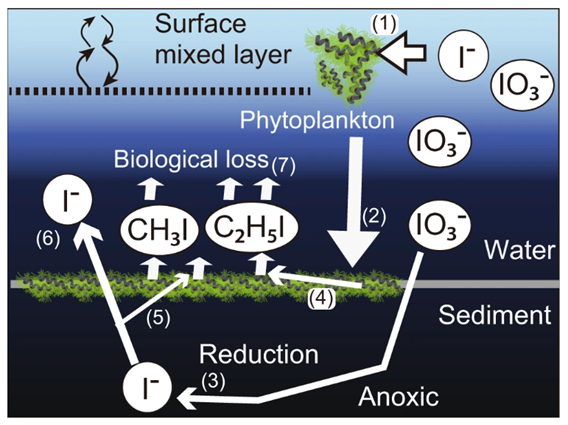
    • The cycle of organic iodine gas in seawater and sediments is summarized in Figure 5. (1) Phytoplankton absorbs iodide ions (I-) from seawater and then (2) settles to the sediment surface. (3) Iodic acid ions (IO3-), which are abundant in seawater, are reduced to I- at some depth in the sediment. (4) Diatom aggregates on the sediment surface produce ethyl iodide (C2H5I) and methyl iodide (CH3I) from I- in their bodies. (5) Diatom aggregates can also use the I- produced in the sediment to make these organic iodine gases. (6) I- in the sediment seeps into the water directly above. (7) C2H5I and CH3I that seep into bottom water are decomposed by microorganisms relatively quickly and their concentration is thought to decrease.

      Translated with DeepL

    • Journal: Communications Earth & Environment

      URL: https://www.nature.com/articles/s43247-022-00513-7

      Title: Marine sediment as a likely source of methyl and ethyl iodides in subpolar and polar seas

      Author: 

      OOKI Atsushi (Faculty of Fisheries Sciences, Hokkaido University)

      MINAMIKAWA Keita (Graduate School of Fisheries Sciences, Hokkaido University) 

      MENG Fanxing (Graduate School of Fisheries Sciences, Hokkaido University)

      MIYASHITA Naoya (School of Fisheries Sciences, Hokkaido University; Himeji City Science Museum; Graduate School of Human Science and Environment, University of Hyogo)

      HIRAWAKE Toru (Faculty of Fisheries Sciences, Hokkaido University; National Institute of Polar Research)

      UENO Hiromichi (Faculty of Fisheries Sciences, Hokkaido University)

      NOSAKA Yuichi (Tokai University, Department of Marine Biology and Sciences)

      TAKATSU Tetsuya (Faculty of Fisheries Sciences, Hokkaido University)


  • Research Introduction  Marine Biology