單元大綱

    • Publication: Environmental Pollution (Journal of environmental science)

      Title: Trophic transfer of microplastics from mysids to fish greatly exceeds direct ingestion from the water column
           

      Author:

      HASEGAWA Takaaki (Graduate School of Environmental Science, Hokkaido University)

      NAKAOKA Masahiro (Field Science Center for Northern Biosphere, Hokkaido University)


      URL: 10.1016/j.envpol.2021.116468

      Available online 9 January 2021


    • Discovered that carnivorous fish take in large amounts of microplastics from their prey.

      Microplastics that accumulate in fish are smaller due to those subdivided by prey species.

      Pointed out that microplastics can have a serious impact on marine ecosystems through the food chain.

    • HASEGAWA Takaaki, a master course student at the Graduate School of Environmental Science, Hokkaido University, and NAKAOKA Masahiro, a professor at the Field Science Center for Northern Biosphere, same university, have revealed that the amount of microplastics taken up by fish from seawater is much higher through prey organisms than through direct intake from the water.

      As marine pollution from plastic debris continues to increase worldwide, there is particular concern about the impact of microplastics on marine organisms. Fish take up microplastics not only directly from seawater but also indirectly by feeding on prey, but the relative importance of the two pathways has been unclear. In this study, we examined the importance of the prey-mediated pathway in the uptake of microplastics by fish using the carnivorous fish, Myoxocephalus brandti, and its prey, the mysids, Neomysis spp.

      The results showed that the amount of microplastics ingested by M. brandti through the feeding of microplastic-containing mysids was 3 to 11 times greater than that ingested directly from the water. In addition, microplastics taken up by the fish via prey were smaller in size than those taken up directly, because microplastics are broken down into smaller particles during the process of mysid uptake. It has been pointed out that microplastics can migrate into body tissues and cause adverse effects. Plastics also contain toxic chemicals, which may also affect higher consumers by concentrating through the food chain. Further research on these effects is expected.

      The result of this study was published in journal Environmental Pollution released on 9 January 2021.


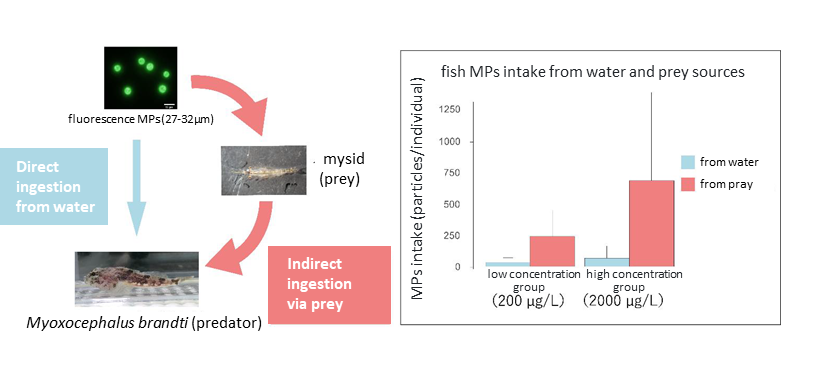
    • Microplastic (MPs) uptake experiment design (left) and experimental results. The fish took up a larger number of microplastics via their prey, the mysids.

    • Marine pollution by plastic litter is increasing around the world, and it is predicted that by 2050 the amount of plastic litter in the world's oceans will be greater than that of fish. In particular, it has been reported that "microplastics" with a particle size of 5 mm or smaller are taken up by all living organisms, and there is concern about their impact on ecosystems. Marine animals are known to take up microplastics not only directly from seawater, but also by feeding on small prey that carry microplastics in their bodies, but no studies have examined the relative importance of these two pathways. Some marine organisms, such as crustaceans, also break down microplastics through feeding and digestion, so microplastics taken up through prey are expected to be even smaller than those taken up directly from the water.

      In this study, we used the carnivorous fish Myoxocephalus brandti and its prey, the small crustacean mysids Neomysis spp. to examine (1) the importance of the indirect pathway via prey in fish ingestion of microplastics and (2) variation of microplastic particle size by indirect pathway (Fig. 1).


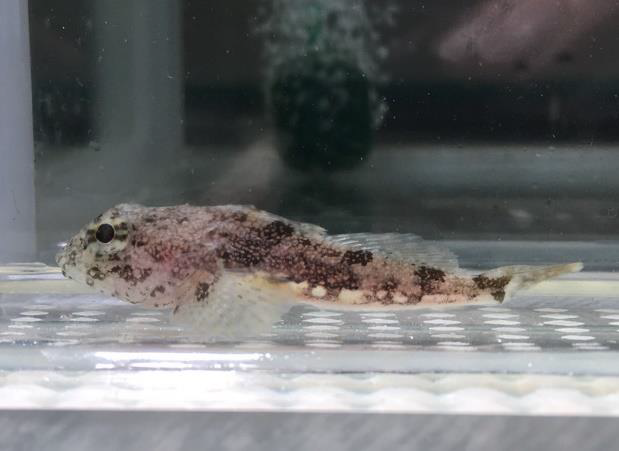
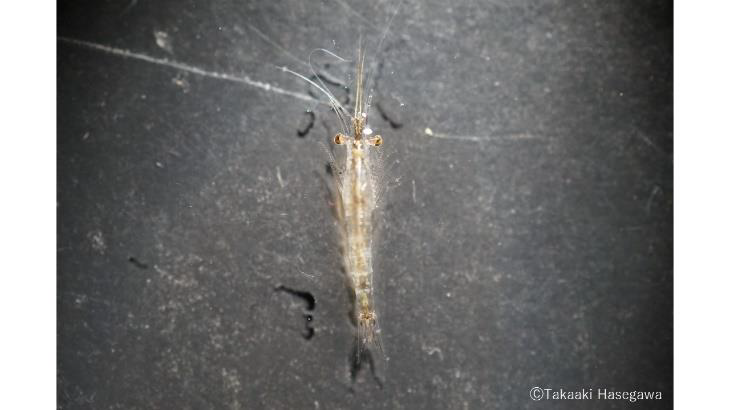
    • Fig. 1 A fish M. brandti (left) and mysid (right) used in the experiment. The body lengths of the fish and mysid are about 8 cm and 1 cm, respectively.

    • Breeding experiments were conducted at the Akkeshi Coastal Research Station of the Field Science Center for Northern Biosphere, Hokkaido University, using mysids and shimofuri sculpin (hereafter referred to as “sculpin”) collected from Lake Akkeshi in eastern Hokkaido. Fluorescent polyethylene particles with a particle diameter of 30 μm were used as microplastics. Direct ingestion of microplastics from the water was examined by rearing sculpin in tanks containing two different concentrations (200 and 2000 μg/L) of microplastics in seawater (water group). On the other hand, uptake of microplastics through indirect pathways via prey was investigated by feeding mysids (Fig. 2) exposed to microplastics at the same concentration conditions to sculpin in tanks without microplastics (mysid group). The amount and particle size of microplastics accumulated in the digestive tract of sculpin in each group were quantified and compared among treatment groups.


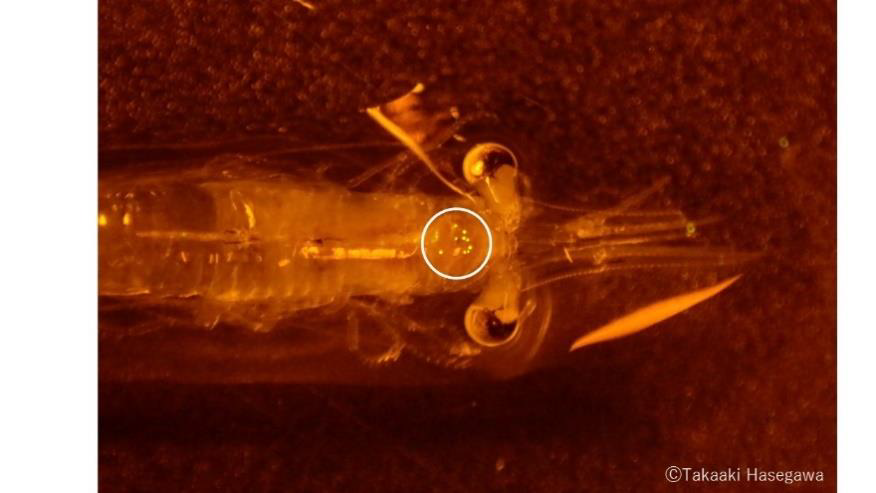
    • Fig. 2 Mysid with microplastics (fluorescent beads) incorporated. The portion of the stomach where the fluorescent beads were incorporated is indicated by a white circle.

    • Sculpin in the mysid group took in 8 to 11 times more microplastics by number and 3 to 5 times more by mass than those in the water group. The microplastics were finely granulated during the process of uptake by mysids, and as a result, the microplastics taken up by sculpins in the mysid group were smaller in particle size than those in the water group. This indicates that the indirect pathway via prey organisms is more important than the direct pathway from the water for the uptake of microplastics by fish.

    • This research has revealed that microplastics are transferred through the food chain to animals at higher levels in the marine ecosystem. Microplastics not only have a negative effect on animal feeding and digestion activities, but also, when finer particles are produced, they migrate from the digestive tract to the body tissues and have adverse effects. It has also been suggested that plastics contain a variety of toxic chemicals*1 that may also affect higher consumers by concentrating through the food chain. We are currently conducting an experiment to investigate the accumulation of various chemical substances in body of sculpins by feeding mysid that contain microplastics containing toxic chemicals to sculpins. Through this experiment, we hope to clarify the overall picture of the impact of microplastics on marine ecosystems through the food chain.

      *1 Toxic chemicals: Plastic, a petroleum product, adsorbs POPs (persistent organic pollutants) such as PCBs and PAHs due to its chemical affinity, and also contains various chemical additives such as brominated flame retardants and UV absorbers. In animals, including humans, these chemical substances are known to cause various adverse effects when they accumulate in high concentrations in the body.

    •  Research Introduction Laboratorywork Fieldwork