單元大綱

    • Oshoro-Maru Marine Scinece Department, Faculty of Fisheries, Hokkaido University Keiri Imai, Kenji Koguma, Kohki Sawada.

    •   In order to elucidate the material cycle of the ocean, taking into account the life history and activity capacity of zooplankton communities, it is necessary to capture their distribution with high spatio-temporal resolution. Therefore, a multi-level plankton net has been developed that can continuously collect plankton samples from multiple depth ranges. The VMPS (Vertical Multiple opening and closing Plankton Sampler) was developed specifically for continuous vertical sampling, The VMPS is equipped with several plankton nets, which can be opened and closed in sequence during towing to collect plankton communities by layer. The VMPS is smaller and lighter than typical multistage retractable nets such as the MOCNESS and BIONESS, making it easier to handle. VMPS is a domestically produced observation device developed by Dr. Makoto Terasaki (Professor Emeritus, University of Tokyo) in collaboration with a domestic manufacturer. This section describes (1) the configuration of VMPS, (2) the net opening and closing mechanism, and (3) an overview of the collection process.

      [Open Access] Terazaki & Tomatsu, 1997,  J. Adv. Mar. Sci. Tech. Soci.
       VMPS 水中部写真


      1 VMPS underwater station


    •  

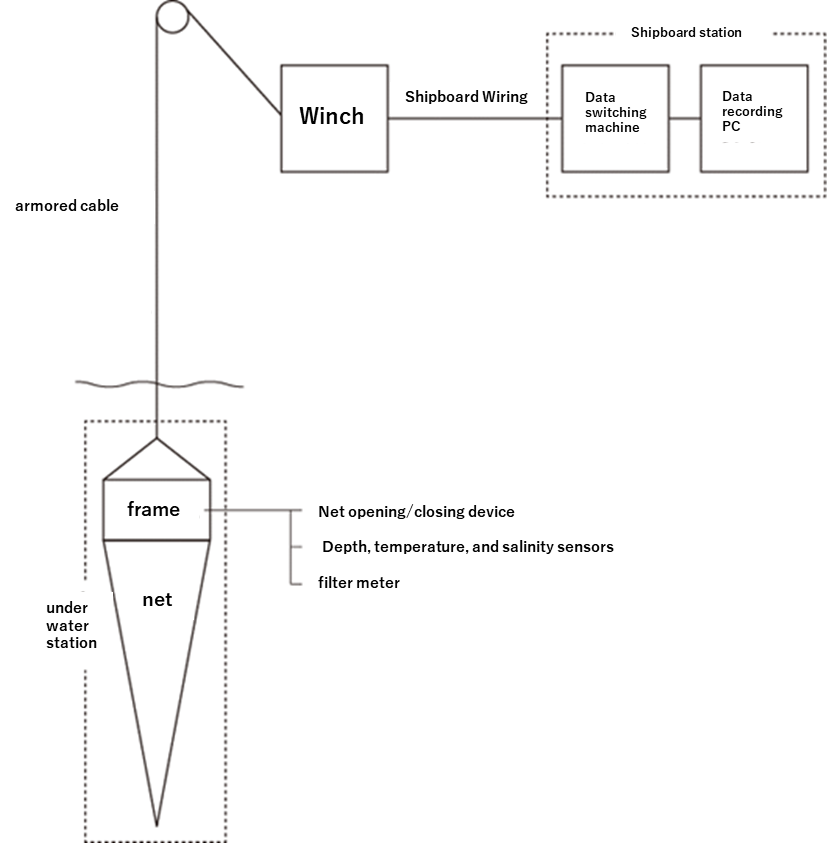
      The VMPS system configuration is shown in Figure 2 and consists of an "underwater station" that moves in the sea to collect plankton, a "shipboard station" that supplies power to the underwater station and transmits and receives electrical signals, and cables that electrically connect the two stations.


       The "armored cable" used to raise and lower the underwater station in the sea is a special coaxial cable covered with steel wire on the outside, and is the same as that used for the CTD water sampling system. The armored cable is wound around a special winch for several thousand meters. Measurements sent from the underwater station through the cable are displayed in real time on a monitor at the onboard station. Trigger signals to open and close the net are also sent from the onboard station to the underwater bureau via the armored cable.


    • 図2 VMPS System Configuration Chart


    • (1)-1 underwater bureau 

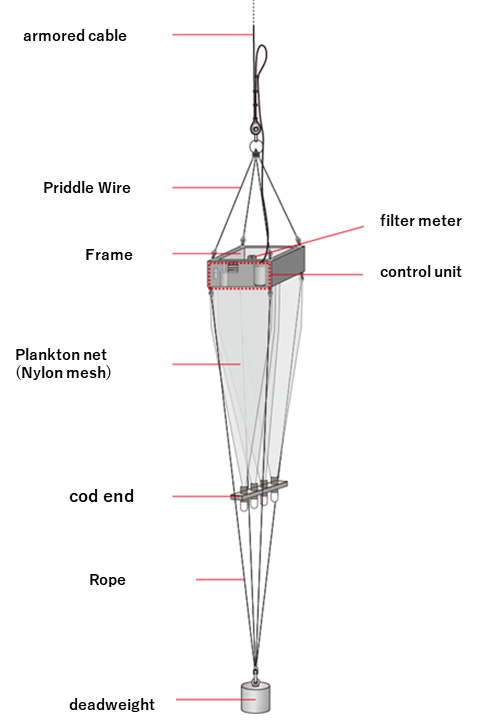
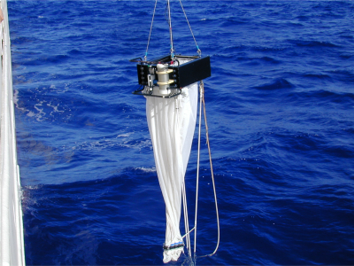
       Details of the underwater station are shown in Figure 3. The underwater station consists of multiple plankton nets made of nylon mesh netting sewn together and a rectangular metal frame that secures the net opening. The frame incorporates a control unit for the underwater bureau, an underwater sensor that measures depth, temperature, and salinity at the site, and a filter water meter.


       The underwater station is towed by four wire ropes (bridle wires) connected to the top of the frame. A weight is suspended from the rope (force rope) connected to the underside of the frame to submerge the underwater station. The bottom of the net (cod-end) is bound with a jig and then fastened to the power rope. This prevents the net from twisting or blowing up and keeps the net in proper shape during towing. The net can be easily detached from the frame and replaced with a net of the appropriate mesh size for the purpose of the survey.


    • 3 Composition of Underwater bureau

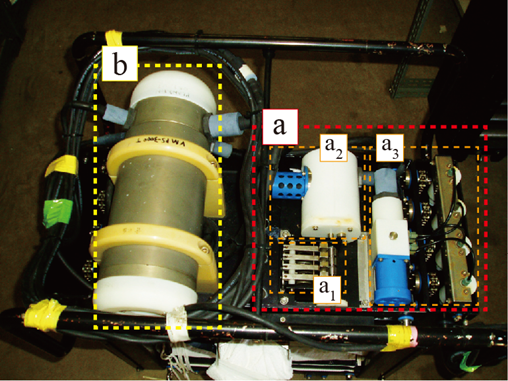
    •  A photograph of the control unit of an underwater station is shown in Figure 4. The control unit consists of a mechanism that opens and closes the net (Figure 4-a: Net Open/Close Device) and a metal pressure-resistant container (Figure 4-b: Underwater Chamber) that contains various control boards and power supply units. The "net opening/closing device" consists of a trigger to open and close the net (Figure 4-a1: Trigger), a motor to operate the trigger (Figure 4-a2: Motor for Trigger), and a sensor to detect when the net is opened or closed normally in the water (Figure 4-a3: Net opening/closing detection sensor). The "underwater chamber" controls the "net open/close device" according to the net open/close signals sent from the onboard station, and converts the outputs received from various underwater sensors (depth, water temperature, salinity, and filtrate) into electrical signals and transmits them to the onboard station.


    • VMPS 水中局の制御装置

      4 Underwater station control equipment

                           a) Net opening/closing device a1) Trigger a2) Motor for trigger a3) Net opening/closing detection sensor


                                                                                                 b) Underwater chamber


    • (1)-2 Shipboard Stations 


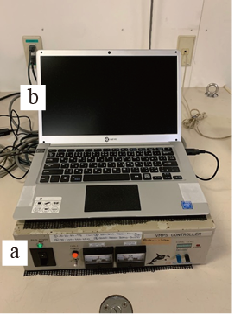
       The VMPS onboard station is shown in Figure 5. The onboard station consists of a "data converter" (hereinafter referred to as "converter") and a "data recording PC" (hereinafter referred to as "PC"). The transducer supplies power to the station and mediates the exchange of signals between the PC and the station (VMPS main unit), while the dedicated software installed on the PC is used to transmit net open/close signals and record and display measurement data. Normally, the onboard station, which is installed in a laboratory on board the ship, is connected to the underwater station via armored cables and inboard wiring as shown in the system configuration diagram in Figure 2.

    • VMPS 船上局

      5 VMPS Shipboard station

      a) Data converter b) Data recording PC

      Photo courtesy of Dr. YAGUCHI Atushi (Faculty of Fisheries Science, Hokkaido University)

    •  The VMPS is equipped with multiple nets, which are opened in sequence to collect samples from different depth layers for each net. This section describes the net opening and closing mechanism of the VMPS.


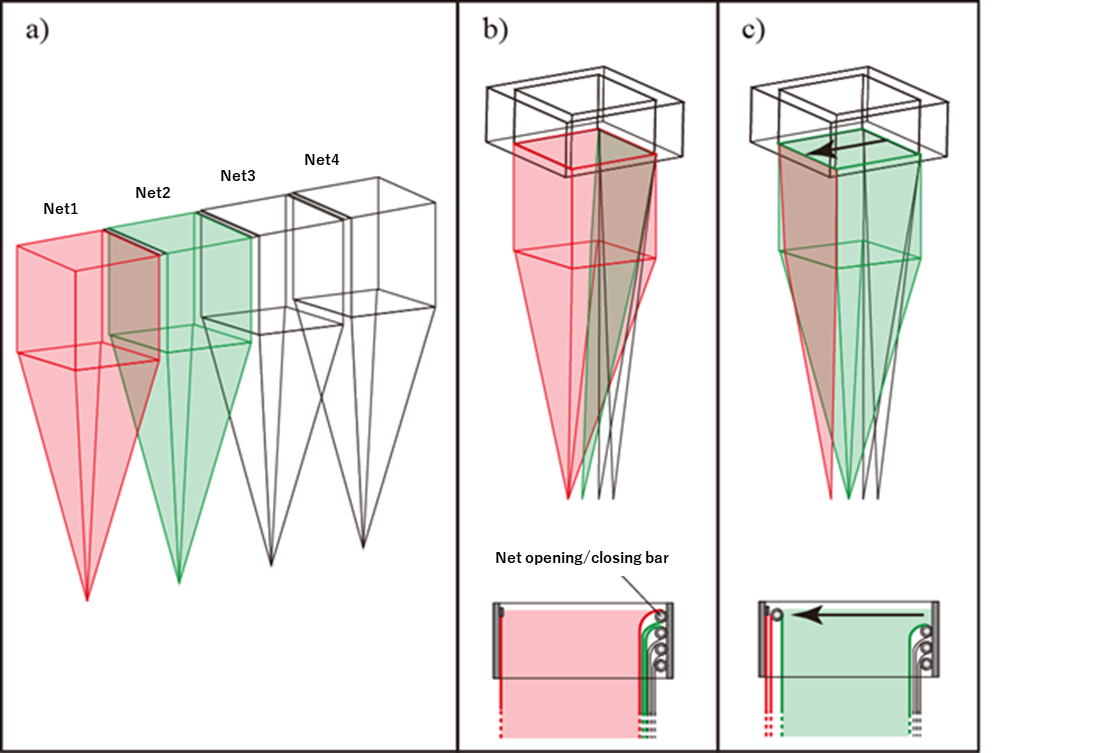
       The VMPS net consists of four plankton nets with square mesh openings, connected to each other by one edge of the mesh opening (Figure 6-a). are closed (Figure 6-b). A metal bar, the net opening/closing bar (hereafter referred to as the "opening/closing bar"), is inserted in the joint between the nets. Sliding the opening/closing bar closes the opening of net 1 and simultaneously opens the opening of the next net (net 2: green) (Figure 6-c).


    • Figure 6 Shape of the net and state of opening and closing of the net opening


      a) Shape of the net


      b) Net 1 open state


      c) Net 1 closed (Net 2 open)


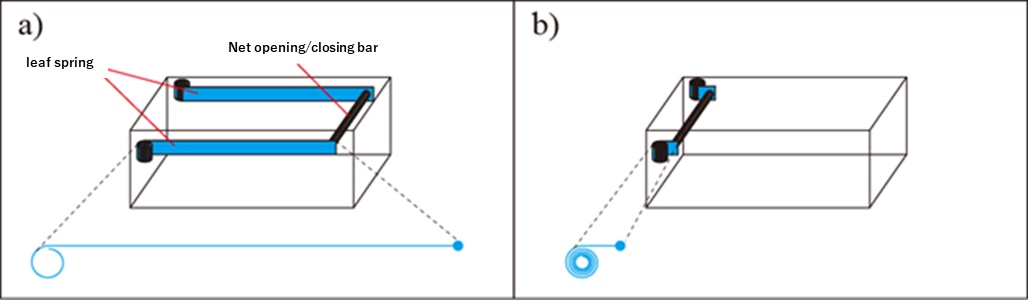
    •  Next, the mechanism by which the open/close bar is driven is explained based on Figure 7. Both ends of the open/close bar are fixed to a plate spring. When the open/close bar is fixed to the trigger, the plate spring is extended (Fig. 7-a). When the trigger is actuated, the open/close bar slides due to the contracting force of the plate spring (Fig. 7-b).


    •       Fig. 7 Positions of the net opening/closing bar and expansion/contraction state of the plate spring


                    a) Before trigger activation b) After trigger activation

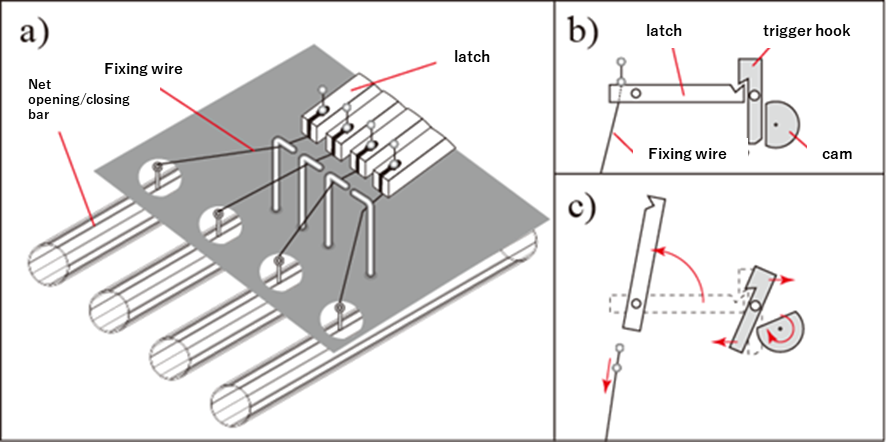
    •  Finally, the trigger mechanism for opening and closing the net is shown in Figure 8. A fixing wire is connected to the center of the opening/closing bar. The metal ball at the end of the fixing wire is hooked into a notch in the latch to secure the opening/closing bar (Figure 8-a). (Figure 8-a). The latch is secured by engaging the trigger hook (Figure 8-b). When the submersible station receives the open/close signal from the onboard station, the trigger motor is activated and the cam rotates. When the trigger hook is released by the movement of the cam, the latch jumps up and the securing wire is released (Figure 8-c), resulting in the opening and closing of the net.


    • Fig. 8 Mechanism of net opening/closing trigger


      a) Fixed state of the net opening/closing bar


      b) Trigger set state


      c) Movement when trigger is released


    •  The VMPS sampling process proceeds in the following order: (1) preparation, (2) casting, (3) towing, (4) lifting, and (5) sample collection. The following is a step-by-step explanation of each of these operations.


    • (1) Preparation before

       Before arriving at the observation site, connect the net, bridle wire, power line, and deadweight to the underwater station. After connecting the underwater station to the onboard station with an armored cable, an operational test will be conducted onboard if possible. The actuation test confirms that the switchgear and underwater sensors are working properly. Once the open/close bar is set on the trigger latch, it is ready to be put in.

    • (2) Loading operation

       After arriving at the observation point and stopping the vessel, the underwater station is lifted above the sea surface by a crane. After that, the armored cable is unrolled and the submersible station is put into the sea. After turning on the transducer, the dedicated software on the PC starts displaying and recording the data sent from the underwater station.

    • (3) Towing net

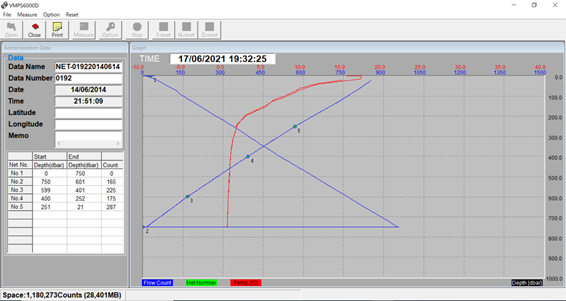
       The armored cable is unrolled and the underwater station is sunk directly down (vertically) to the target depth. The VMPS observation screen is shown in Figure 9. In this example, the red line shows the vertical distribution of water temperature, the blue line shows the rotation speed of the water filter (which is reset to 0 at the deepest point), and the green mark on the blue line shows the net open/close status.
      9  VMPS Observation screen

      Image courtesy of Dr. YAMAGUCHI Atushi (Faculty of Fisheries Science, Hokkaido University)


    • Figure 10 VMPS towing example


       While the underwater station is being lowered, the depth sensor readings are continuously monitored on the onboard station monitor. As soon as the underwater station reaches the desired depth, the cable is hoisted and the towing begins. Since the plankton collection efficiency depends on the speed at which the net is moved, the cable is wound up at a constant speed to ensure that the collection efficiency does not vary during the tow. The net is opened and closed by sending an open/close signal from the on-board station at an arbitrary timing during the tow. Usually, a collection range (depth) is determined in advance, and the net is opened and closed when the underwater station passes through that depth. The net is sometimes monitored for water temperature, salinity, and other parameters, and the collecting area is determined based on these parameters. Also, when the underwater station is in the water, the ship must be maneuvered to avoid being separated from the station by currents and winds.

      *Example of a Towing Net


       An example of a VMPS tow net is shown in Figure 10. In this example, the net is opened and closed at three depths of 750, 500, and 250 meters during the ascent (tow) after the underwater station has been lowered to 1,000 meters. By doing so, the plankton community in four different ranges (0~250, 250~500, 500~750, and 750~1,000 meters) can be sampled separately in a single tow.
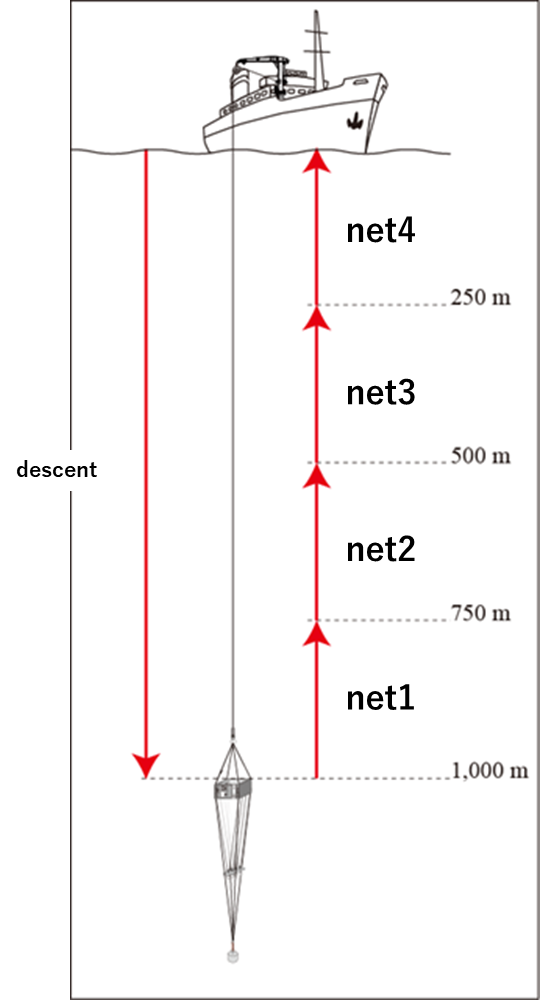

      Figure 10: Example of VMPS towing


    • (4) Lifting operation


       Once the underwater station is lifted into the air, data recording is terminated and the transducer is turned off. While the underwater station is being lifted out of the water by crane, seawater is poured over it with a hose from the outside of the net, and any samples caught in the net or stuck in the nets are poured into the lowest part of the net (codend). This process is called "net washing," and it not only improves the quantitativeness of the sample collection, but also prevents contamination of the sample at the next haul or a decrease in the collection efficiency due to clogging of the net. After the net washing is completed, the underwater station is pulled into the vessel by crane and landed on the deck.


    • (5) Sample collection


       The collected sample is taken out from the codend. A vinyl chloride tube is attached to the cod-end, and the sample is collected in a bag made of nylon mesh or a bucket made of vinyl chloride fixed to the lower end of the tube. The bag-type codend is tied to the PVC pipe with a thin rope, and the bag can be removed by untying the rope (Figure 11-a). The bucket-type codend is fastened to the PVC pipe with a screw and can be removed by turning it counterclockwise (Figure 11-b). Transfer the contents of the cod-end into a sample bottle, being careful not to spill the contents on the deck.

        dictionary
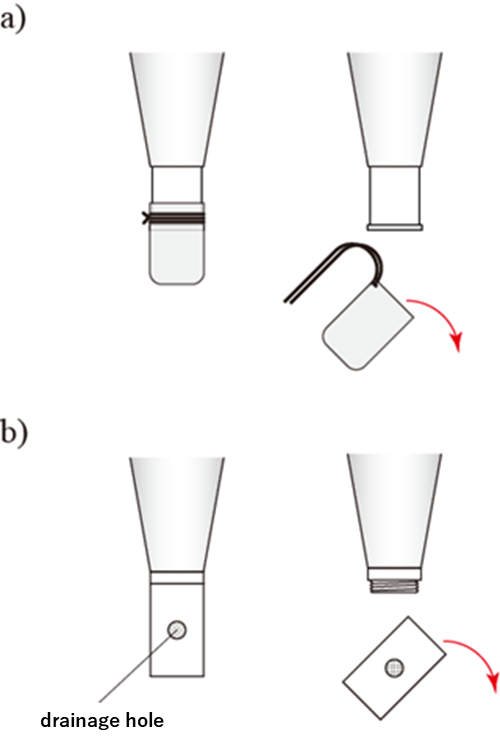


        Fig. 11 Cod ends of VMPS


        a) Bag type b) Bucket type

    • Reseach Methods Trainig Ship