Section outline

    •  MOHT is a type of trawl net used to collect large zooplankton, juveniles, larvae, and small fish. When attempting to collect organisms capable of swimming, if the net is towed at a faster speed than the organisms, escapement from the net mouth can be suppressed. On the other hand, when a trawl net is towed at high speed, the increased drag makes it difficult for the net to sink. The MOHT is equipped with a diving plate that increases the sinking force as the towing speed increases, so that the net does not easily float even when towed at high speed and can be towed stably at the target depth, so that it is used as a quantitative sampling device suitable for stratified sampling to investigate the stock of marine resources. This section describes the configuration of the MOHT and its observation and towing operations.

      [Open Access] Oozeki at.al. (2004)


    • MOHT投網作業

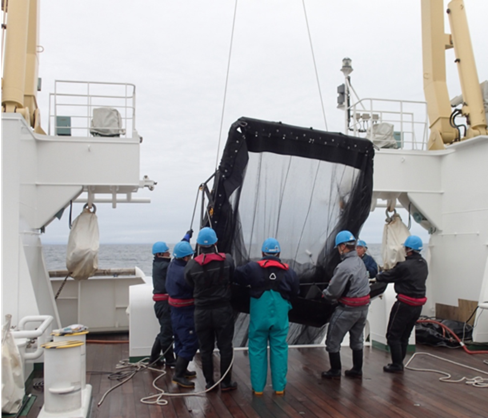
      Figure 1 MOHT netting operation

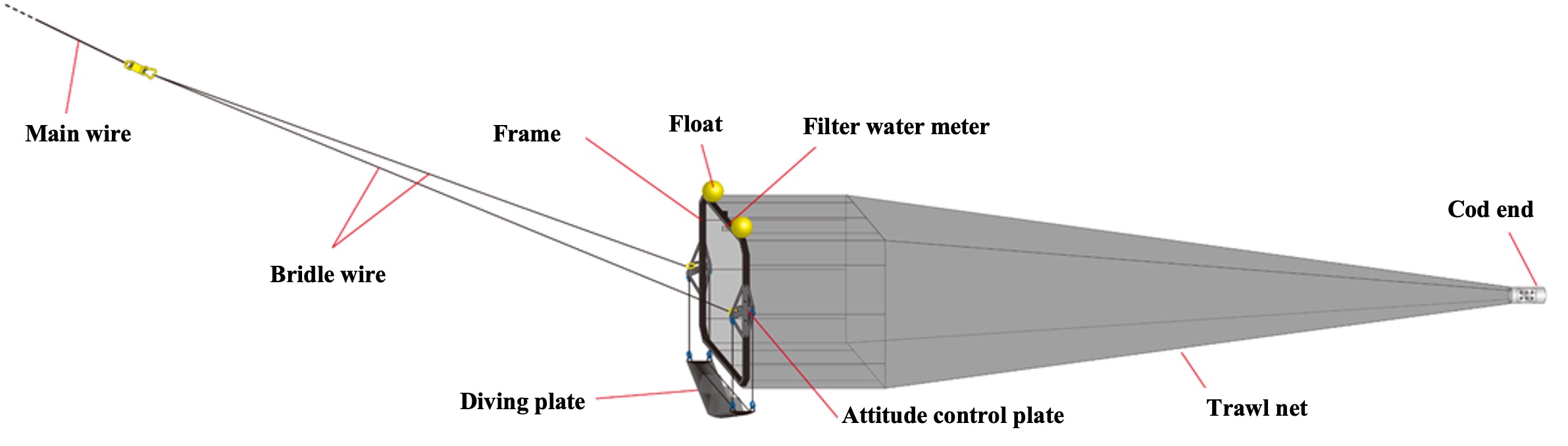
    •  A configuration diagram of the MOHT is shown in Figure 2. A black trawl net is fixed to a square metal frame. The trawl net is made of high-strength synthetic fiber netting to withstand high speeds (up to 4 knots ≈ 2 m s-1). Four wire ropes of equal length, two each from the attitude control plates attached to the left and right sides of the frame, are suspended from which the diving plate is suspended. A pressure-resistant float is attached to the top of the frame to provide buoyancy and reduce the effect of its own weight on the depth of the net. Bridle wires are connected to the left and right sides of the frame, and the net is towed by pulling the ends of the bridle wires with the wire rope (main wire) of the hoisting machine. A detachable bucket is attached to the end of the net (cod-end) where the collected samples accumulate. To determine the amount of seawater that has passed through the net opening, a filter water meter is attached to the inside of the frame.


    • MOHT Configurations

      Figure 2 MOHT configuration


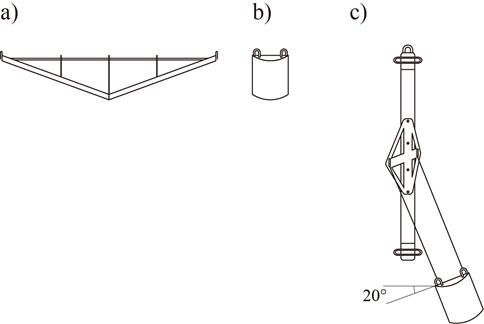
    •  The shape of the diving plate and its posture during towing are shown in Figure 3. The diving plate is a V-shaped metal plate with a convex curved underside to generate stronger diving force. The position of the connection to the attitude control plate is optimized so that the diving plate is maintained at an angle that generates the most effective diving force (20°). When the diving plate is subjected to water current, it generates a downward force (diving force) corresponding to the velocity of the current, which prevents the net from rising when towing at high speed.


    • MOHT 潜行板

      Figure 3 Diving plate

      a) Front view b) Side view c) Posture of diving plate during towing (side view)


    •  MOHT uses a method called "horizontal towing" or "slant towing" in which the ship is moved forward through the water (link: Towing Methods). The MOHT is characterized by its ability to tow at a stable depth without floating, even when the speed at which it moves through the water is increased.

       The following is a step-by-step overview of MOHT's towing operations.

      1)After the frame is lifted from the deck using the crane at the stern of the ship, the aft most part of the MOHT, the cod-end section, is dropped into the sea. Next, while moving the ship forward, the main wire is unloaded and fed into the sea up to the frame section.

      2)The main wire is unrolled and the net is sunk to the target depth. When the net reaches the target depth, the main wire is stopped. The ship's speed is increased to the target speed and the net is towed for the desired length of time or distance.

      3)When the tow is completed, the main wire is wound up and the MOHT is pulled up to the surface. The hoisting speed is slowed down and the net is gradually brought closer to the ship.

      4)When the frame is just behind the ship, the stern crane lifts the frame up and onto the deck. Because MOHT nets are long, the rear part of the net is still underwater when the frame is lifted onto the deck. The long net is then hauled up, and the cod end is lifted out of the water. At this time, seawater is poured over the outside of the net with a hose at the same time as the MOHT is being lifted. This is done to collect samples that are stuck in the middle of the net or clogged in the nets. This process not only improves the quantitativeness of the sample collection, but also prevents the sample from being contaminated the next time the net is towed or the collection efficiency from being reduced due to the clogging of the net.

      5)Once the bucket attached to the cod-end is lifted, the collected material in the bucket is transferred to another container to be used as a sample for investigation and research. The amount of seawater collected is estimated by reading the rotation speed of the filter water meter.


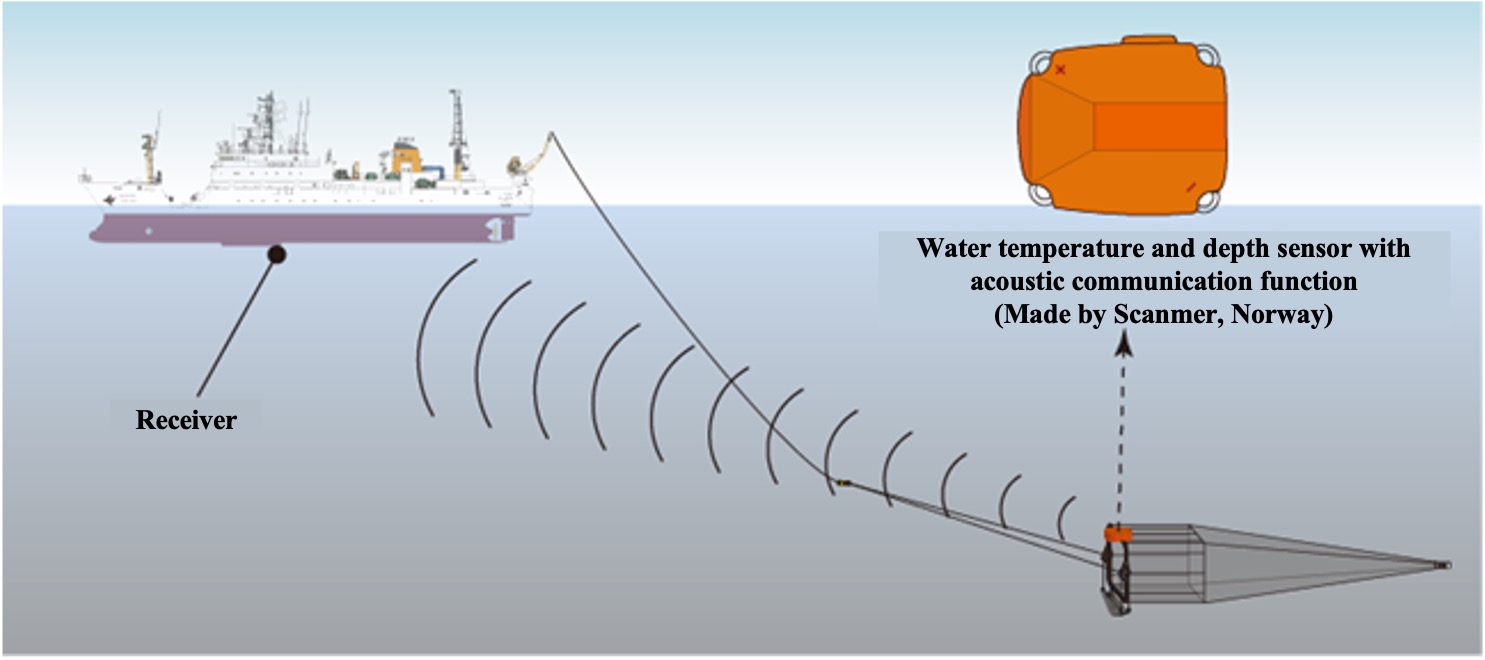
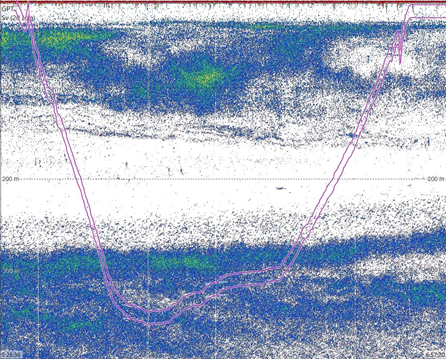
       Despite the excellent depth stability of MOHT, the net depth can change during towing due to the resistance the unrolled wire rope receives in the water, the dead weight of the wire rope, and clogging of the net. The net depth can be determined from the tilt angle of the main wire, or the net depth can be monitored using a depth sensor with acoustic communication (Figure 4:  Fishing Gear Shape Measuring Device) and the length of the main wire adjusted if it deviates from the desired depth. Using a system that combines a fishing gear shape measuring device and a quantitative echosounder it is possible to tow the net while matching the location of the biological community with the depth of the net on the echogram, as shown in Figure 5.


    • MOHT Scanmar

      Figure 4 Fishing gear shape measuring device


    • MOHT Trawl Line

      Figure 5 Net trajectory displayed on the echogram of an echo sounder

  • Reseach Methods Trainig Ship