セクションアウトライン

    • 北海道大学水産学部おしょろ丸海洋調査部 今井圭理、小熊健治、澤田光希

    • A sledge net is a bottom trawl used to collect benthic organisms such as starfish, sea cucumbers, shellfish, and bottom fish that live on or near the seafloor surface. Since samples are obtained by dragging it over the seafloor surface, the underside of the frame is shaped like a sledge so that it can move smoothly over the uneven seafloor. Unlike fishing gear such as otter trawls, in which the shape of the net opening changes during towing, the net opening is fixed by the frame, making it possible to calculate the towed net area and thus collect biological samples in a more quantitative manner. The population density of benthic organisms (number of organisms per unit area) can be estimated from the number of organisms collected and the tow net area.


    • ソリネット

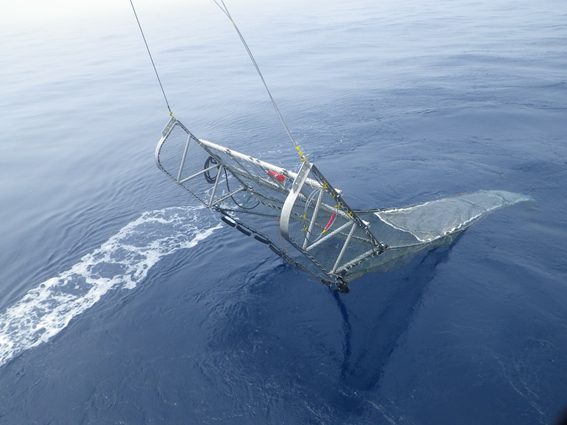
      Fig. 1 Sledge net to be put into the sea


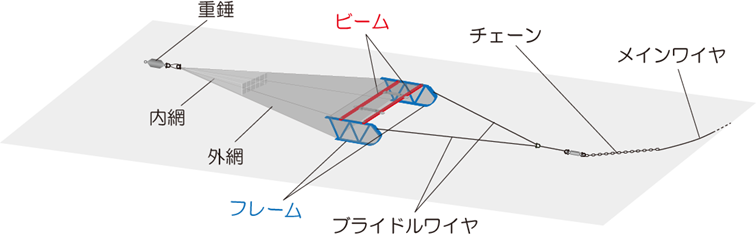
    • Figure 2 shows the configuration (schematic diagram) of a sledge net. A sledge net consists of a bag-shaped mesh mouth fixed to a sledge-shaped frame. The frame that holds the opening of the net is made up of a pair of frames connected by metal rods (beams), and the frames and beams can be disassembled for easy transportation and storage. An inner mesh with a smaller mesh size than the outer mesh is attached at the tail end (cod-end) of the mesh where the collected samples are gathered to prevent the loss of samples collected inside the outer mesh.

      The sledge net is towed by cables (bridle wires) connected to the left and right frames. Weights are suspended from the tail of the net to prevent the net from floating up and getting entangled in the sledge (frame) sections and ropes while being lowered toward the seafloor before being towed, or to keep the net in proper shape during towing. A steel chain is connected to the end of the fuse wire to prevent the main wire from rubbing against the seabed and damaging it. The weight of the chain also keeps the frame from lifting during towing.


    • ソリネットの構成

      Fig. 2 Illustration of sledge net structure

      重錘: weight ビーム: beams チェーン: chain メインワイヤ: main wire

      内網: inner mesh 外網: outer mesh フレーム: frame ブライドルワイヤ: bridle wires

    • When towing a sledge net, it may get caught on a reef or other obstacle on the seafloor. If the net continues to be towed while caught, not only will the net be wrecked, but in the worst case, the main wire of the winch may break, causing the entire net to be lost.

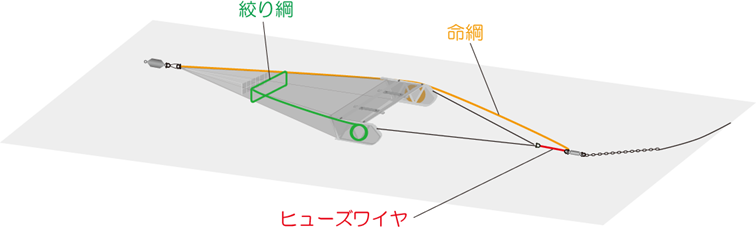
      Therefore, in actual observations, a device is used to avoid the risk as shown in Fig. 3. A fuse wire is attached between the bridle wire and the chain. The fuse wire is a wire rope thinner than the main wire, and it breaks before the main wire when excessive tension is likely to be applied. The net is then towed by the “lifeline” connected to the tail of the net, and at the same time the direction of the sledge changes, releasing the sledge net from the obstacle and allowing it to be retrieved.

      If the net contains a larger-than-expected amount of collected material, there is a risk that the fuse wire may be loaded to the point of breaking when the net is pulled on board. To avoid such a risk, a “squeeze rope” is installed in the middle of the net to squeeze the cod-end and lift it up at two places to collect it on board.


    • ソリネットの安全索

      Fig.3 Manrope of sledge net

      絞り綱: squeeze rope 命綱: lifeline ヒューズワイヤ: fuse wire

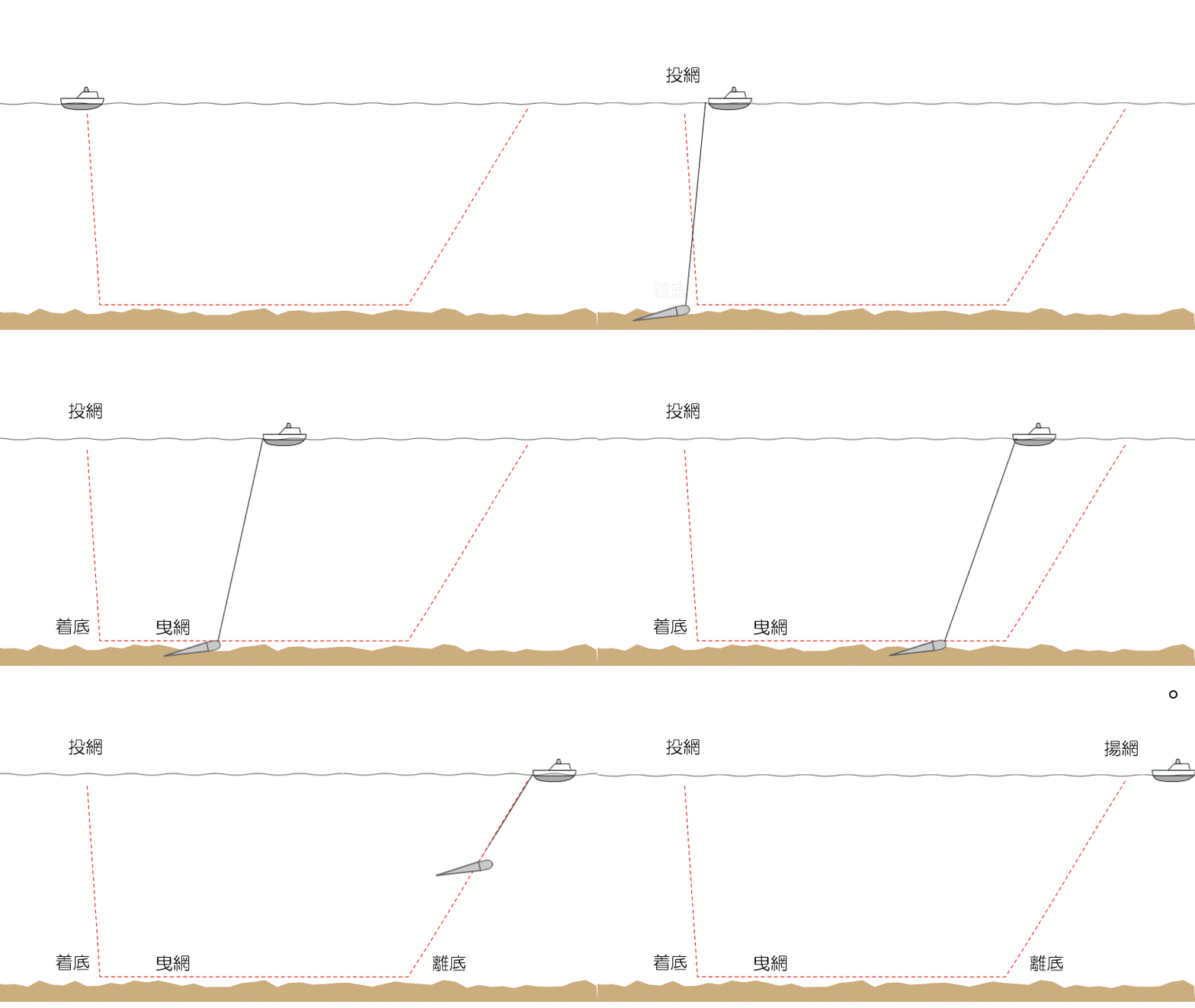
    • Figure 4 illustrates the flow of the collection process using a sledge net. The sledge net is placed in the sea, and the main wire of the winch is unrolled and sunk into the sea (casting). When the net reaches the seafloor (landing), the vessel tows the net over the seafloor surface (towing). The length of wire required to reach the bottom is predicted in advance based on the water depth in the research area, and the final determination of landing is based on the change in tension applied to the main wire.

      When the net reaches the bottom, the tension on the main wire decreases, and the tension increases or decreases in small increments due to drag resistance on the seafloor surface. If the main wire is stopped immediately after landing the bottom, the net may float up, so it should be stopped when it has been extended for a certain length longer than the length of the wire at the time of reaching the bottom or continued to be extended at a slower speed after reaching the bottom. The tension is carefully monitored throughout the tow to respond immediately in the event of a large load, such as being caught on an obstacle or a large amount of material being caught in the net.

      After towing a desired distance or after elapsed a desired amount of time, the main wire begins to wind up. Until the net leaves the seafloor (leaving), it is wound up at a slow speed while continuing to monitor changes in tension. When the net leaves the seabed, the hoisting speed is increased and the net is retrieved on board (hauling). Once the sledge net is recovered on board, the cod-end is opened and the material is removed from the net.


    • Fig. 4 Flow of collecting operation

      投網: casting 着底: landing 曳網: towing 離底: leaving 揚網: hauling

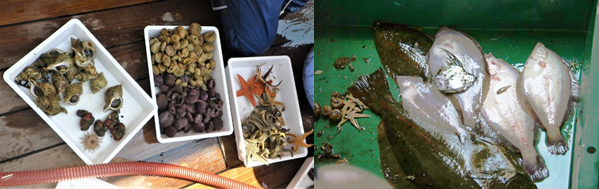
    • ソリネット採集試料の例

      Fig. 5 Biological samples collected by sledge net


    • It is not easy to estimate the condition of a net submerged at the bottom of deep water by relying only on tension. Especially when the water depth is great, the weight of the wire rope is much greater than the weight of the net, and the slack and stretch of the wire rope have a large effect, so it is difficult to determine whether the net has reached or left the bottom only by changes in tension. Therefore, acoustic communication devices such as fishing gear shape measuring devices are sometimes used to determine the position and posture of the net during towing in more detail.


  • Reseach Methods Trainig Ship