섹션 개요

    • Introduction of KUDO Laboratory, Marine biology and Biodiversity, Division of Marine Bioresource and Environmental Science.

    • Professor KUDO retired from Hokkaido University in March, 2025.

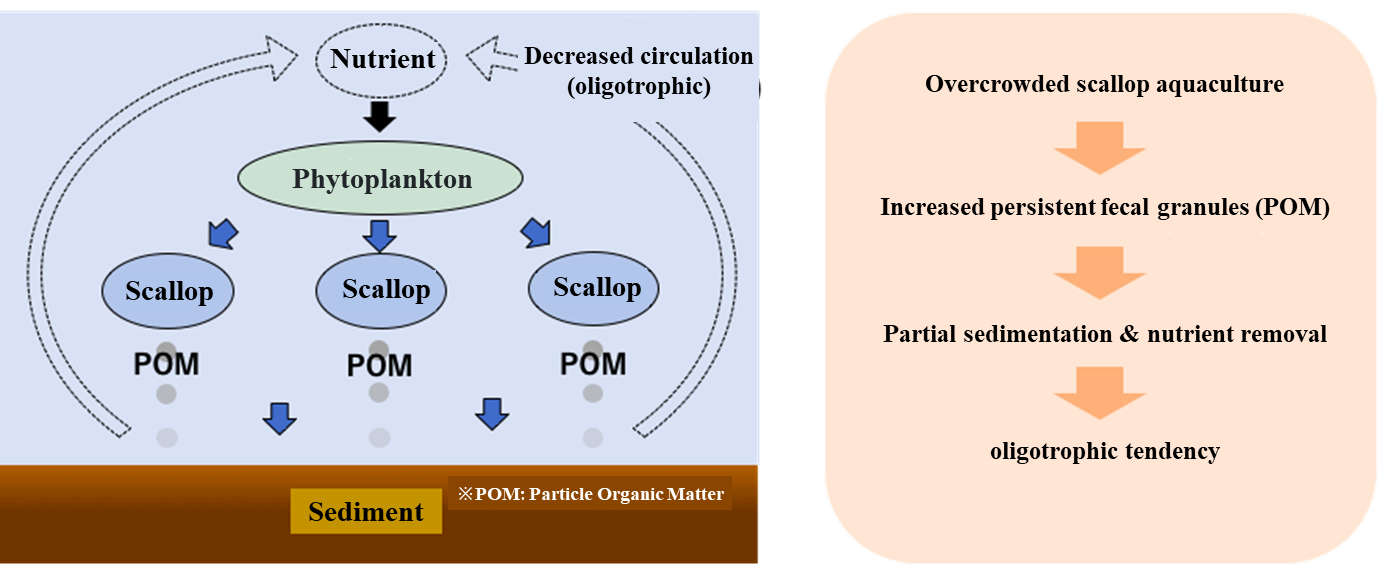
    • In Mutsu Bay, Aomori Prefecture, where scallop drooping culture fisheries have rapidly increased in production since the 1970s, it has become clear that “oligotrophication”, a decrease in nutrient concentrations, has occurred in recent years (Kudo et al., 2014). The purpose of this research is to elucidate the mechanisms of “oligotrophication” in the sea area that could threaten the maintenance of sustainable biological production activities, and based on these findings, to examine countermeasures against oligotrophication and recommend effective measures.


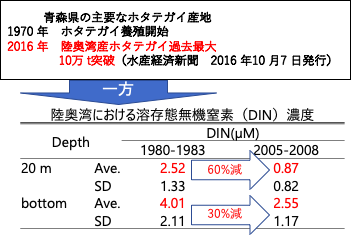
    • Main Scallop Production Area of Aomori Prefecture

      1970 Start of scallop cultivation

      2016 Mutsu Bay scallops exceed 100,000 tons, the largest ever (The Suisan-Keizai Daily News, October 7, 2016)

      On the other hand,

      Dissolved orientation nitrogen (DIN) concentration in Mutsu Bay

      60% decrease (20 m) 30% decrease (bottom)


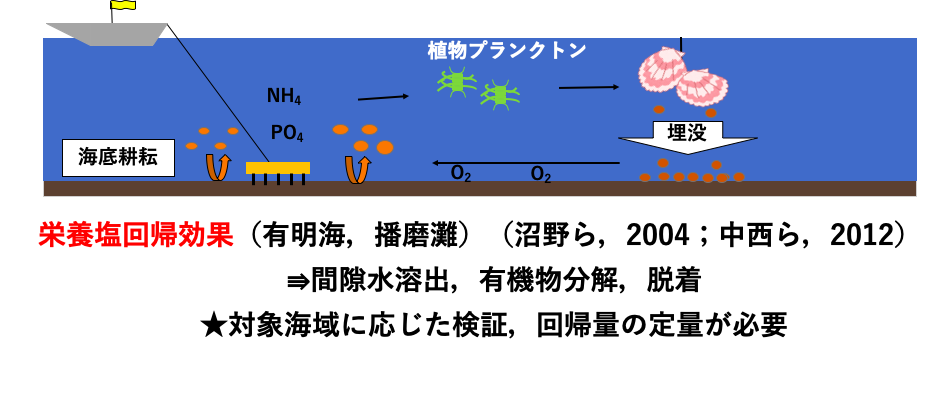
    • Agitation of sediments and improvement of seabed environment using steel girders (JF Osaka Fisheries Federation)


    • 海底耕耘: seabed tilling 植物プランクトン: phytoplankton 埋没: burial

      Nutrient regression effects (Ariake Sea, Sea of Harima) (Numano et al., 2004; Nakanishi et al., 2012)

      pore water dissolution, organic matter decomposition, desorption

      Verification and quantification of regression amounts are required according to the target sea area.


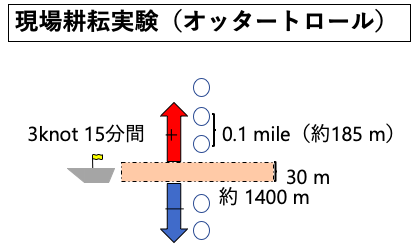
    • On-site tilling experiment (otter trawl)


    • 採取項目: sampling item

      濁度: turbidity 密度: density 水温: water temperature 酸素濃度: oxygen concentration

      栄養塩試料: nutrient sample

      堆積物試料(耕耘点のみ): sediment sample (tilling points only) 含水率: moisture content間隙水: pore water 堆積物直上酸素濃度: oxygen concentration directly above sediment


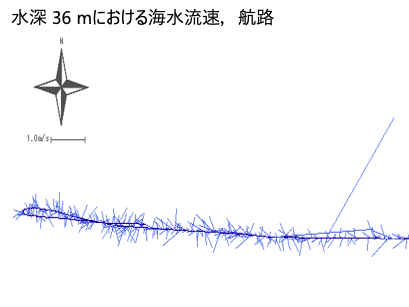
    • Seawater velocity at a depth of 36 m and passage


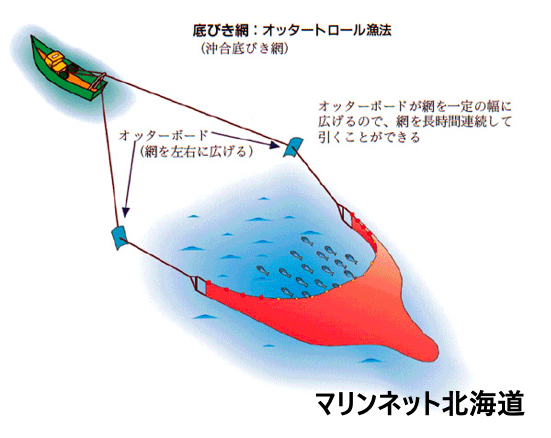
    • 底引き網オッタートロール漁法(沖合底引き網): Otter trawl fishing method (offshore trawl)

      オッターボード(網を左右に広げる): Otter board (spreading the net from side to side)

      The otter board spreads the net to a constant width, allowing the net to be pulled continuously for a long period of time.


      マリンネット北海道: Marine Net Hokkaido, Hokkaido Research Organization, Fisheries Research Department


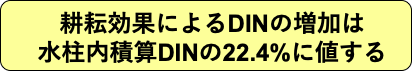
    • The increase in DIN due to the tilling effect is equivalent to 22.4% of the total DIN in the water.

    • In Mutsu Bay, winter vertical mixing began to progress from the first half of September to the latter half of September and November, when the inflow of Tsugaru Warm Current water weakened and the residence time of seawater in the bay increased. In order to increase biological productivity in the bay through seabed tilling, it is necessary for the tilling seawater to stay in the bay for a long period of time and to be supplied to the light layer where phytoplankton can utilize that seawater. Therefore, fall and winter seasons, when seawater is transported vertically and the residence time of seawater in the bay is long, are considered to be the most suitable seasons for tilling.

      Seabed cultivation is a simple method that is relatively inexpensive and can be performed simply and quickly by fishermen.

      It is necessary to examine whether there will be significant adverse effects on the marine ecosystem at the site in the future.

      Future studies are needed to examine the effects of sediment redox environment before and after tilling, and the effects of seabed tilling by bottom trawling on benthic organisms. By clarifying these issues, it is expected that seabed tilling will be established as a more effective tool for protecting the richness of the sea and conducting aquaculture projects under appropriate management.