섹션 개요

    • ーFlow of water
          ・・・
          -Spring bloom and surface mixed layer
          -Water mass classification

      -Organic matter in the ocean
      ・・・


    • Since the vertical movement and mixing of seawater is governed by density differences, the movement of water has been studied from the density differences of water by measuring salinity and water temperature.

      Water masses in a given area and at a given depth have a certain characteristic (unique) range of salinity and temperature. To understand the movement and mixing of water masses, it is fundamental to investigate water temperature and salinity.


    • Scenes from CTD observations on the training ship "Ushio-Maru" (LASBOS Youtube video)

      The CTD instrument measures Conductivity, Temperature, and Depth, so it is called a CTD instrument. There is also an option to simultaneously measure the phytoplankton pigment chlorophyll and oxygen concentration. Along with the CTD, a bottle to sample seawater is sometimes included. The video below shows a CTD-only observation. On the Funka-Bay observation (Ushio-Maru), students do deck work for CTD observations. There are not many research and training vessels where students are at the forefront of deck work.


      CTD observation (video below: 41MB)

      (Observations by the School of Fisheries Sciences, Hokkaido University.)
      Search "Youtube LASBOS hokudai" to view related videos, including this one.
    •  An X-Y plot of seawater temperature (T) and salinity (S) measured along an observation line (vertical or horizontal) is called a T-S diagram.

       Each water mass has its own characteristic plot. This is useful for classifying water masses and studying the movement and mixing of water masses, so let's use the T-S diagram around Japan as an example to understand the characteristics of the subtropical and subarctic and their transition regions in the Northwest Pacific.
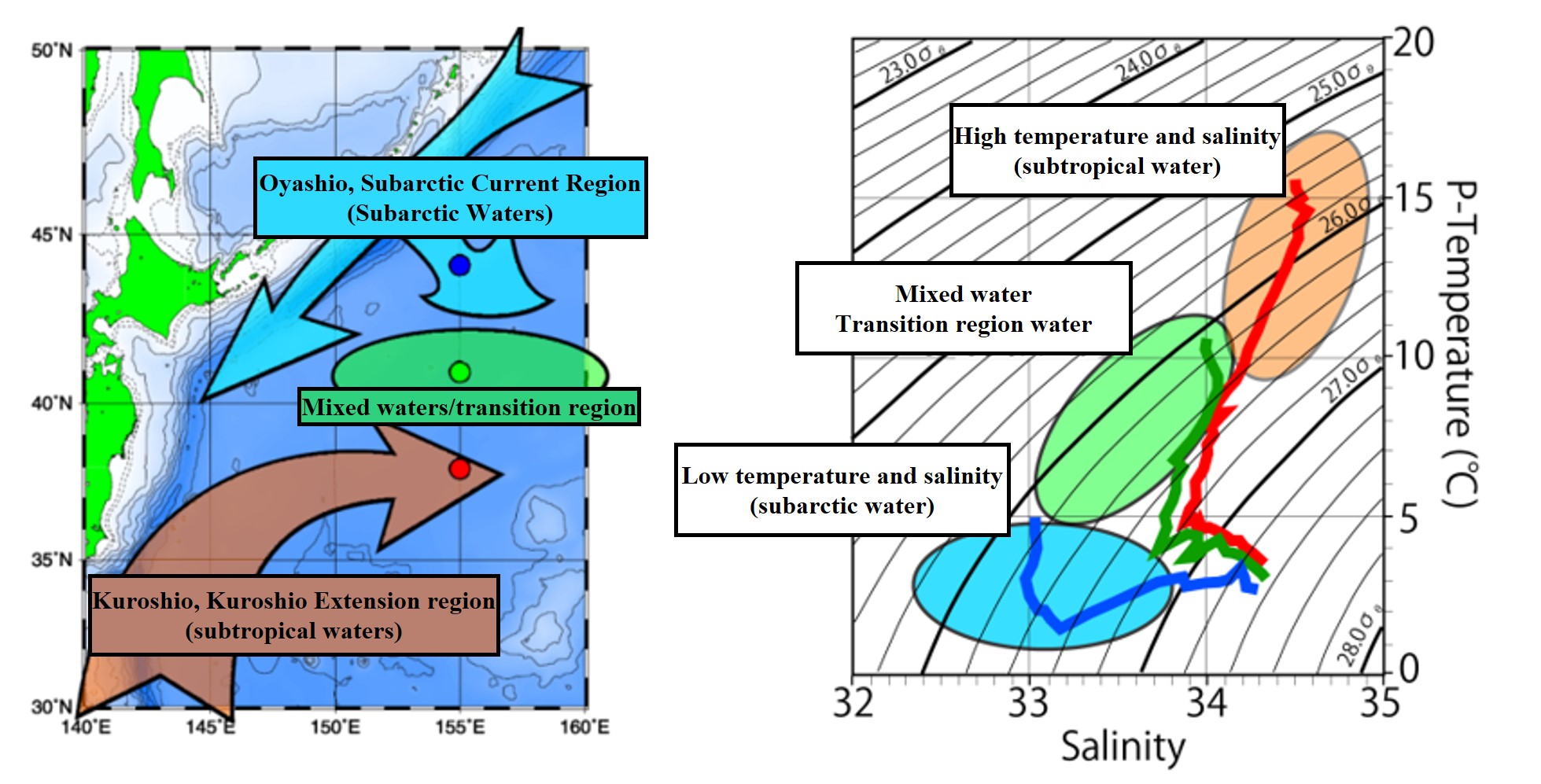
      Figure 1

    • Roughly, a density of less than 26.7σ is considered a surface layer. The surface layer is the combination of the surface mixed layer and the subduction layer. The subtropical has a thick surface layer and the subarctic has a thin surface layer. The subarctic and subtropical of the North Pacific are divided by a salinity of 34.
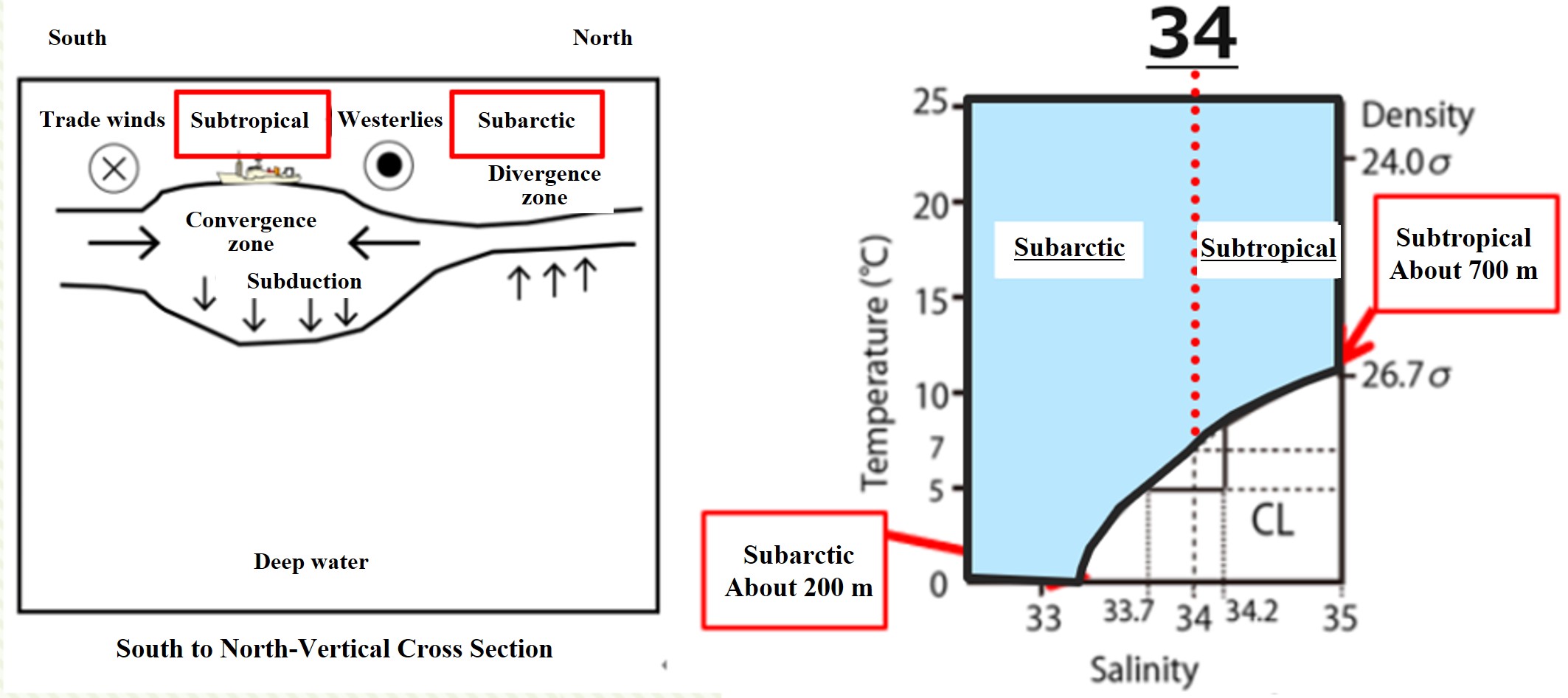
      Figure 2

    • Understand the water temperature and salinity range of the Oyashio and Kuroshio currents transition regions.
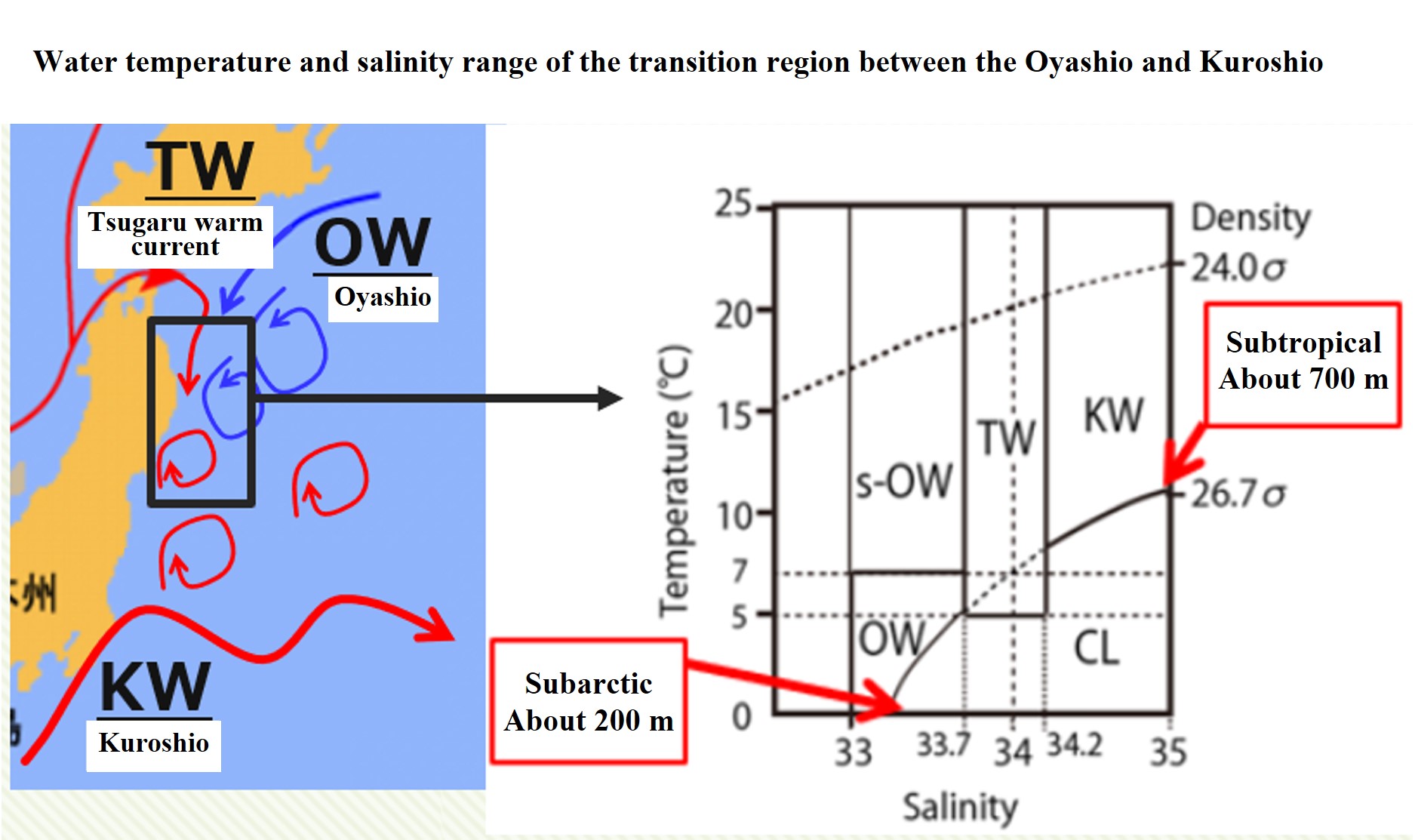
      Figure 3

    • This is a predictability experiment and information provided by the JAMSTEC Application Lab along the coast of Japan.
    • The Japan Coast Guard also provides detailed information on ocean currents and tides.

    • Fisheries resources (e.g., fish) are also distributed according to the distribution of water temperature.
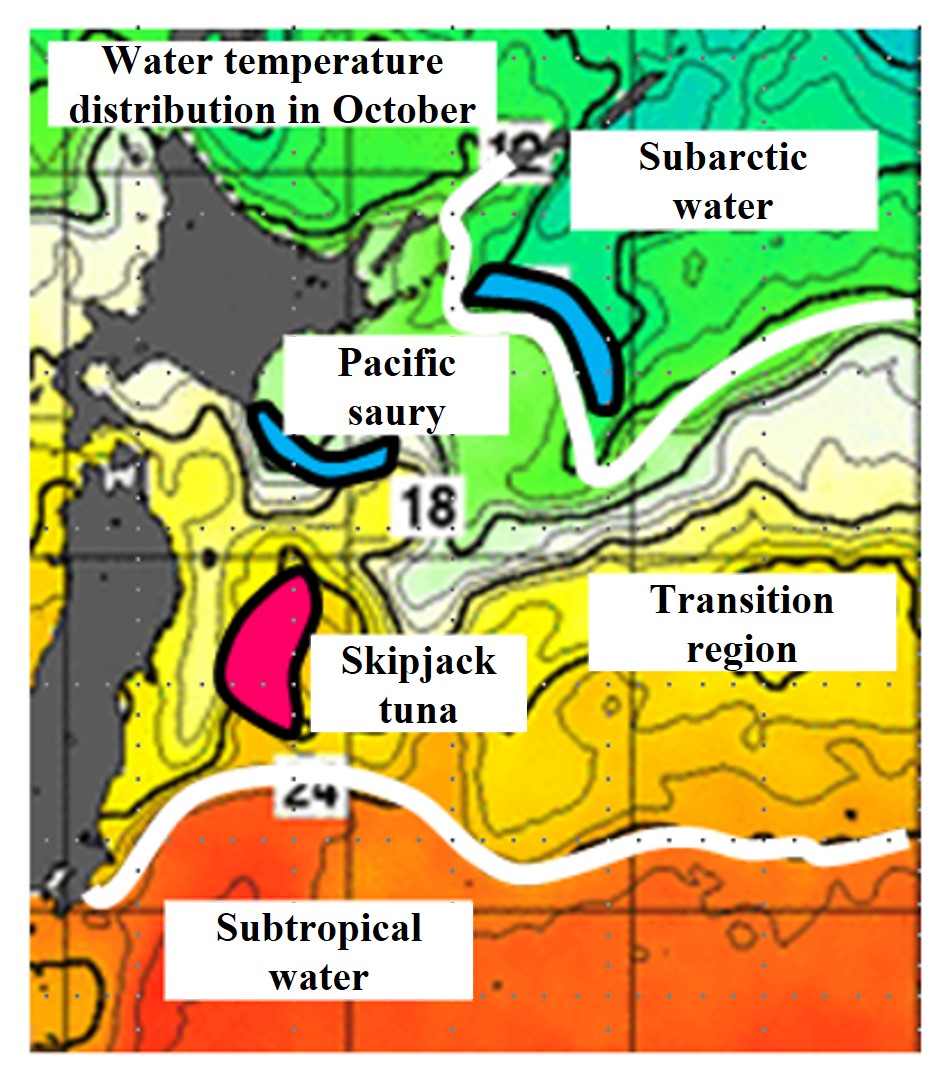
      Figure 4

    •  Oceanographers based on ship observations are desperately trying to get data aboard research vessels. An oceanographer must not be seasick, you might think so. It is indeed easier to observe if one does not get seasick. However, "getting seasick" does not necessarily mean "not suited for oceanography," and "not getting seasick" does not necessarily mean "suited for oceanography". I think that many people have made great achievements in oceanography who suffer from seasickness. Seasickness is hard, and since the samples were taken while nearly dying, the samples and data must be analyzed carefully. If the seasickness is just bearable, I think they will eventually achieve great results. On the other hand, if all the researchers aboard the research vessel were suffering from seasickness, the tension would be lowered. We also need researchers who are as energetic as idiots in rough seas. I have never felt seasick. I cannot give any prescriptive advice for seasickness at all, but I think I must write articles like this one.


       On the other hand, Dr. GAMO of the Atmosphere and Ocean Research Institute of the University of Tokyo (currently professor emeritus) talks about seasickness in his column in his book,「Ocean Science, Toshitaka GAMO (author) NHK BOOKS」from the perspective of a person who gets seasick. After all, he said, "The worst thing you can do is to worry about it. No one dies of seasickness. ~omisshin~ If you are willing to devote yourself to your research with all your might and with all your life, you should be able to forget about seasickness...." This column is a fearful read, but more than that, it tells us that marine research is fascinating.

       I had the pleasure of working with Dr. GAMO on several voyages with the Hakuho-Maru. Dr. GAMO, the voyage leader, participated in almost all of the observations※ and was solely responsible for measuring alkalinity and pH.

      ※Marine observation is a 24-hour operation, and once at an observation location, we work hourly shifts, often in three shifts of 0-4, 4-8, and 8-0 (2 x 4 hours per day). Outside of duty hours, we also do seawater processing for individual studies.

      (OOKI Atsushi)

    •  Flipping through a textbook on ocean physics, many people are bound to be frustrated from the very beginning when they suddenly encounter partial differential equations in fluid mechanics. The author of this reference book (OOKI) is a physics graduate, so when I was an undergraduate student, I solved partial differential equations as a matter of course. However, since it was more than 20 years ago, that feeling seems to have flown away somewhere. I should learn fluid mechanics from scratch again, but I have been skipping it for a long time. I will learn ocean physics from scratch when I decide to make a chapter of "Ocean Physics Starting from Zero" in this course later on.

       Putting myself aside, I urge young people who are the future of oceanography to study ocean physics as well, even if they consider themselves to be biology/chemistry guys.

      The following is within the scope of a general textbook on oceanography.

       For the vertical structure of seawater, water masses, and ocean currents, see "New Ocean Science, by NOZAWA Genemon, Seizando Shoten" published 30 years ago. I wish it would bear the "new" title forever! I will write a review of the differences between this book and the earlier "Old Marine Science?" The book is carefully explained for beginners. You can get used books online. "Almost new" is at a premium price of 6,000 yen (1,500 yen for "good condition")!

       The book I plan to read and learn from now is "Physics of the Ocean, Introduction to Modern Earth Science Series 4, Kyoritsu Shuppan, by HANAWA Kimio". This one has just been published. I am just flipping through it, but the explanations are easy to understand.

       If you want to understand qualitatively how ocean currents work, I recommend "Science of Ocean Currents and Waves, by UNOKI Sanaei, Tokai University Press". I am glad that I thought (...) I understood the ocean currents qualitatively with this book. This book also gave me a chance to know ocean physics a little more deeply. However, this book may not be an introduction to ocean physics, since ocean physics is based on constructing mathematical equations and solving them thoroughly. It would be better if a biologist/chemist reads this book, gets interested in ocean physics, and then gets introduced to ocean physics.

      (OOKI Atsushi)