

Marine Radionuclides (Summary)
Perfilado de sección
-
Many natural radionuclides are soluble in seawater, so here we calculated the abundance of nuclides that are soluble in seawater.
The figure below shows the abundance when the amount of seawater is 1.4 billion km3. Units are PBq (1015 becquerels) or trillions of becquerels. The most common of these is potassium 40 (40K), 1022 becquerels (Bq). Compared to rubidium 87 (87Rb) and uranium 238 (238U), the amount of becquerel is about two orders of magnitude higher. Potassium 40 (40K) weighs about 40 billion tons. Uranium-238 (238U) is about 4 billion tons. It can be imagined that seawater as a whole contains a considerable amount of natural radionuclides.
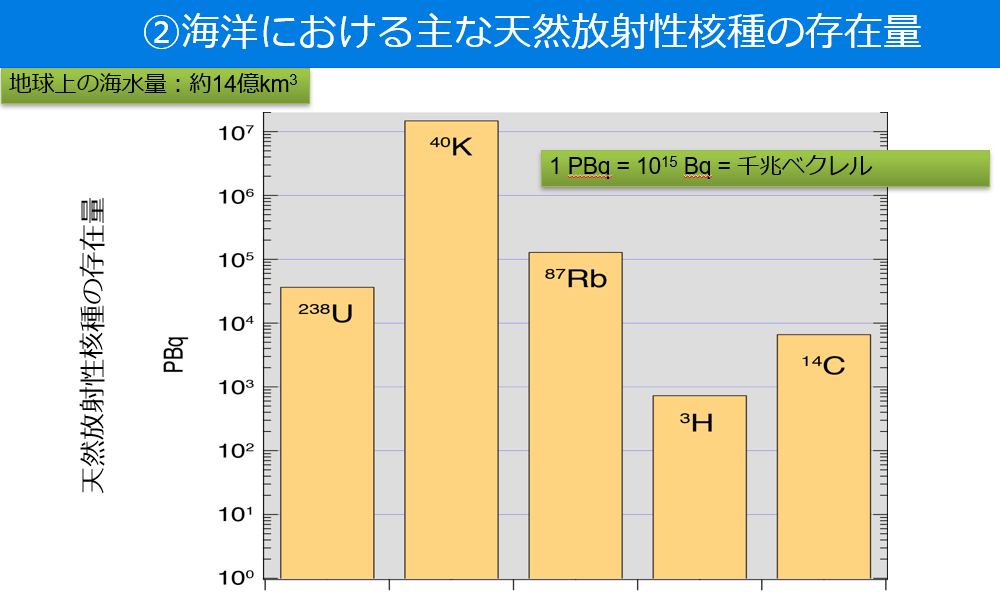
海洋における主な天然放射性核種の存在量
Abundance of major natural radionuclides in the ocean
地球上の海水量:約14億km3
Amount of seawater on Earth: Approximately 1.4 billion km3
天然放射性核種の存在量
Abundance of major natural radionuclides
千兆ベクレル 1e15 Bq
-
-
Finally, we compare natural and artificial radionuclides. In the figure below, natural radionuclides are light brown and artificial radionuclides are pink.
Since tritium (3H) and carbon 14 (14C) have sources from both sources, they were calculated separately.
After all, you can see that the abundance of natural radionuclides is overwhelming. However, tritium (3H) seems to be more artificial. This is because artificial radionuclides released by atmospheric nuclear testing remain. Estimates are for the year 2000 AD, so in 2020 we can calculate that the ratio of natural and artificial will be about half and half. As I mentioned about tritium, tritium (3H) is also produced from nuclear power plants, but it is characterized by the overwhelming amount produced by cosmic rays. As for carbon 14 (14C), the ratio of man-made to natural is about 1%, so if it is used for dating, the error is only a small amount.
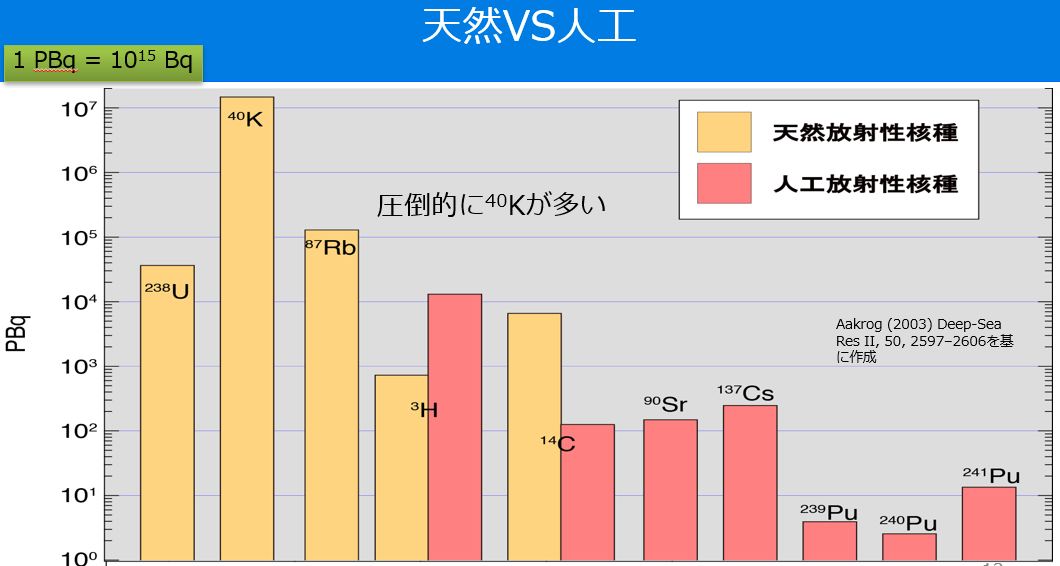
天然VS人口natural vs population 天然放射性核種natural radionuclides 人工放射性核種artificial radionuclides 圧倒的にK40が多いThere are overwhelmingly many K40
-