

Marine radionuclides (natural vs. man-made)
セクションアウトライン
-
-
Finally, we compare natural and artificial radionuclides. In the figure below, natural radionuclides are light brown and artificial radionuclides are pink.
Since tritium (3H) and carbon 14 (14C) have sources from both sources, they were calculated separately.
After all, you can see that the abundance of natural radionuclides is overwhelming. However, tritium (3H) seems to be more artificial. This is because artificial radionuclides released by atmospheric nuclear testing remain. Estimates are for the year 2000 AD, so in 2020 we can calculate that the ratio of natural and artificial will be about half and half. As I mentioned about tritium, tritium (3H) is also produced from nuclear power plants, but it is characterized by the overwhelming amount produced by cosmic rays. As for carbon 14 (14C), the ratio of man-made to natural is about 1%, so if it is used for dating, the error is only a small amount.
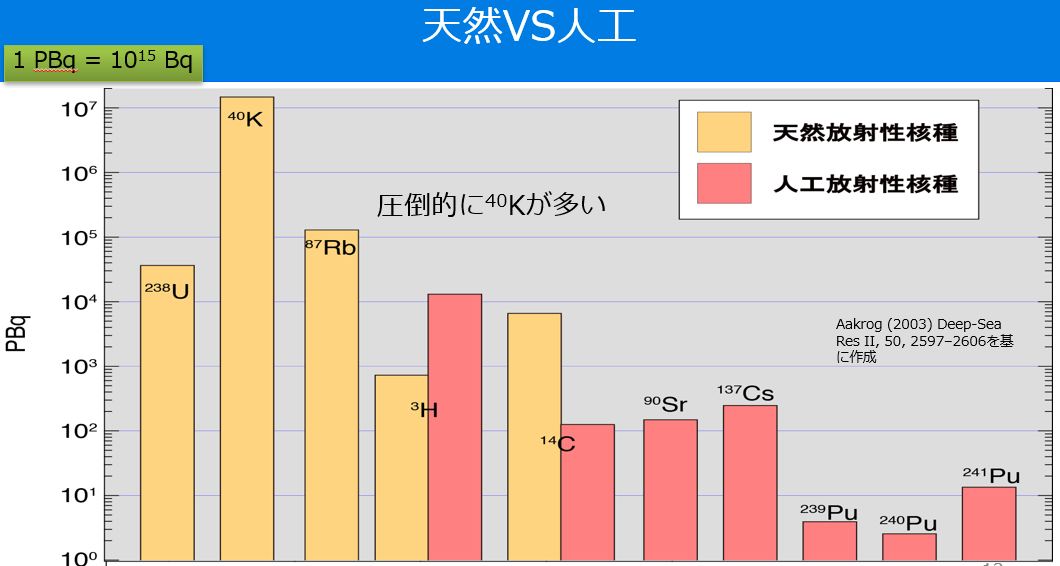
天然VS人口natural vs population 天然放射性核種natural radionuclides 人工放射性核種artificial radionuclides 圧倒的にK40が多いThere are overwhelmingly many K40
-