

Radionuclides of carbon, beryllium, and iodine (Details of cosmic-ray radionuclides)
Section outline
-
-
Carbon makes up about 0.01% of the elements that make up the Earth. It is present in the Earth's surface atmosphere as carbon dioxide at about 0.04%. Carbon-12 (12C) and carbon-13 (13C) are stable without emitting radiation. Carbon-14 (14C) emits radiation and has a half-life of about 5,700 years. Although it is a very small percentage of total carbon, it can be detected by the unique radiation (β-rays) emitted by carbon 14. 14C may also be measured in environmental samples using an accelerator mass spectrometer.
Carbon-14 is used as a dating tool for paintings and archaeological sites. In the case of paintings, the paint is made by extracting it from plants and other sources. There is a certain percentage of carbon 12, 13, and 14 in the paint. The percentages of carbon 12 and 13 do not change, but only carbon 14 decreases over time. As it decreases, the ratio of each isotope changes, and the age can be estimated from the change in the ratio.
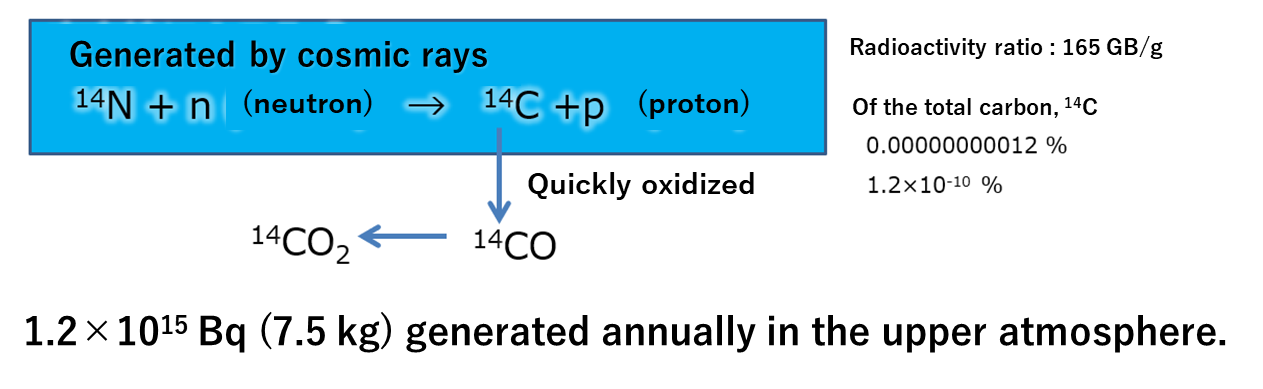
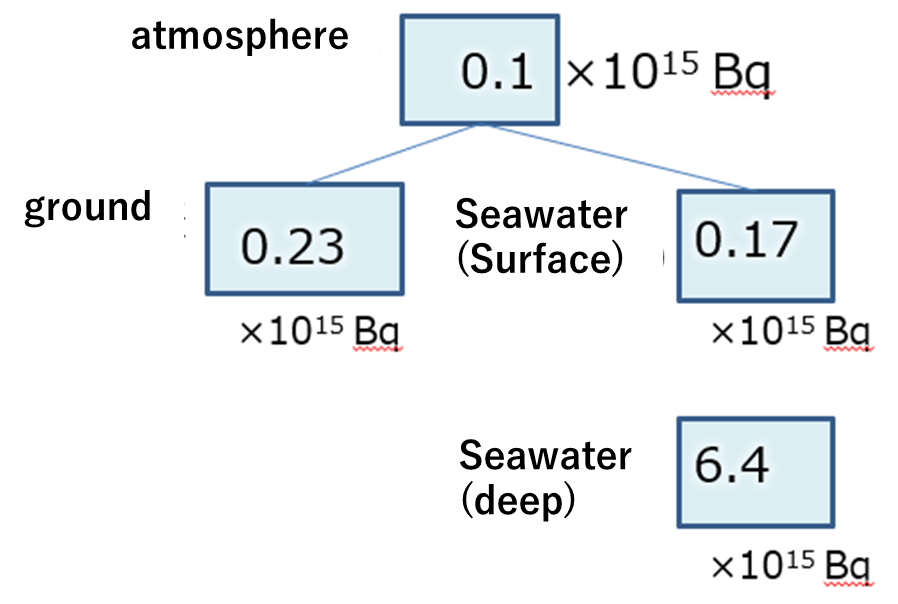
Carbon-14 (14C) produced in the upper atmosphere exists as carbon dioxide. Carbon dioxide in the lower atmosphere is dissolved into the surface ocean water. The picture below summarizes the amount of 14C in the atmosphere, surface seawater, and deep seawater. Since a large amount of carbon dioxide dissolves in seawater, the 14C content in deep seawater, which has the largest volume, is the highest. 14C is only supplied by the atmosphere, so in deep water 14C continues to decrease due to radiative decay. By measuring the ratio of stable carbon to 14C, we can estimate the age (residence time) of the seawater as it sinks and becomes deep water. The 14C ratio in the North Pacific surface layer is smaller than that on land because this older seawater is carried to the surface by upwelling in the North Pacific. 14C age estimates differ by several hundred years. The 14C age estimates for marine organisms grown in this seawater are also said to be off by about 400 years.
-
You can also find an explanation of how to use radiocarbon isotope ratios to estimate the age here.
-
-
-
Beryllium is a very light metal with atomic number 4 (proton number 4). The nuclide with a neutron number of 5 is a stable isotope. Although it is not a familiar element, it is known as the main constituent of emeralds. Beryllium is also known as beryllium-7 (7Be), a radioactive nuclide with a neutron number of 3. Beryllium-7 (7Be) is produced when cosmic rays hit nitrogen and oxygen in the atmosphere and destroy these elements (nuclear spallation reaction). Beryllium-7 (7Be) is characterized by its relatively short half-life of 40 days.
Since beryllium is a metal, when 7Be is produced in the upper atmosphere, it exists attached to other particles. It is then deposited in the oceans with other particles, and is deposited on the seafloor surface while adhering to particles in seawater as well. Since the half-life of 7Be is relatively short (40 days), it is useful to measure the amount of 7Be to investigate the movement (residence time, etc.) of particles in seawater over such a time scale.
For example, 7Be is rarely detected in layers deeper than the surface mixed layer (~50m). By looking at the rate of decrease of 7Be in the surface mixed layer, we can estimate the residence time of particles in the surface mixed layer.

-
-
-
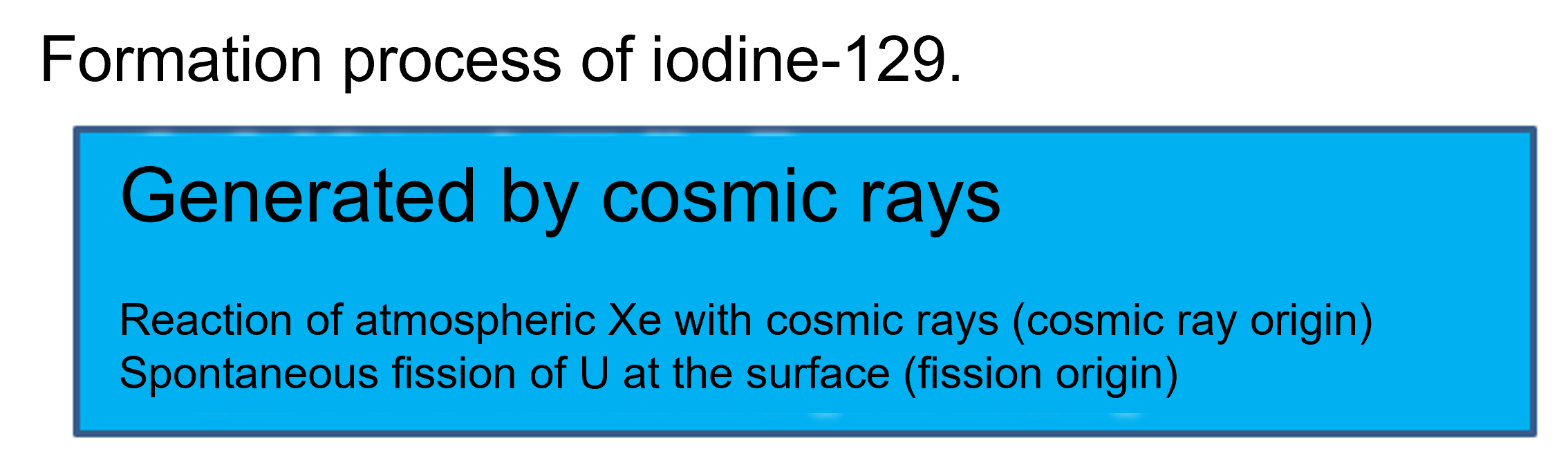
Iodine-129 (129I) is produced when xenon in the atmosphere reacts with cosmic rays. It can also be produced in the earth's crust during the spontaneous fission of natural uranium. It has a half-life of 15.7 million years, which is longer than that of other radioactive iodine, but its low abundance makes it very difficult to measure.
The Fukushima Daiichi Nuclear Power Plant accident released a significant amount of iodine-131, a nuclide with a half-life of 8 days, which is currently undetectable, but attempts are being made to reproduce this behavior using iodine-129 (129I), which also originated from the accident.
-