Section outline


    • This page provides an easy-to-read overview of the class and relevant links.
      For the most up-to-date "Class Plan," "Grading Criteria and Methods," and other information,
      Be sure to check the official syllabus of Hokkaido University.


    • Teacher:  MUNEHARA  Hiroyuki    hm◎fsc.hokudai.ac.jp (Change ◎ to @)


    • Acquire knowledge, concepts and analytical tools (genetic markers) important for studying the ecology of marine biology through the results of research on  northerly  biology.


    •   1.The foundation of ecological research is biota

                     Biogeography, phylogeny, habitat, life history of organisms


              2.  Powerful tools for ecological research --- various genetic markers

                        Molecular phylogeny, mode of inheritance, non-Mendelian inheritance


              3.  Adaptation and evolution of organisms --- research concepts and tools

                       Darwinian era theories of natural selection and adaptive strategies, Natural selection after Darwin


               4.   The deeds of fish that survived in the northern seas  

                       Species and ecological diversity of sculpin, genome evolution of lingcod

    • 1st period: Fish Fauna and Factors of Variation in Northern Japan

      2st period: Biogeographical analysis - distributional stage laws

      3st period: Evolution of the genus greenling - Molecular Phylogeny and Speciation

      4st period: Ecological Evolution of Japanese fluvial sculpin. Bullhead -Mating and Egg Protection

      5st period: Post-mating sexual selection that even Darwin didn't realize -sperm competition

      6st period: Ecology of hybridization - secondary encounters and cloning

      7st Period: Expansion into polar regions - antifreeze protein genes

      8st Period: Drifting of temperate fishes - DNA barcoding

      9st Period: Recent Topics in Cold Fish Research - Ecological research using genetic markers

      Home Study①:Juvenile fish species assessment by morphological observation

      Home Study②:Juvenile fish species assessment using genebanks


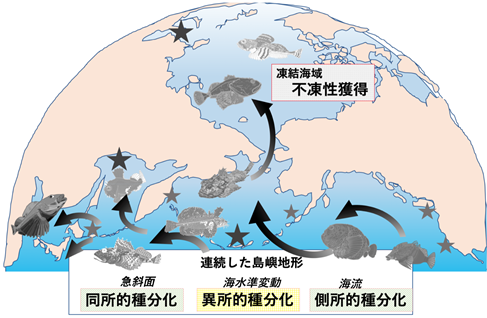
    • 凍結海域:Frozen sea  不凍性獲得:antifreeze acquisition 連続した島嶼地形:Contiguous island landforms

      急斜面:steep slope 海水準変動:sea level change 海流:ocean current 

      同所的種分化:sympatric speciation 異所的種分化:allopatric speciation 側所的種分化:parapatric speciation


    • The North Pacific coast is a landform of islands, metaphorically called the necklace of the earth, through which cold currents flow in a counterclockwise direction. The North Pacific coast is home to a variety of speciation mechanisms that result from geological history and topography, including habitat fragmentation due to sea-level change, the opening of straits to the marginal seas, and environmental gradients based on latitude and depth. Large-scale phylogenetic and gene expression analyses will elucidate the origin and evolutionary processes of North Pacific Rim marine biology.