섹션 개요

    • This page provides an easy-to-read overview of the class and relevant links.
      For the most up-to-date "Class Plan", "Grading Criteria and Methods," and other information,
      be sure to check the official syllabus of Hokkaido University.

    • Teacher

      • MUKAI Tohru (Faculty of Fisheries Sciences)
      • ONISHI Hiroji (Faculty of Fisheries Sciences)
      • HASEGAWA Kohei (Faculty of Fisheries Sciences) 
      • TAKAHASHI Yuki (Faculty of Fisheries Sciences)
      • TOMIYASU Makoto (Faculty of Fisheries Sciences)
      • KASAI Akihide (Faculty of Fisheries Sciences)

    • <<Experimental report writing methods>>
      1. How to use the information processing room.
      2. Basic rules of experimental report writing.
      3. Experimental report writing techniques: numerical and formula formatting and figure and table formats.

      <<Marine acoustics experiments>> 
      1.Lecture on the purpose and methods of the experiment and related topics (lecture)
      2.Measurement of directivity of airborne acoustic transducers (experiment)
      3.Measurement of acoustic target strength of simple shaped objects (experiment)

      Course: Laboratory work on marine resources Ⅰ(Ocean acoustics experiment) 【experimental video】 (hokudai.ac.jp)

      <<Fishing gear engineering experiments>> 
      1.Fish school behavior experiments on fishing gear
      2.Data processing methods for fish school behavior experiments
      3.How to summarize the results and discussion of the fish school behavior experiment
      4.Fishing gear catch characteristics testing
      5.Data processing methods for catch characteristics testing
      6.How to summarize the results and discussion of the catch characteristics testing

      <<Geophysical fluid information processing experiments>> 
      1.Introduction and basic use of free statistical analysis software R (computer practice)
      2.General statistical computing and graphing using R (computer practice)
      3.Filtering time series data using R (computer practice)
      4.Auto- and cross-correlation of time series data using R (computer practice)
      5.Analysis of netCDF data using R (computer practice)

    • Teacher

      • BOWER Jphn Richard (Faculty of Fisheries Sciences)
      • KUDO Hideaki (Faculty of Fisheries Sciences)
      • AKITA Shingo (Faculty of Fisheries Sciences)
      • KASAI Akihide (Faculty of Fisheries Sciences) 
      • ISODA Yutaka (Faculty of Fisheries Sciences)
      • SASAKI Takafumi (Faculty of Fisheries Sciences)

    • Marine environmental science:
      1-1. Freshwater stratification and convection experiments
      1-2. Saltwater stratification and convection experiments
      1-3. Analysis of the vertical distribution of water temperature and salinity in coastal areas
      2-1. Understand the basic concepts of numerical modeling through a simple box model
      2-2. Understand the relationship between "equations describing flow" and "equations describing diffusion," which are fundamental equations describing oceanic phenomena
      2-3. Derive the wave equation from the "equation describing flow" and the diffusion equation from the "equation describing diffusion"
      2-4. Find exact solutions to the wave equation and diffusion equation
      2-5. Learn the basics of difference method (stability, difference scheme, implicit solution method, non-linear treatment) and learn the difference between exact and numerical solutions
      2-6. Learn from mesh division to differencing and programming, using numerical computation of the wave equation as an example.
      2-7. Understand physical phenomena described by the Laplace equation and learn how to solve this equation numerically

      Humans and the ocean
      1-1. To study the classification, morphology, and ecology of aquatic organisms (e.g., salmonids), which are the target species for aquaculture and region-specific resources, by touching actual biological specimens, making measurements, and making observations, etc.
      1-2. To experience and understand the actual situation through video and numerical data on aquaculture and advanced utilization of the above target species.
      2-1. Communicating in English: The basics of clear presentations and writing
      2-2. Practice debates (discussions) on international scientific topics related to marine resource science (whaling, DDT contamination, nuclear power, genetically engineered foods, etc.)
      3-1. Conduct basic analysis on fishery management structure using fishery census and discuss the results
      3-2. Conduct basic analysis on fishery production structure using annual report of fishery and aquaculture production statistics, etc., and discuss the results

    • Teacher

      • YAMAMOTO Jun (Field Science Center for Northern Biosphere (Hakodate))
      • MIYASHITA Kazushi (Field Science Center for Northern Biosphere (Hakodate))
      • UENO Hiromichi (Faculty of Fisheries Sciences)
      • YASUMA Hiroki (Faculty of Fisheries Sciences)
      • TAKAGI Tsutomu (Faculty of Fisheries Sciences)
      • TAKAHASHI Yuki (Faculty of Fisheries Sciences)
      • MINAMI Kenji (Field Science Center for Northern Biosphere (Hakodate))
      • ABE Hiroto (Faculty of Fisheries Sciences)
      • KASAI Akihide (Faculty of Fisheries Sciences)
      • KOMEYAMA Kazuyoshi (Faculty of Fisheries Sciences)

    • [Behavioral ecology experiments]

      1. Basic experiments on biotelemetry and biologging technologies

      2. 3D measurement experiment using a stereo camera


      [Satellite data analysis - microwave remote sensing]

      1. Examine the values and formats contained in satellite microwave remote sensing data, such as sea surface temperature, sea surface altitude, and sea surface winds

      2. How to use software to process, analyze, and visualize satellite microwave remote sensing data

      3. After conducting multi-sensor data analysis and plotting the figures, the participants will discuss the physical phenomena seen at the sea surface


      [Ocean observation data analysis]

      1. How to calculate basic parameters of the physical marine environment, such as potential water temperature and density

      2. How to use software for processing, analyzing, and visualizing ocean observation data

      3. Create diagrams necessary for understanding the physical oceanographic environment, such as temperature-salinity cross sections and TS diagrams, from oceanographic observation data, and discuss spatio-temporal variations in the physical oceanographic environment


      [Fish swimming dynamics]

      1. Swimming motion is quantitatively evaluated from the acquired images by taking video of the swimming state using a circular flow tank.

      2. Analysis of the relationship between the propulsive mobility of fish and parameters related to swimming motion


      [Experiments on behavior measurement by image processing]

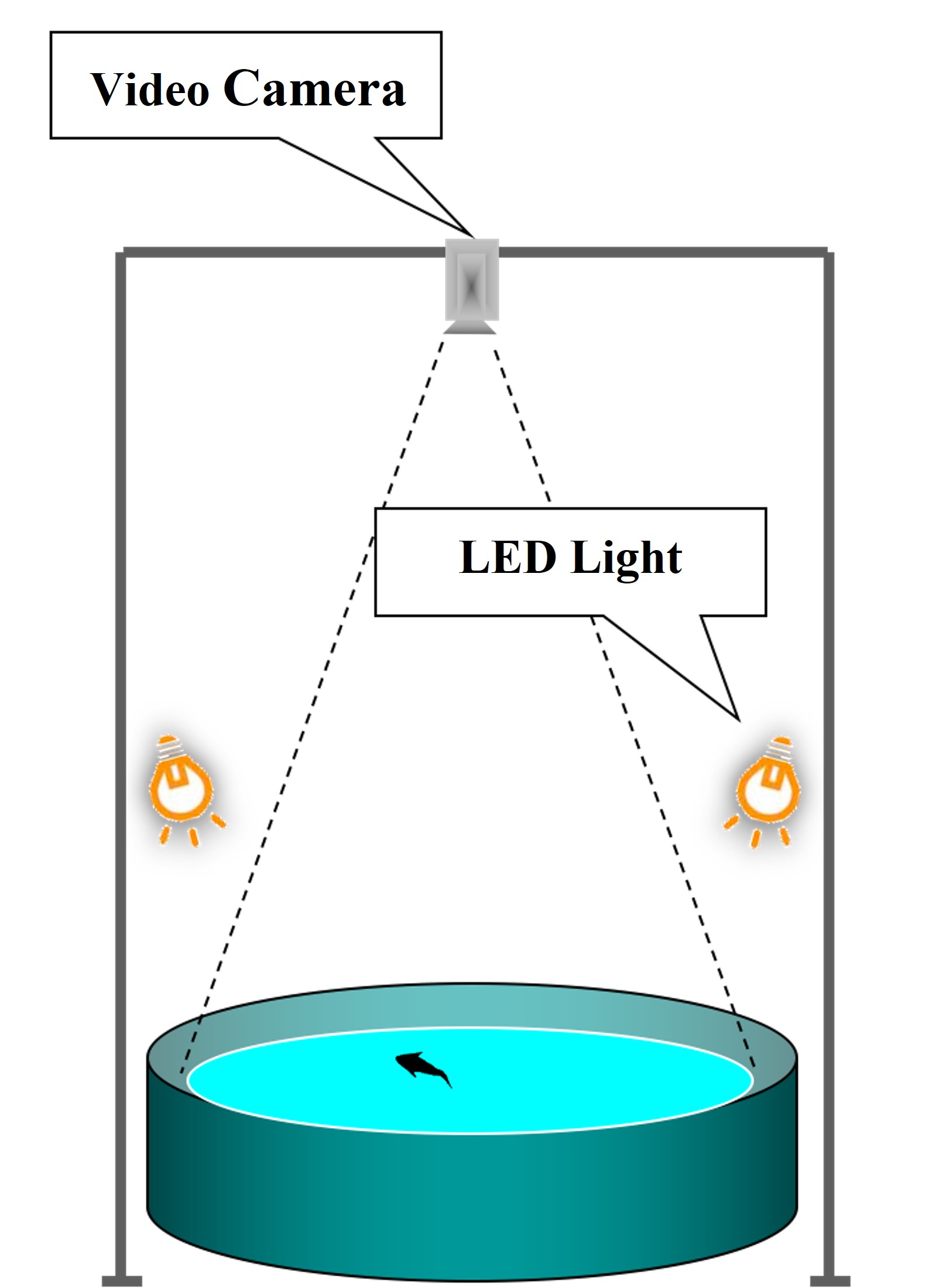
      1. Take pictures of the fish swimming freely in the experimental tank

      2. Automatic detection of fish positions and visualization of movement trajectories through image processing

      3. Consider the impact of frame rate, threshold, and color space selection on the results.


      [Fisheries and ocean engineering]

      1. Fundamentals of fluid mechanics and floating body kinematics

      2. Measurement and data analysis of the motion of a floating body using a large water tank

      3. Measurement and data analysis of fluid forces acting on an object by a circulating water tank


      [Fisheries information engineering, numerical fluid analysis]

      1. Fundamentals of numerical fluid analysis

      2. Model design by CAD

      3. Numerical fluid analysis

    • Behavior measurement using image processing【Instructor: YONEYAMA】

      Among the many methods of behavior measurement, this course focuses on behavior measurement using image processing, which is non-contact and non-intrusive to the target fish, and teaches how to detect and track the position of fish (moving objects) by performing image processing of video and image data.
      図

      The position of fish can be detected and traced for each frame of video using image processing to automatically plot their movement trajectory. Analysis of the movement trajectory enables the user to determine swimming speed, curvature, distance from the tank wall, etc., and to understand behavior patterns.


    • Ocean observation data analysisInstructor UENO

      The Oshoro-Maru, a training ship attached to the Faculty of Fisheries, has conducted numerous oceanographic observations. Among them, the observation of the 155°E north-south line has been conducted continuously since the 1980s, and its data is very valuable for understanding long-term changes in the ocean area east of Honshu. In this experiment, using the Oshoro Maru 155°E observation as an example, you will learn how to analyze data to investigate spatio-temporal variations in the interior of the ocean from ocean observation data.

      Translated with DeepL

      Example of data obtained from the Oshoro Maru oceanographic observation in May 2006


    • Fisheries information engineering, numerical fluid analysis【Instructor YASUMA・TAKAHASHI】

      〜Visualization of flow fields occurring in a breeding tank

      In aquaculture production, it is known that mass die-offs can occur depending on the setting of water flow, since the swimming ability of fish when they are juveniles is poor and easily affected by the flow field in the tank. In this experiment, the flow in the aquaculture tank, which cannot be confirmed visually, will be analyzed using CFD (Computational Fluild Dynamics) analysis and visualization experiments.

      Flow visualization experiment on a breeding tank model

      Simulation of flow field in a breeding tank model by CFD analysis