
Otter trawl configuration
섹션 개요
-
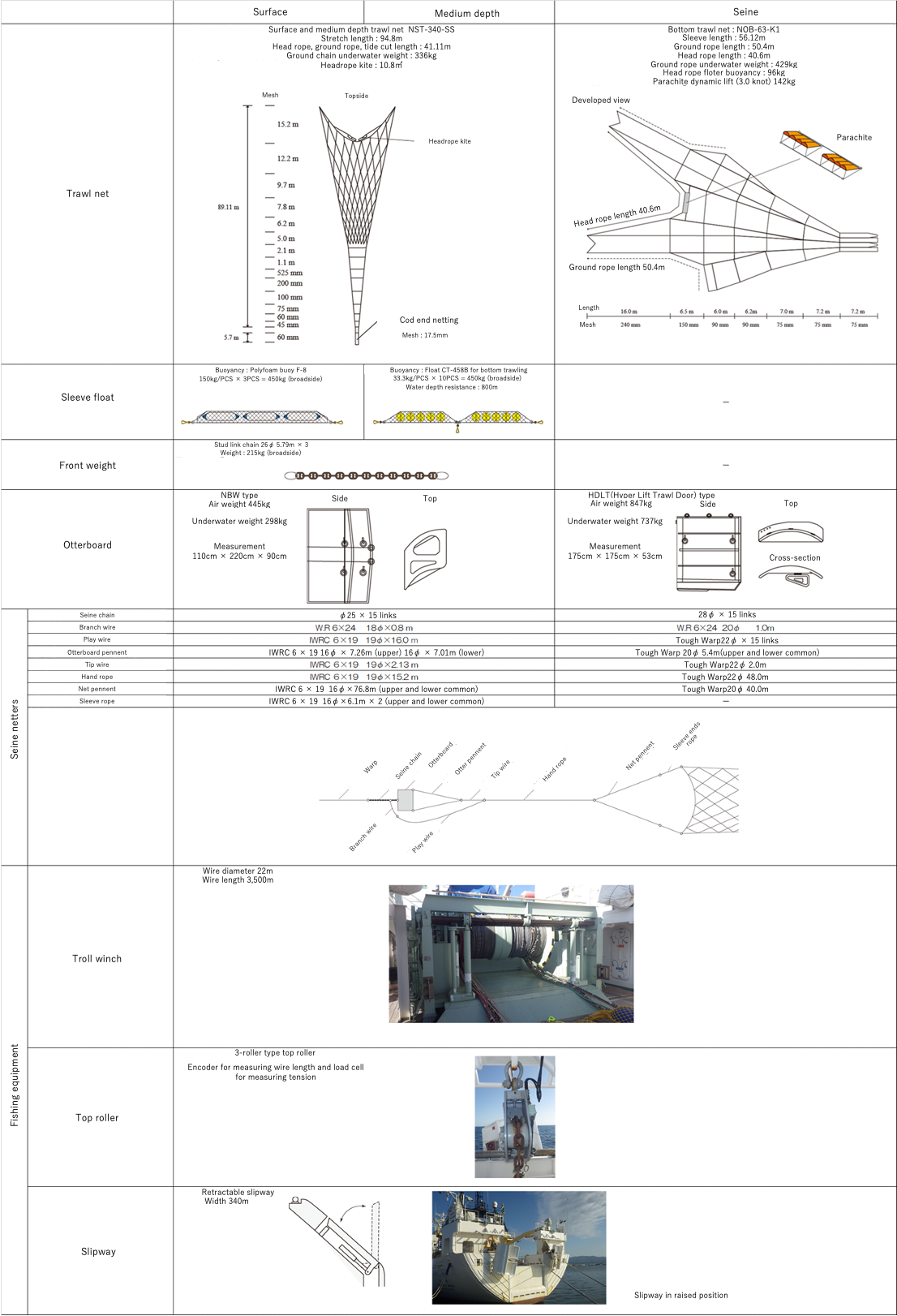
An otter trawl consists of a trawl net, an otter board, and wire ropes for towing them. Table 1 shows the configuration of the otter trawl for surface and bottom towing equipped on Oshoro-Maru. There is no major difference in the components of the trawl lines between surface and bottom trawls, but the lengths of the trawl lines are adjusted according to the different shapes of the trawl nets. In addition, wire ropes that are more difficult to break are used for trawls for bottom landing, as they are prone to high tension due to obstacles on the seafloor. A tip-sleeve rope is connected to the end of the sleeve net of the surface and mid-water trawl, and A float or weight is attached to it so that the opening of the net can be expanded vertically.
A trawl net consists of a "bag net," which is the main body of the net, and a "sleeve net," which is deployed from side to side in front of the net opening to drive nektons into the net. A float or kite (a structure that receives water currents and generates buoyancy) is built into the top (head rope) of the net mouth, and a metal chain is built into the bottom (ground rope) of the net mouth to serve as a weight, thereby expanding the net mouth in the vertical direction and increasing collection efficiency. The mesh of a bag net becomes finer from the net mouth to the tail, with the tail having an area for storing the catch. The tail section is called the cod-end, and when the size of the target species is small or there is a possibility that it may escape through the mesh, a bag of finer mesh mesh is inserted inside the cod-end. Insert a bag of finer minnow nets inside the cod-end.
The otter board is a sturdy metal plate with a curved cross-section, to which metal fittings are attached to connect the towline. The shape of the net is designed to take advantage of water resistance so that the distance between the left and right otter boards is open to enhance the net's unfolding action.-
Table 1 Composition of Otter Trolls
-