
Organisms with swimming ability (Nekton)
單元大綱
-
Nektons are the organisms that have the ability to swim and live freely in the water, including many fish, cephalopod squids, and marine mammals such as dolphins and whales. These nektons are collected by quantitative sampling tools developed for research and surveys as well as by commercial fishing gear and fishing methods.
-
【Research and study collection tools】
For quantitative collection of small swimming organisms such as juveniles, a collection device similar to a plankton net is used. Nektons are distributed sparsely or patchily in the sea, so they are collected by filtering a large amount of seawater. For this reason, swimmers are collected using nets with large mesh openings and good water drainage (filtration efficiency). The mesh size is larger than that of plankton nets, and the nets are strong enough to be towed as fast as possible in order to collect organisms with high swimming ability. Typical examples are fry nets (Fig. 4) and MOHT (Fig. 5).

Fig.4 Fry net
吊りロープ: wing pendant リング: net mouth ring (diameter 130 cm) モジ網: minnow net (mesh size: 2 mm) ナイロンメッシュ: nylon mesh
曳網索: towing rope ブライドル: bridle
A surface horizontal tow net for collecting larvae and juveniles. The net is placed near the surface of the water on the broadside and towed horizontally with the vessel running. A coarse mesh minnow net is used at the front of the net to reduce reduction of the efficiency of water filtration due to clogging. When towing at night, the vessel's lights are turned off to prevent the light from attracting organisms.
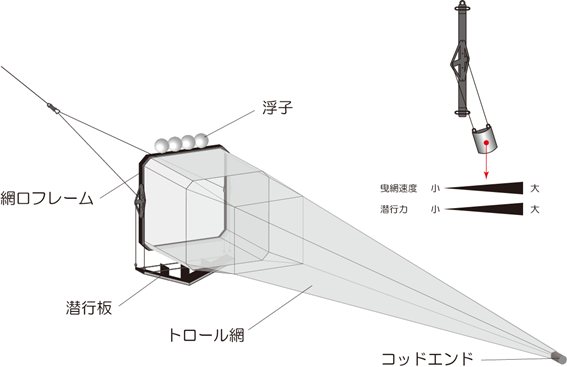
Fig. 5 MOHT
浮子: float 網口フレーム: gape frame
潜行板: depressor トロール網: trawl net コッドエンド: cod-end
曳網速度: Trawling speed 潜行力: Diving force
A type of frame trawl. It is used for quantitative collection of small fish and large plankton such as krill. It is equipped with a special depressor that changes its diving force in response to changes in towing speed, and has excellent depth stability during towing.
-
【Fishing gear and method】
Fishery methods, which are conventionally used, are sometimes chosen as the method to collect marine biological samples. Fisheries methods, which are commercially efficient and large-volume sampling of marine organisms, are an effective means of surveying large numbers of individual organisms or estimating the amount of living marine resources. There are various kinds of fishing gears and methods, not only gill nets, purse seines, set nets, and other net fishing gears, but also angling such as longlines and fishing rods, harpooning, and hooks used to pull fish off rocks.

Fig. 6 Examples of fishing gear and method
立て縄: flag line 延縄: longline 流し網: drift net オッタートロール: otter trawl
Link to ocean observation method "otter trawl"
-