

3.Methods of measuring particle size distribution
섹션 개요
-
-
3-1.Andresen pipette method
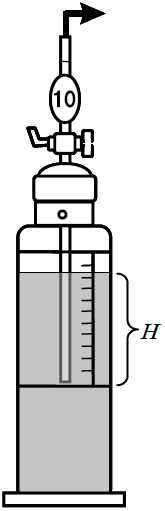
The particle sizing operation using an Andresen pipette (see right) is very simple as follows.
1)Add a predetermined amount of liquid and powder to an Andresen pipette, stir well and allow to stand.
2)Sample liquid is collected at predetermined times with a pipette attached to the top and the concentration of solids is measured.
3)Usually, the concentration is determined by measuring the mass of solids remaining in the dried sample solution.
The mass of solids in the sample solution decreases with time. The reduced mass is equal to the mass of the group of particles with a settling velocity that can pass from the liquid surface to the pipette tip (distance H) during the time between standing still and taking the sample (time t).Therefore, the solid concentration C of the sample solution collected at time t divided by the initial concentration C0 corresponds to the proportion of the particle population with a terminal velocity slower than H/t (pass rate), and a pass rate curve can be drawn by converting the collection time into particle size using the Stokes formula (Equation 2-2).
-
3-2.sedimentation balance method
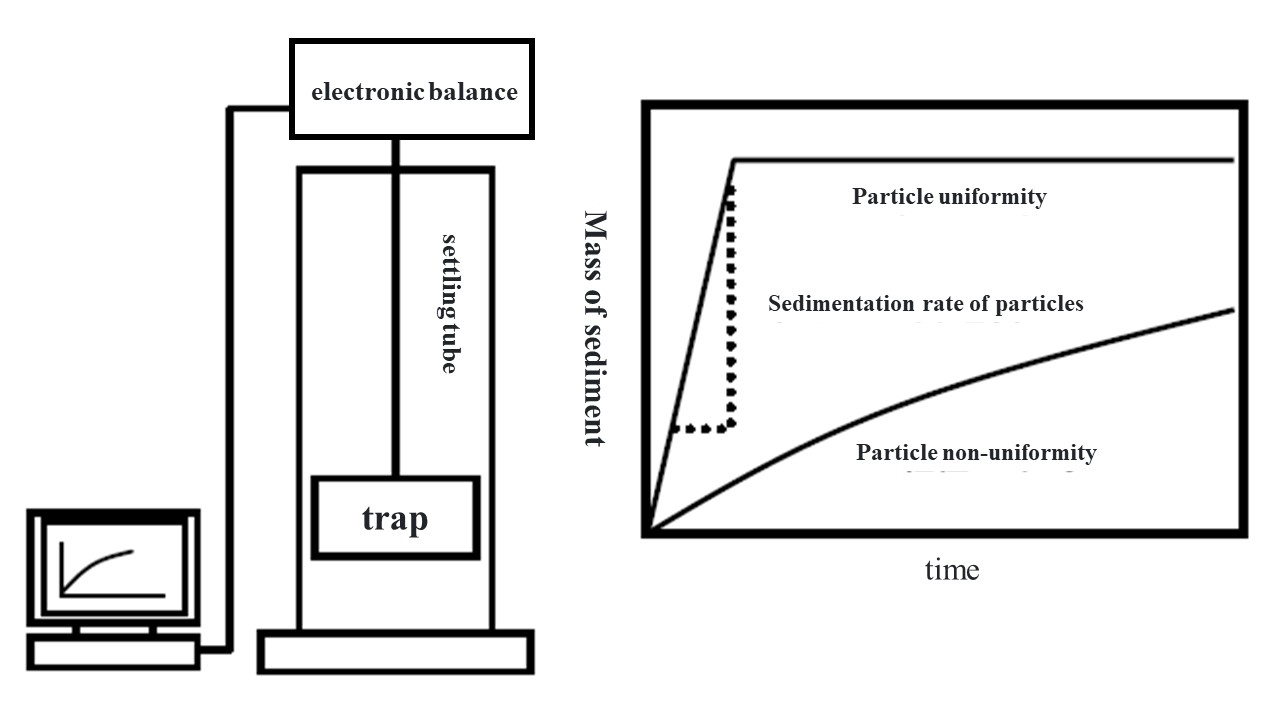
If a well-stirred suspension is placed in the settling tube shown on the bottom left and the change over time in the mass of solids deposited in the trap is measured, a graph (settling curve) like that shown on the bottom right can be obtained. If the grain size is uniform, the mass increases linearly; if it is non-uniform, it is non-linear. If the deposited weight at time t is Wt and the weight when the weight no longer changes is Wf, the residual rate R is
 (3-1)
(3-1)Differentiating Equation 3-1 with respect to t yields
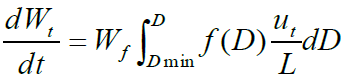 (3-2)
(3-2)From Equations 3-1 and 3-2, it follows that
 (3-3)
(3-3)Once the density of the particles and the density and viscosity of the fluid are known, time can be converted to particle size by the Stokes equation. On the other hand, since the intercept of the tangent to the sedimentation curve is equal to the residual fraction R, from this result a residual fraction curve can be drawn.
電子天秤electronic balance 沈降管settling tube 堆積物の質量Mass of sediment 粒子が均一Particle uniformity 粒子の沈降速度Sedimentation rate of particles 粒子が不均一Particle non-uniformity 時間time