

earth's oxygen
セクションアウトライン
-
-
I explained that climate change is "the history of the carbon cycle." In contrast, the evolution of life can be described as the "history of oxygen circulation." Generally, the ``earth's oxygen cycle'' does not attract attention, but it is more fun to think about it in conjunction with the carbon cycle. Let me introduce some findings about Earth's oxygen in comparison to carbon.
The major difference between oxygen and carbon is their abundance on Earth. Among the elements that make up the earth, oxygen (30%) is second only to iron (32%). Most oxygen exists in the Earth's crust and mantle as SiO2 and MgO (Morgan, PNAS, 1980). By the way, most of the iron exists in the core, and also exists as iron oxide in the crust and mantle.
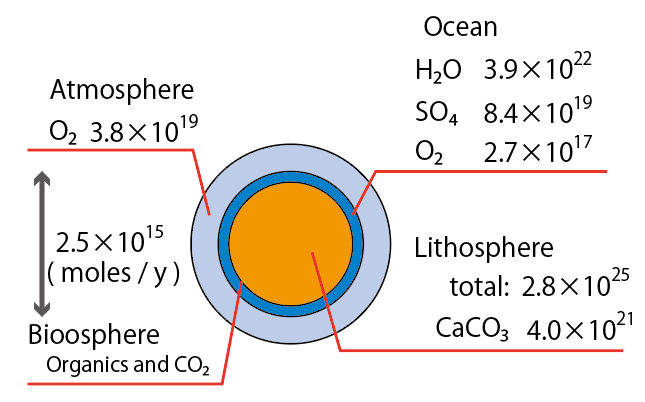
The original figure was created using data from Garrels, et al., Controls of Atmospheric O2 and CO2: Past, Present, and Future, American Scientist, 64, 306-315 (1976). Regarding the amount of oxygen on Earth, this data is taken from an earth and planetary science textbook. The amount of oxygen in seawater was calculated assuming the average oxygen concentration of seawater as 0.2 mmol/kg.
-