Perfilado de sección

    •  

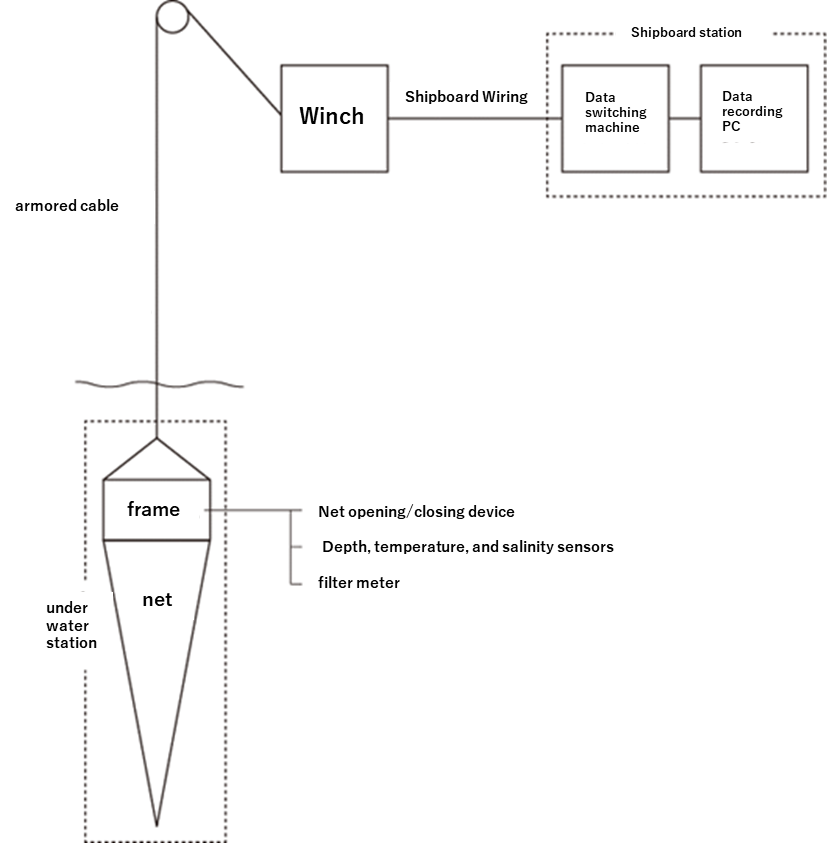
      The VMPS system configuration is shown in Figure 2 and consists of an "underwater station" that moves in the sea to collect plankton, a "shipboard station" that supplies power to the underwater station and transmits and receives electrical signals, and cables that electrically connect the two stations.


       The "armored cable" used to raise and lower the underwater station in the sea is a special coaxial cable covered with steel wire on the outside, and is the same as that used for the CTD water sampling system. The armored cable is wound around a special winch for several thousand meters. Measurements sent from the underwater station through the cable are displayed in real time on a monitor at the onboard station. Trigger signals to open and close the net are also sent from the onboard station to the underwater bureau via the armored cable.


    • 図2 VMPS System Configuration Chart


    • (1)-1 underwater bureau 

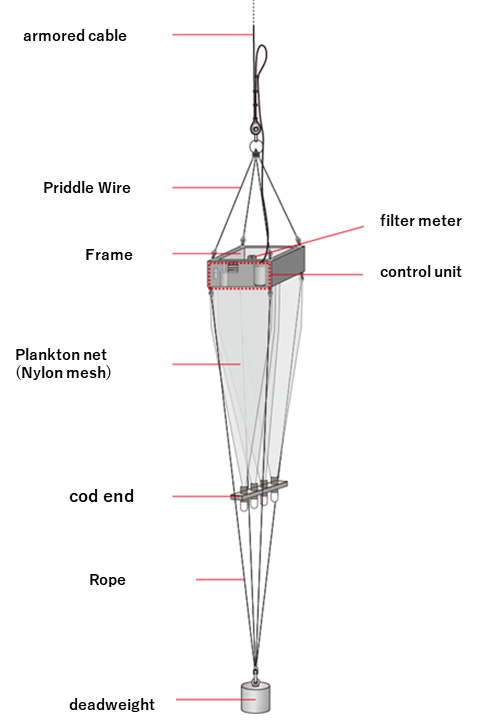
       Details of the underwater station are shown in Figure 3. The underwater station consists of multiple plankton nets made of nylon mesh netting sewn together and a rectangular metal frame that secures the net opening. The frame incorporates a control unit for the underwater bureau, an underwater sensor that measures depth, temperature, and salinity at the site, and a filter water meter.


       The underwater station is towed by four wire ropes (bridle wires) connected to the top of the frame. A weight is suspended from the rope (force rope) connected to the underside of the frame to submerge the underwater station. The bottom of the net (cod-end) is bound with a jig and then fastened to the power rope. This prevents the net from twisting or blowing up and keeps the net in proper shape during towing. The net can be easily detached from the frame and replaced with a net of the appropriate mesh size for the purpose of the survey.


    • 3 Composition of Underwater bureau

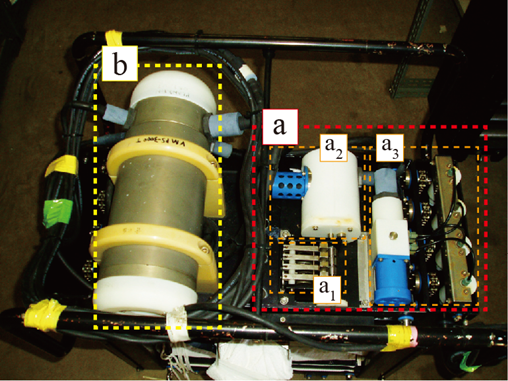
    •  A photograph of the control unit of an underwater station is shown in Figure 4. The control unit consists of a mechanism that opens and closes the net (Figure 4-a: Net Open/Close Device) and a metal pressure-resistant container (Figure 4-b: Underwater Chamber) that contains various control boards and power supply units. The "net opening/closing device" consists of a trigger to open and close the net (Figure 4-a1: Trigger), a motor to operate the trigger (Figure 4-a2: Motor for Trigger), and a sensor to detect when the net is opened or closed normally in the water (Figure 4-a3: Net opening/closing detection sensor). The "underwater chamber" controls the "net open/close device" according to the net open/close signals sent from the onboard station, and converts the outputs received from various underwater sensors (depth, water temperature, salinity, and filtrate) into electrical signals and transmits them to the onboard station.


    • VMPS 水中局の制御装置

      4 Underwater station control equipment

                           a) Net opening/closing device a1) Trigger a2) Motor for trigger a3) Net opening/closing detection sensor


                                                                                                 b) Underwater chamber


    • (1)-2 Shipboard Stations 


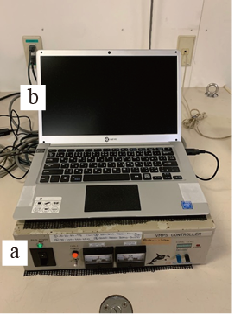
       The VMPS onboard station is shown in Figure 5. The onboard station consists of a "data converter" (hereinafter referred to as "converter") and a "data recording PC" (hereinafter referred to as "PC"). The transducer supplies power to the station and mediates the exchange of signals between the PC and the station (VMPS main unit), while the dedicated software installed on the PC is used to transmit net open/close signals and record and display measurement data. Normally, the onboard station, which is installed in a laboratory on board the ship, is connected to the underwater station via armored cables and inboard wiring as shown in the system configuration diagram in Figure 2.

    • VMPS 船上局

      5 VMPS Shipboard station

      a) Data converter b) Data recording PC

      Photo courtesy of Dr. YAGUCHI Atushi (Faculty of Fisheries Science, Hokkaido University)