Muscle of Aurelia aurita
章节大纲
-
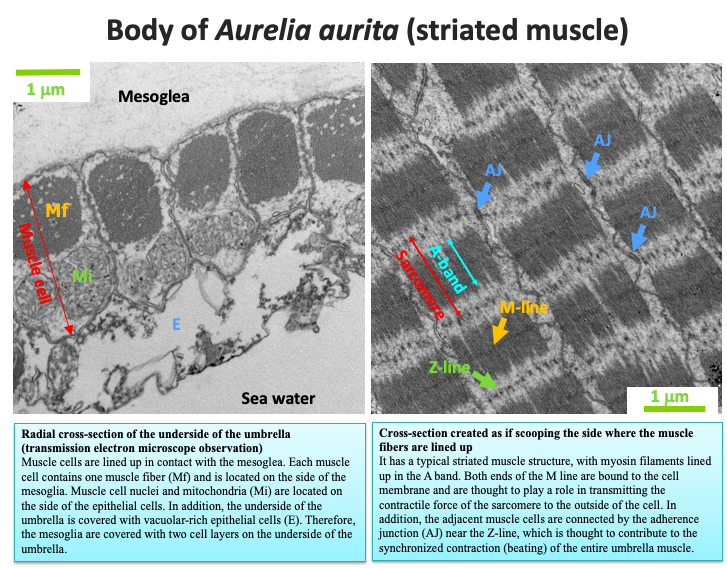
The beating of a jellyfish umbrella is caused by the contraction and relaxation of the muscles in the epithelium behind the umbrella. There are fibers of striated muscle on the back of Aurelia aurita umbrella that run concentrically. When they contract, the umbrella becomes deflated, and when they relax, the elasticity of the thick mesoglia above the umbrella restores them to the original open shape. Jellyfish can swim in the water by repeating this action. Aurelia aurita at the ephyra larval stage has radial muscles, which run radially, in addition to the concentric circular muscles, but the radial muscles degenerate as they grow. On the other hand, the radial muscles remain even after maturity in Cyanea capillata. The beating cycle becomes longer (slower) as it grows, and it changes depending on the water temperature. With individual differences in the beating cycle, those jellyfish beating the umbrella vigorously grow well because their tentacles on the edge of the umbrella flutter well with each beat, collecting and eating a lot of food.
Each muscle fiber is contained in a muscle cell. Muscle fibers contain actin filaments and myosin filaments, and myosin, the main protein component of the myosin filaments, binds to the actin filaments, pulling them, as it decomposes ATP. Then, the actin and myosin filaments slide against each other, causing the muscle fibers to contract. The striated muscle of A. aurita has a striated structure similar to the striated muscle of the Bilateralia, despite some different characteristics. One of the differences is that the length of its sarcomere, which is a repeating unit of striated muscle, is shorter (1.5 micrometers) than those of many Bilateralia (2.5 micrometers). Comparing the case in which muscle fibers of the same length are composed, there are those with many short sarcomeres, while there are a small number of long sarcomeres, and the shorter sarcomere muscle fibers have a higher overall shortening rate even if the actin and myosin filaments slide at the same rate. In other words, the striated muscle of Aurelia aurita is thought to have a mechanism that allows the entire muscle to contract quickly, even if the actin and myosin filaments slide at a low speed. Another characteristic is the Z‐line morphology, which looks very dark in the Bilateralia when viewed under an electron microscope. However, it gives the impression of discontinuity and fragility in jellyfish.
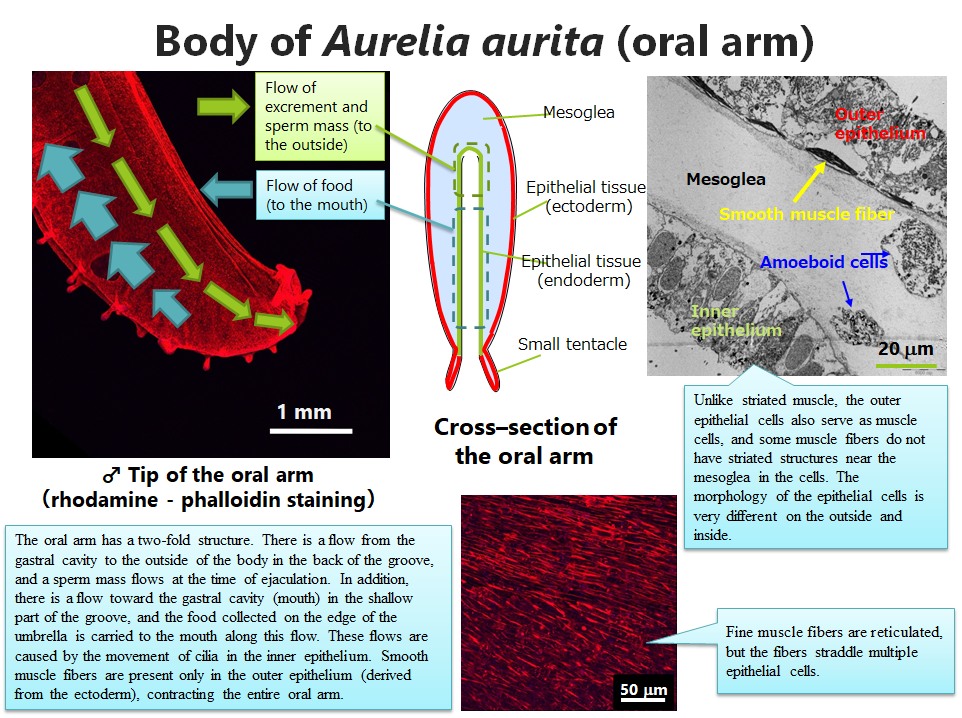
On the other hand, the tentacles and oral arms have smooth muscles. The oral arms are folded in half, and food, excrement, eggs, sperm, and inedible objects caught by mistake move on the inner side. These take different routes: sperm are sent from the testes to the tip of the oral arm through the innermost part of the double-folded groove and released into the sea, while the eggs exit the ditch near the mouth. These are caused by the movement of the cilia in the inner epithelium. The inner and outer epithelia are quite different in their cell morphology, and smooth muscle fibers are located in the outer epithelial cells. This is very different from the striated muscle, which has separate epithelial cells and muscle cells. Smooth muscle fibers appear to be reticulated and connected together throughout the oral arm, but are actually divided into individual epithelial cells.