The body of Aurelia aurita
セクションアウトライン
-
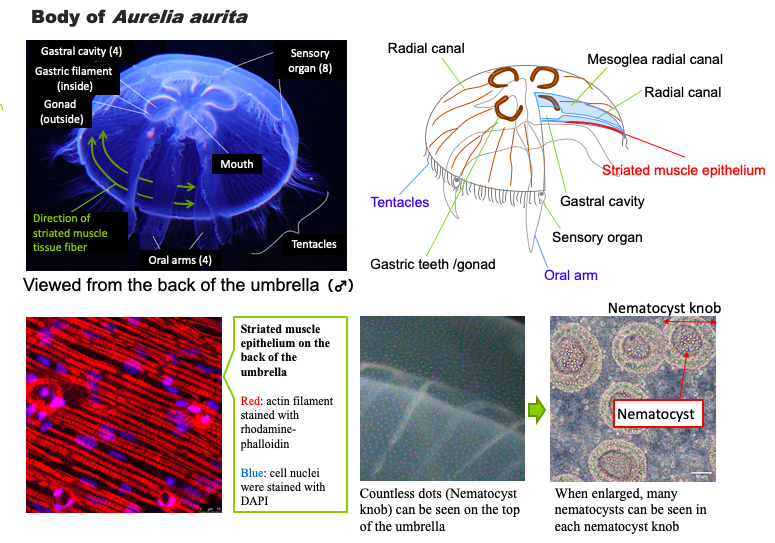
The digested and liquefied food is carried throughout the body via radial canals that radiate from the gastral cavity. The radial canals not only act as a nutrient absorbing organ like the intestinal tract, but also circulate nutrients throughout the body like blood vessels. However, they are not the equivalent of the heart, and the flow of fluid in the radial canals is caused by the movement of the cilia that grow inside. While the flow direction in some radial canals is from the gastral cavity to the edge of the umbrella, others have the flow from the edge of the umbrella back to the gastral cavity. The fluid that returns to the gastral cavity is thought to contain waste products and undigested and unabsorbed food, but these (excrement) are released again into the sea through the oral arms. In the oral arms, the route through which food passes is different from the route through which excrement passes.
The majority of the body of Aurelia aurita is comprised of collagen gel (mesoglia) that is rich in water (95%). Amoeboid cells are sparsely present in the mesoglia, which appear to be responsible for biological defense, gel repair, and nutrient transport. The surface of the mesoglia is covered with one or two thin layers of cells, in which major vital functions, such as the nerves and muscles, digestion and absorption, and germ cell formation, are concentrated.
There are tentacles on the edge of the umbrella to catch food, and the surface of the tentacles is lined with “nematocysts,” which are capsules containing poisonous stings. When zooplankton, a prey, comes into contact with the nematocysts, a poisonous sting is ejected vigorously, piercing the body of the prey to inject the venom. The killed prey is entangled in the mucus secreted from the body surface and collected on the edge of the umbrella by the movement of the cilia on the body surface. The collected food is further licked by the oral arms and carried through the oral arms to the mouth located in the center of the underside of the umbrella. Jellyfish often have four gastral cavities immediately above the mouth, and because there are gastric filaments and gonads along the outer edge of the gastral cavity, a four-leaf clover-like shape is seen in the center of the transparent body. The gastric filaments look like short, dense hair bundles, and the trapped food is digested by secreted digestive enzymes. Although individuals with six gastral cavities are common, some have three, five, or seven, in which there are six, three, five, and seven oral arms, respectively.