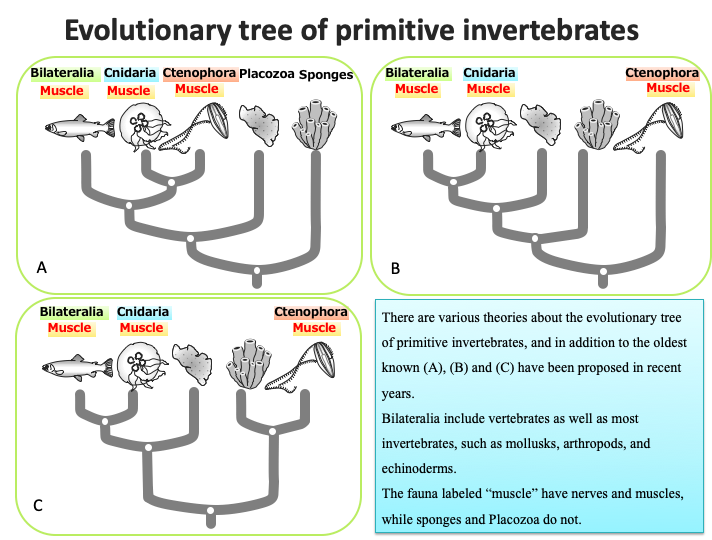
Evolutionary tree of primitive invertebrates
セクションアウトライン
-
Cnidaria and Bilateralia have much in common regarding the mechanisms of action of the muscles and nerves at the molecular level. In contrast, the Ctenophora appears to be very different from these, and its neurotransmitters are different from those of other animals.
Some jellyfish belong to the phylum Cnidaria (including coral, sea anemone, and hydra), such as Aurelia aurita, Mastigias papua, and Aequorea victoria, while others belong to the phylum Ctenophora, such as Beroe cucumis. Historically, these were grouped together as the phylum Coelenterate, but genetic analyses have recently revealed that they belong to very different groups of animals (B and C in the figure below).
In addition, jellyfish are thought to be the first animals to have acquired nerves and muscles approximately 600 million years ago. Animals that have acquired nerves and muscles are able to “act” even when they grow in size, adapting to various environments, dramatically evolving, and developing intelligence. Jellyfish muscle is composed of the actin-myosin system that, albeit primitive, efficiently uses intracellular energy (ATP) to generate large forces. In addition, its nerves have the division of roles corresponding to the sensory nerves that receive and transmit stimuli such as light and contact, motor nerves that control muscle contractions, and autonomic nerves that regulate the functions of various organs.
Jellyfish have a scattered nervous system and do not have a brain. However, on observation, they sometimes behave as if they were thinking and acting (Video: Predatory behavior of Eutonina indicans and polyp). The rhythm of the beat of Cnidarian jellyfish is created by the nerve cells located on the edge of the umbrella. In addition, the edge of the umbrella contains a sensory organ that senses light and gravity, and some species have eyes with lenses and retinas. Therefore, nerve cells are concentrated in a ring shape on the edge of the umbrella, which is thought to work like the central nervous system.