章节大纲

    • This page provides an easy-to-read overview of the class and relevant links.
      For the most up-to-date "Class Plan," "Grading Criteria and Methods," and other information,
      Be sure to check the official syllabus of Hokkaido University.

    • Practice of Marine Bioprocess Engineering 

      Summary

       By utilizing the model equipment and manufacturing machines installed in the Chemical Resources Research Building, students will understand the theory of unit operations such as freezing, heating, distillation, etc., and learn how to apply these unit operations to food manufacturing and processing processes. Students learn the theory of unit operations such as freezing, heating, and distillation, as well as the application of these unit operations to food manufacturing and processing processes.
       In addition, students learn the process of separation and purification of valuable components contained in marine products, as well as methods of analyzing the components.

      Year of Eligible Students 3~
      Course start semester 2nd Semester
       Eligible Students School of Fisheries Sciences  (Marine Bioresources Chemistry)

    • Refrigeration Engineering Theory

      Purpose

      ■ Refrigeration equipment is an indispensable part of modern life. They are used in all aspects of manufacturing, distribution, medical care, housing, and research and development. In this practical training, students will understand the operating principles of single-stage compression and two-stage compression chillers that produce low and ultra-low temperatures, and learn how to calculate their refrigeration capacities.

      Teaching staff in charge
       

       Marine Chemical Resource Development

       Associate professor Hideo MARUYAMA  Associate professor Yuya KUMAGAI 


    • Practical training videos

    • Theory of Continuous Distillation

      Purpose

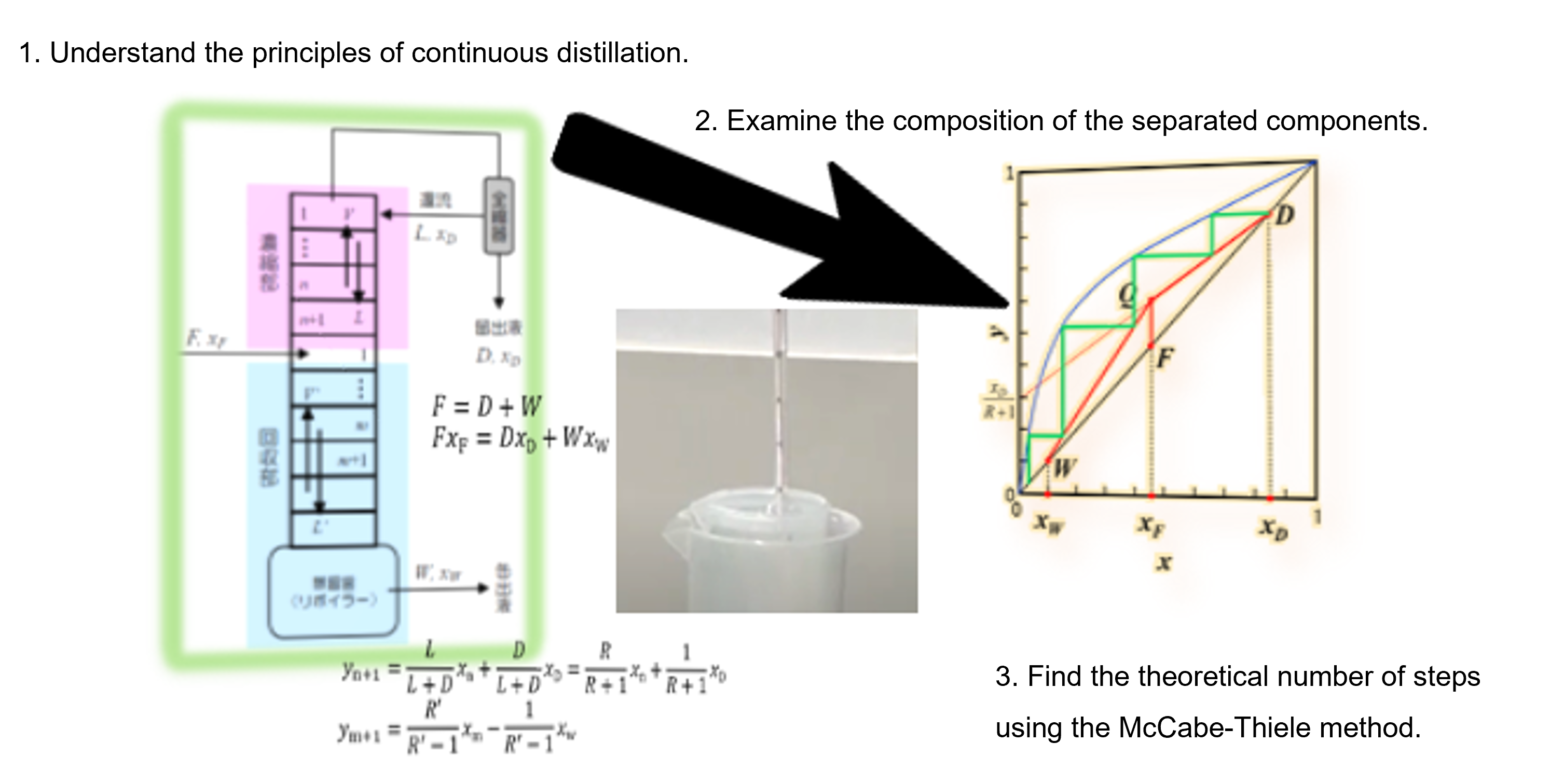
       Distillation operation is a method of separation using the difference in boiling points in a mixed solution. Continuous distillation is a method of separating components of interest from mixed solutions to a high degree of purity. In this practical training, students learn how to calculate the operating efficiency by obtaining the theoretical number of stages from the composition of components obtained by the continuous distillation equipment in the Chemical Resources Research Building.

      ■ Teaching staff in charge

       Marine Chemical Resource Development

       Associate professor Hideo MARUYAMA Associate professor Yuya KUMAGAI


    • Practical training videos

    • Crude fish oil production

      Purpose

      ■ Marine fish are also important as raw materials for fish oil and fish meal. What is the process by which they are manufactured?

          In this practical training, students learn the process and principles of extracting crude fish oil by the wet fusion method, which is a typical production method, albeit at the laboratory level.

      Teaching staff in charge

       Marine Bioresources Chemistry Bioanalytical Chemistry Laboratory

       Associate Professor Yasuhiro ANDO


    • Compositional analysis of crude fish oil

      Purpose

      ■ Fats and oils vary greatly in quality, application, and nutritional value depending on the components they contain. How should this component analysis be performed?

          In practical training, using thin layer chromatography and gas chromatography,

      (1) Detect free fatty acids and wax esters related to the quality and uses of crude fish oil,

      (2) Determination of fatty acid composition related to the evaluation of nutritional value.


      ■ Teaching staff in charge

       Marine Bioresources Chemistry Bioanalytical Chemistry Laboratory

       Associate Professor Yasuhiro ANDO