

Decay Series_Uranium Series & Thorium Series
セクションアウトライン
-
-
【Description of the uranium series】
Uranium-238 (238U), the parent of the uranium family, is uniformly present in seawater at a concentration of 3 micro(10-6) grams/liter. Expressing this in becquerels gives a concentration of 0.04 becquerels (Bq/liter). For example, the concentration of radioactive cesium 137 (137Cs), which was released in large quantities by atmospheric nuclear tests and the Fukushima Daiichi Nuclear Power Plant accident, in seawater along the coast of Japan is 0.001 to 0.003 Bq/liter, so
Uranium 238 (238U) has a higher concentration.After that, uranium-238 (238U) undergoes alpha decay (emits two protons and neutrons each), and becomes daughter nuclides such as thorium-234 (234Th), radium-226 (226Ra), and radon-222 (222Rn). It becomes lead 206 (206Pb), a stable nuclide.
【Description of the thorium series】
Unlike uranium-238 (238U), the parent nuclide, thorium-232 (232Th), is extremely insoluble in seawater, so its concentration in seawater is as low as about 0.3 nano(10-9) grams/liter. Expressing this in becquerels is a very small amount of 0.0000012 becquerels (Bq) per liter.
After that, thorium-232 (232Th) undergoes alpha decay in the same way as uranium-238 (238U), becoming radium-228 (228Ra) and radon-212 (212Rn), and finally becomes stable nuclide lead-208 (208Pb).
Radium 228 (228Ra) generated from thorium 232 (232Th) has a short half-life of about 6 years. On the other hand, radium-226 (226Ra) generated from uranium-238 (238U) has a long half-life of 1600 years. So by looking at the ratio of these isotopes, it is possible to distinguish whether it is open ocean seawater or coastal seawater (you can see the history of the influence of rivers). For example, both radium 228 (228Ra) and radium 226 (226Ra) flow out to the coast from rivers, and the 228Ra/226Ra ratio exceeds 1. On the other hand, open ocean waters have very little radium-228 (228Ra), resulting in a very low 228Ra/226Ra ratio.
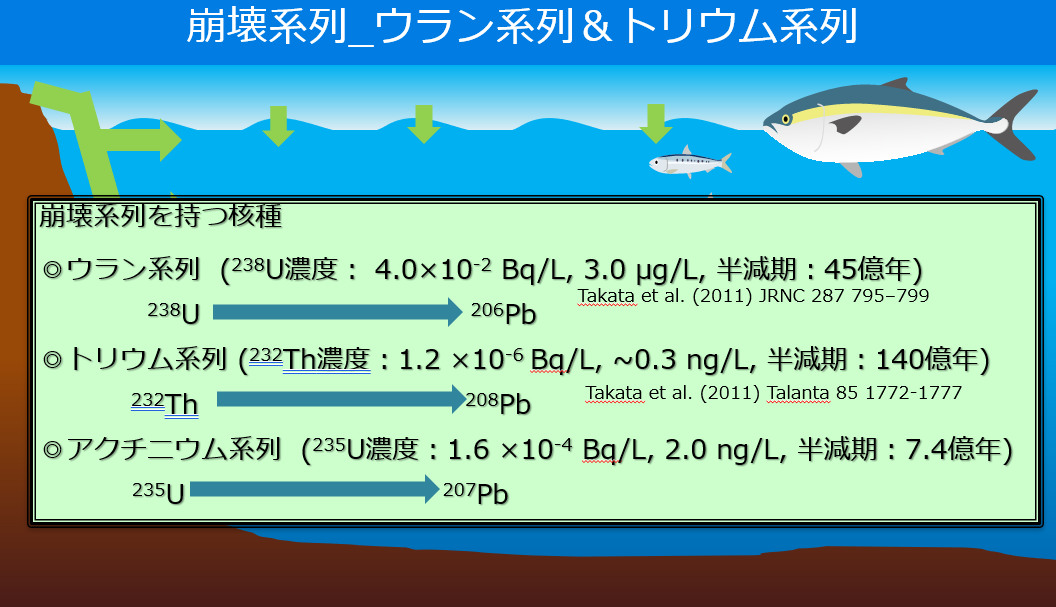
崩壊系列を持つ核種Nuclides with decay series ウラン系列Uranium series アクチニウム系列Actinium series 濃度concentration 半減期half-life 1億年100 million years
-
【The Past and Future of Uranium-235 and Uranium-238】
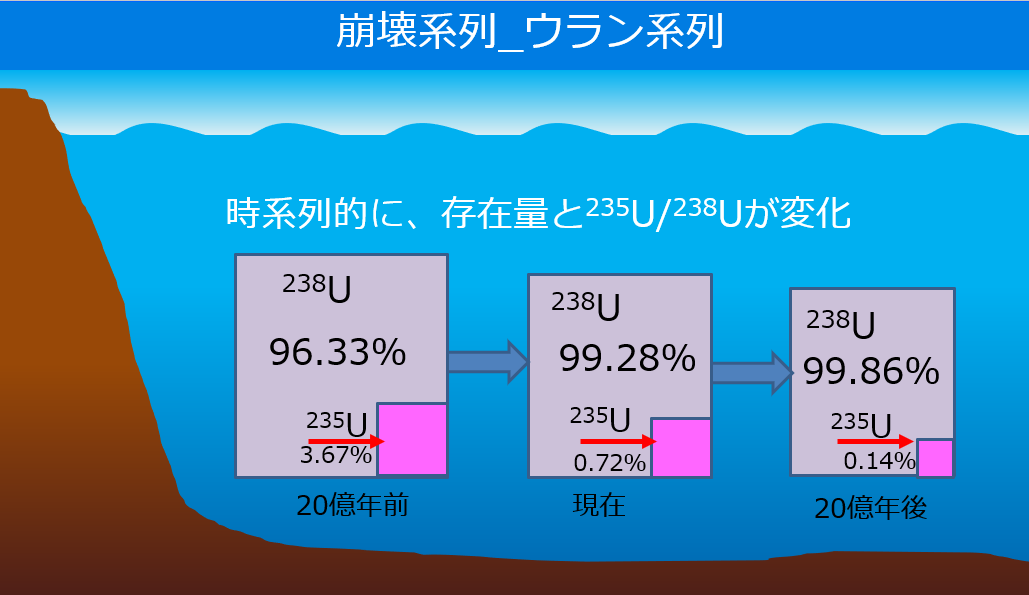
As mentioned above, the current ratio of the two uranium isotopes is about 9:0.7, but has the ratio been the same since the birth of the earth?
The figure below shows the isotope ratio of uranium in the past (2 billion years ago), the present, and the future (2 billion years from now).
Since the two isotopes have different half-lives, their proportions change over time. Uranium-235 (235U) now makes up 0.7% of all uranium, compared with 3.67% in the past. After another 2 billion years, it is estimated to be 0.14%. Carbon 14 (14C), which I talked about before, is always produced by cosmic rays, but uranium has hardly been produced since the birth of the earth, and stable uranium has not been confirmed.
 崩壊系列decay series ウラン系列Uranium series
時系列的に、存在量と235U/238Uが変化Changes in abundance and 235U/238U over time
20億年前2 billion years ago 現在the present 20億年後2 billion later
-
【Mysterious movements of the uranium series】
The figure below explains the daughter nuclides produced by the decay of uranium-238 (238U).
Black arrows: indicates that they are easily removed from seawater (become gas or deposit in seafloor sediments)
Blue arrows: indicates daughter nuclides that are soluble in seawater
Various daughter nuclides enter seawater from the atmosphere, rivers, and seafloor sediments, or are removed from seawater through decay. For example, when uranium-238 (238U) in seawater becomes thorium-234 (234Th), it is removed from seawater by adsorption to particles, but thorium-234 (234Th) has a half-life of several tens of days, so it quickly becomes uranium-234 (234U) and dissolves in water. It also turns into thorium-230 (230Th) and is removed from seawater by adsorption on particles. This time, when it becomes radium 226 (226Ra), it dissolves in seawater again. When radon 222 (222Rn) is formed, it becomes gas and moves into the atmosphere.
Although the movement is somewhat complicated, by skillfully using these properties, it is an excellent tool that can estimate the material circulation of seawater, the degree of influence of rivers and the atmosphere, and the age of water. Successful analysis of the decay series is a valuable source of information for oceanography that tells us about time and displacement.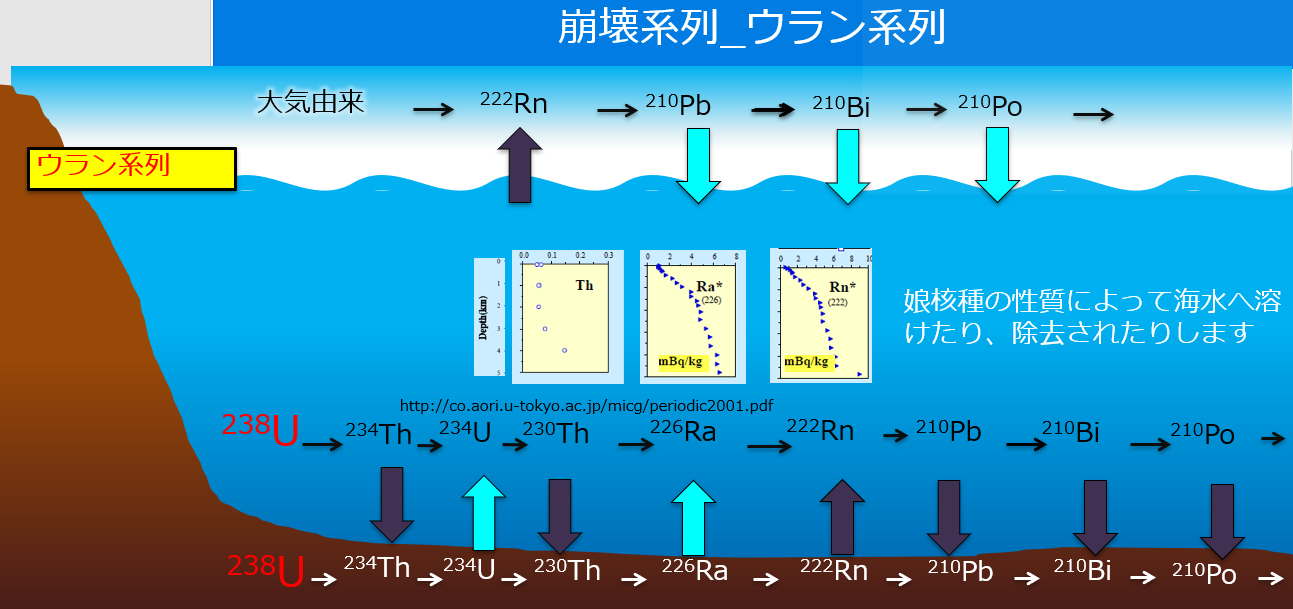
娘核種の性質によって海水へ溶けたり、除去されたりします
Depending on the properties of daughter nuclides, they are dissolved in seawater or removed.