
Perfilado de sección

    •  Many metal elements form refractory oxides (e.g. Fe2O3) and hydroxides (Fe(OH)3). In addition, gold, silver, copper, lead, etc. combine with chloride (Cl-) to form insoluble chloride particles.These substances form in water when the metal ions are supersaturated. This depends on the pH, and the higher the pH, the easier the particles are formed. When the supersaturated state is maintained, these sparingly soluble substances aggregate to form ultrafine nuclei. If the nuclei are abundant, they aggregate into colloidal particles.


       To keep fine particles dispersed in water (colloid), each particle surface must be charged with the same sign (positive or negative). Then the particles will repel each other due to electrostatic force and will not clump together. There are several mechanisms by which the surface of fine particles is charged, so I will introduce two (with reference to Colloid Science, Cosgrove, Tokyo Kagaku Doujin).

      (a) Ionization of surface groups - the case of metal oxides and metal hydroxides -

       Particles with functional groups become charged by ionizing the functional groups exposed on the surface. For example, OH on the surface of hydroxide particles attracts H+ in water at low pH and becomes positively charged. At high pH, ​​it releases H+ and becomes negatively charged.

       When iron chloride (FeCl3) or iron sulfate (FeSO4) is added to water and a small amount of alkaline substance (ammonia or sodium hydroxide) is added, iron oxyhydroxide (FeO(OH)) is produced. OH on the surface of oxide and hydroxide particles attracts H+ in water and becomes positively charged. The particles repel each other because the surfaces of the individual particles are positively charged. As a result, these fine particles do not clump together and remain colloidal.


      (b) Dissociation of ionic solids

        Ionic solids (gold, silver, copper, lead chlorides, iodides, etc.) attract common ions in water to the particle surface and become charged. For example, when a small amount of AgNO3 solution is added to NaCl solution, poorly soluble AgCl fine particles are produced. The ions present in this solution are Na+, Cl, NO3. Among them, the common ion with AgCl is Cl, so the Cl ions are attracted to the AgCl particle surface, and the particle surface is negatively charged. This is called the primary charged layer. In addition, ions of the opposite sign (Na+ in this case) are loosely attracted to the charge of the primary charged layer. This is called an electric double layer. Particles are charged with the same sign, so they repel each other and prevent agglomeration growth.

       Of course, if there are no common ions in the water, there will be no charge, so aggregation will proceed and precipitation will occur.


    •  In environmental analytical chemistry, target components are sometimes recovered from environmental samples using the principle of "co-precipitation", in which the main precipitate grows containing impurities.


      For example,

      Co-precipitation with iron hydroxides for the removal of heavy metals from industrial wastewater


       Iron sulfate (FeSO4) is added to industrial wastewater to dissolve a large amount of Fe2+ in the water. If you add ammonia water or sodium hydroxide to keep it alkaline, you can make FeO(OH) colloid. At this time, the minute amounts of dissolved metal elements also form insoluble ultrafine particles of hydroxides and oxides. A large amount of FeO(OH) colloid precipitates (co-precipitates) involving hydroxide fine particles of other elements. Recovery of this precipitate can effectively remove heavy metals from industrial wastewater.


      Removal of radioactive substances from seawater and application to ocean observation


      Iron coprecipitation method  This is a method that has also been used to enrich trace elements (such as uranium and rare earths) in seawater. The figure below shows the elements that can be recovered by iron coprecipitation. From rare earth elements (La to Lu) to uranium (U) and plutonium (Pu) can be recovered. For this reason, the iron coprecipitation method is used in the initial stage of radioactive material removal in the contaminated water treatment at the Fukushima Daiichi Nuclear Power Plant. The reason why iron hydroxide is used is that the specific surface area of ​​this precipitate is large and the adsorption capacity is large (Sea and Lake Chemistry, Taichiro Fujinaga [editor], Kyoto University Press).
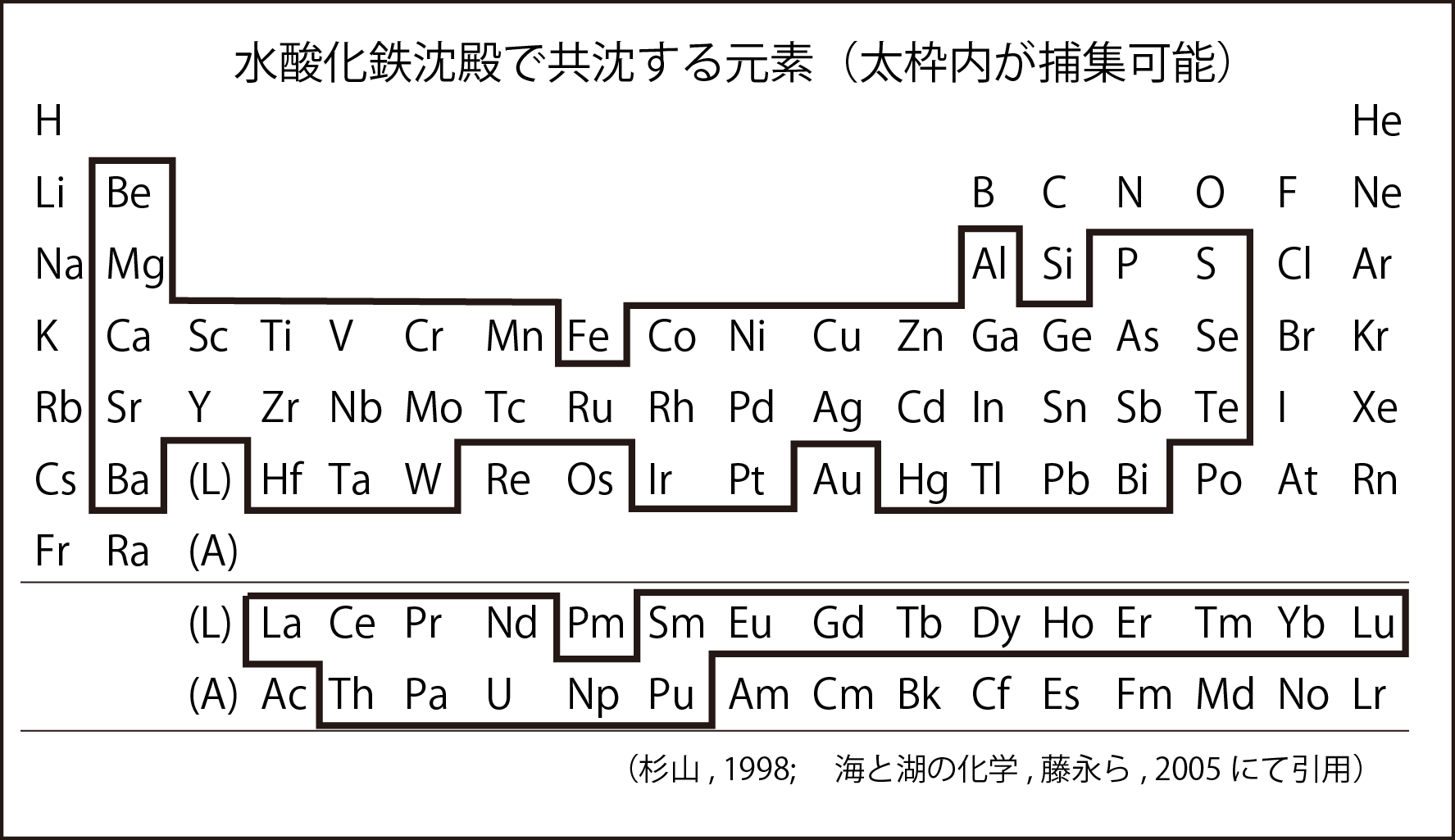

      水酸化鉄沈殿で共沈する元素(太枠内が捕集可能):Elements that co-precipitate with iron hydroxide precipitation (can be collected inside the thick frame)