
Gas chromatography
Perfilado de sección
-
-
Gas chromatography is a technique for separating components in the gas phase using columns. The principle is the same as in ion chromatography. Gas chromatography also uses separation columns. Organic substances in the sample gas are often separated. As columns, capillary columns are mostly used these days.
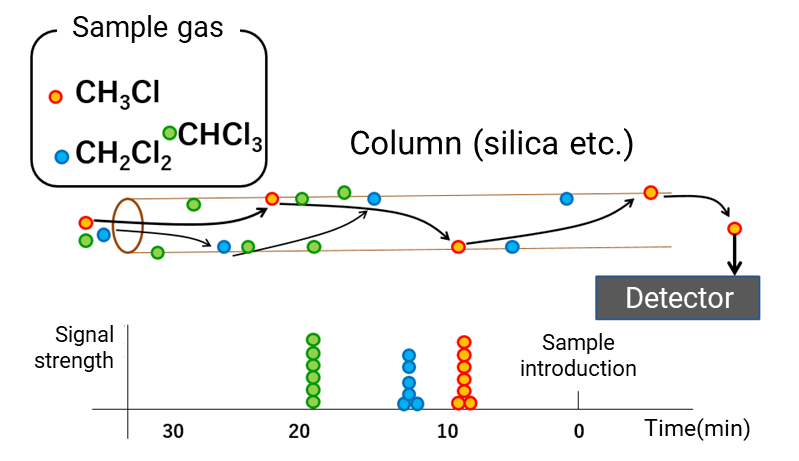
A capillary column is a very thin, 50 m long tube with a diameter (outer diameter) of less than 1 mm and an inner diameter of 100 µm, for example. There are various materials for the inner wall, but fused silica seems to be the most commonly used. This is because molecules (in gaseous form) have a property of adsorption on silica. Different types of molecules have different adsorption capacities and can be separated by capillary columns.
In the picture below, a small molecule organohalogen gas is shown as an example of the organic component. Separating in a column and then getting signal intensity at a downstream detector is the same as described in the previous course (ion chromatography).
-
Gas chromatograph detectors
Electron Capture Detector: ECD
A highly sensitive method for organic analysis is the use of an electron capture detector. A radiation source constantly emits beta rays. When the beta rays hit the nitrogen molecules, electrons are produced. The electrons are attracted by an electrode and the number of electrons is measured. This is the baseline (left-hand side of the diagram below).
Organic molecules from the capillary of the gas chromatograph are introduced into the ECD. When electrons collide with organic molecules (light blue circles), their charged particles are too heavy to reach the electrode. The more organic molecules, the fewer electrons are attracted to the electrode, so they are detected as peaks.
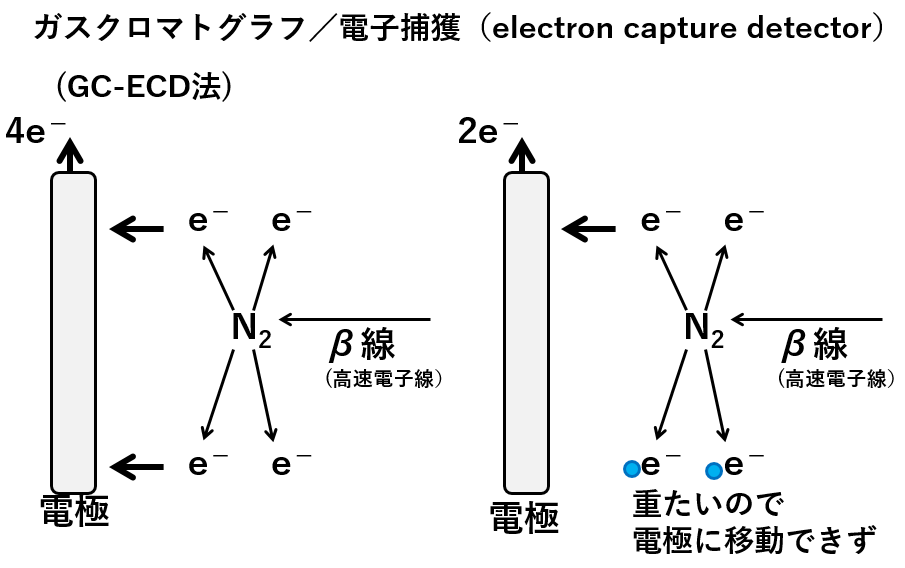
ガスクロマトグラフGas chromatograph β線 β ray 高速電子線high speed electron beam 電極electrode 重たいので電極に移動できずIt is too heavy to move to the electrode.
The advantage of ECD is that the device is simple (relatively inexpensive) and highly sensitive, but as shown in the picture below, analysis cannot be performed unless the organic components have been completely separated.
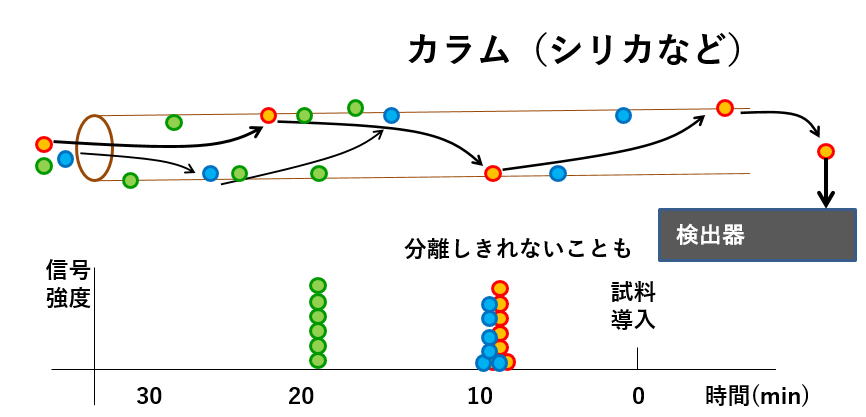
カラム(シリカなど)Column (silica etc.) 信号強度signal strength 分離しきれないこともSometimes it is impossible to separate
-
Mass Spectrometry: MS
Organic molecules emerging from the capillary of a gas chromatograph are bombarded with thermionic electrons. The organic molecules are then charged and become charged particles. As they are charged, they can be moved by a magnetic field. Organic molecules also have mass. Their mass determines the speed at which they are moved by a magnetic field. Only charged particles with a mass that can pass through the magnetic field are introduced into the detector (electron multiplier tube) while the magnetic field is delicately adjusted to obtain the signal intensity. This is called a mass spectrometer because the molecules that pass through the capillary can be detected according to their mass. (Not only organic substances, but also inorganic substances can be analysed by mass spectrometry.)
When a molecule is bombarded with hot electrons, it is broken into fragments (charged particles) of varying masses. The probability of each component of an organic molecule becoming a fragment of any mass has been investigated. This is provided as a library, so that the components can be estimated from the results of mass spectrometry.
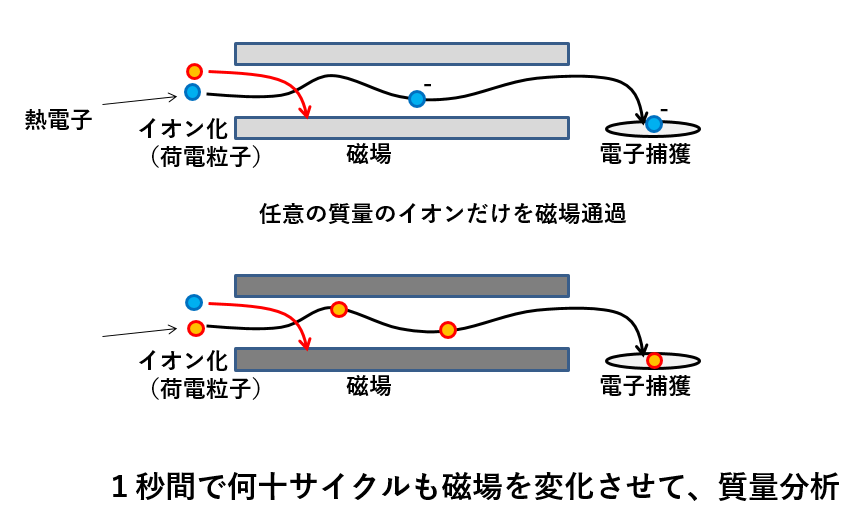
熱電子hot electron イオン化ionization 荷電粒子charged particles 磁場magnetic field 電子捕獲electron capture
任意の質量のイオンだけを磁場通過Only ions of arbitrary mass pass through the magnetic field
1秒間で何十サイクルも磁場を変化させて、質量分析Mass spectrometry by changing the magnetic field dozens of cycles per second
-