

Breakdown of Energy Possessed by Substance (Entropy)
セクションアウトライン
-
-
Explanation of entropy ①
Two beakers containing 100 g of water. One is at 0°C, just below the freezing point (Figure A below), and the other is at a hot 90°C (Figure B below). We poured 20 g of boiling water at 100°C, just above the boiling point, into these beakers. For (A), 120 g resulted in about 16°C water, and for (B), 120 g resulted in about 92°C hot water.
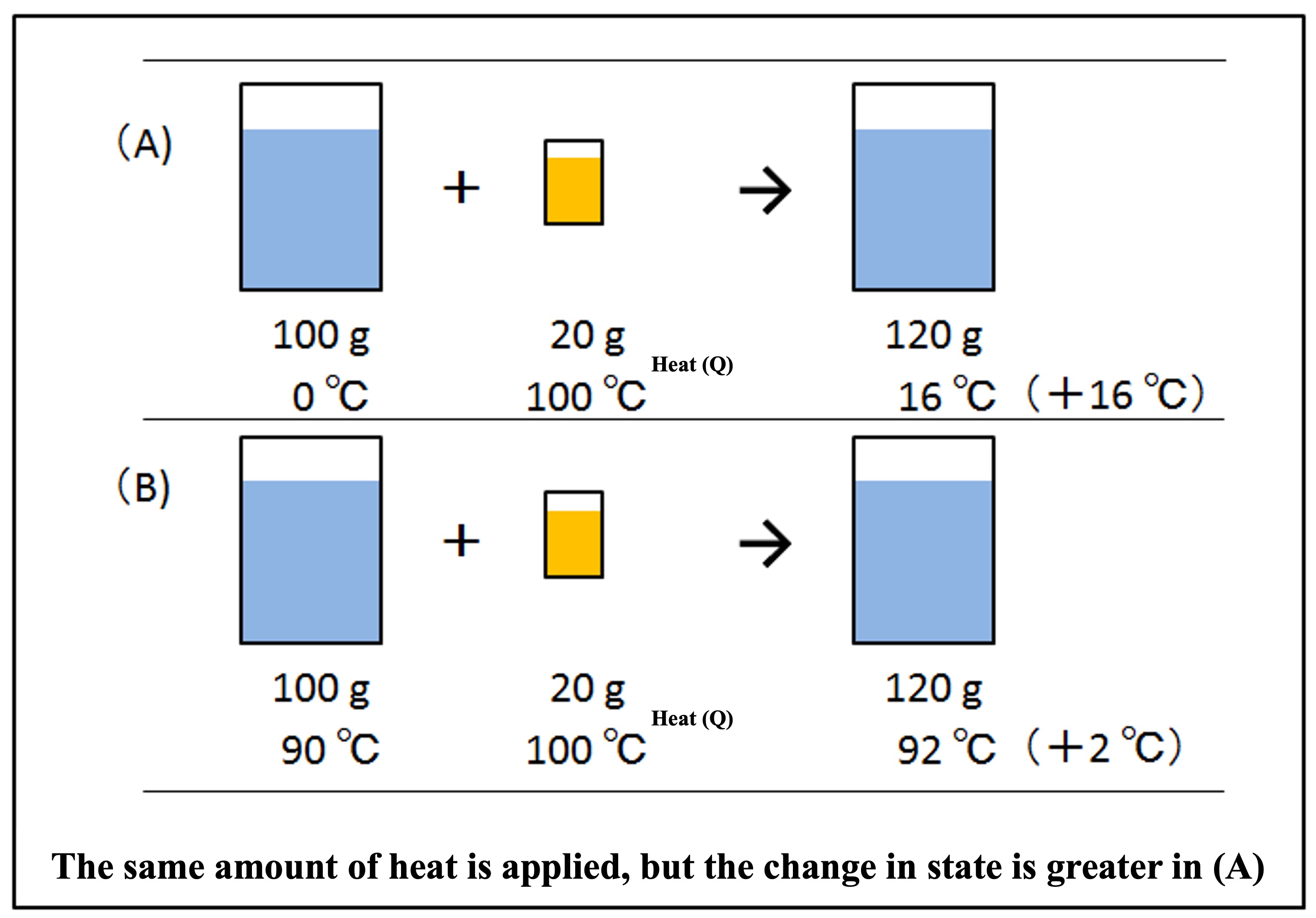
The same amount of heat was added, but (A) rose +16°C, while (B) rose only +2°C. The change in state is greater for (A). To compare the change in state between (A) and (B), we would need some scale. The difference between the two is the original temperature. The lower the original temperature, the greater the change of state.
The amount of heat added (⊿Q: joule) is then divided by the original temperature (T: Kelvin) to define the amount of change in state (⊿S).
⊿S = ⊿Q/T
This S is called entropy, and ⊿S is called entropy change
(【entropy change ⊿S】 x 【temperature T】 equals the amount of heat (⊿Q) added to the system, and 【entropy S】 x 【temperature T】 is the binding energy).
I don't understand the definition of entropy. Textbooks explain that "entropy is the degree of clutter," which makes it even more confusing.
I will give you some examples so you have an idea of entropy.
-
Explanation of entropy ②
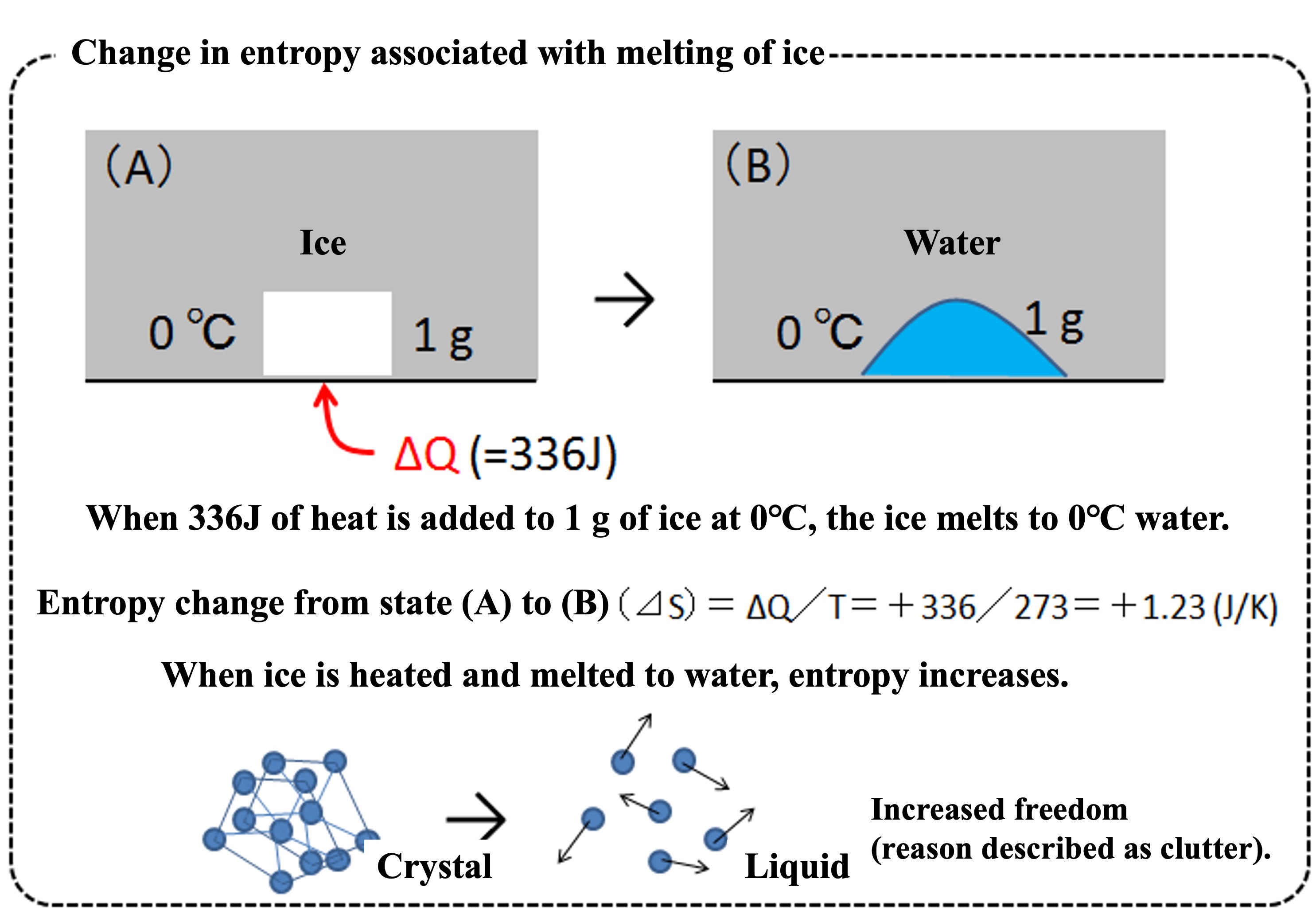
The figure below shows the entropy change associated with the melting of ice. When 336 J of heat is added to 1 g of ice at 0°C (273 K), just below the melting point, the ice melts to 0°C water.
Calculating the entropy change (⊿S= ⊿Q/T) from (A) to (B) as defined earlier, ⊿S = 336 (J)/273 (K) = 1.23 (J/K). In other words, when ice melts to water, entropy increases. In ice, the water molecules are densely aligned, whereas in liquid water molecules are moving apart. In other words, when ice melts to water, we can say that clutter (entropy) has increased.
It's still not clear, is it? Let me add a few more explanations with examples.
-