
セクションアウトライン

    • In the Basic Equations of Chemical Equilibrium (Remember This and Be Able to Use It) course, we noted the conditions that lead to chemical equilibrium.


    • //////////////// Basic equation of chemical equilibrium (review) /////////////////////////


                     【Original form】                   【Product form】


                      aA  +  bB  +  …             xX  +  yY  +
       

      In equilibrium, the following relationship holds.
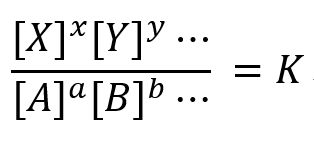


      K is called the equilibrium constant, and this relationship is called the law of mass action.


      [A], [B], [X], [Y] are the equilibrium concentrations for this reaction and a, b, ..., x, y, ... are the reaction molar ratios.


      Here, 

      Sum of standard Gibbs energy of formation for each substance comprising the original form:ΣGf0original form

      Sum of standard Gibbs energy of formation for each substance comprising the product form:ΣGf0product form


      If we take the total difference in the standard Gibbs energy of formation (of the substances that make up the product form and the original form) before and after the reaction,


      ⊿∑Gf0product form-original form = ΣGf0product form - ΣGf0original form


      If this reaction is in equilibrium, the following relationship is satisfied.

       ⊿∑Gf0product form-priginal form = -RTlnK 


      Gas constant R = 8.314, T is absolute temperature

      //////////////////////////////////////////////////////////////////////////


  • This is a lengthy explanation, but scroll down and just remember the parts marked in red.

    •  In a system in which substances A, B, X, and Y are mixed, it is natural that they may not be in equilibrium.

       In general (not necessarily in equilibrium), the sum of the Gibbs energyof a substance, in its original or product form, is expressed as

      (energy required to synthesize a substance in its standard state: standard Gibbs energy of formation) + (energy required to change a substance from its standard state to an arbitrary state or concentration).

      Energy to change a substance from its standard state to an arbitrary state or concentration = RT・ln (activity product).

       (Expression derivation will be covered in a later course.)


      ΣGoriginal form = ΣGforiginal form + RTln (activity product of the original form)


      ΣGproduct form = ΣGfproduct form+ RTln (activity product of the product form)


       The total difference in Gibbs energy (⊿∑Gproduct form-original form) between substances constituting the original form and the product form,


      ⊿∑Gproduct form-original form = ΣGproduct form- ΣGoriginal form


            = (ΣGfproduct form+ RTln (activity product of the product form)) - ( ΣGforiginal form + RTln (activity product of the original form))


            = ΣGfproduct form - ΣGforiginal form +  RTln (activity product of the product form】/【activity product of the original form】)


            = ⊿∑Gf0   +    RTln (activity product of the product form】/【activity product of the original form】)


         (⊿∑Gf0  :Difference between the standard Gibbs energy of formation of substances present in the product and in the original form.)

      Note 1: The 【activity product of the product form】 and 【activity product of the original form】 described here mean the product of any activity when not necessarily in equilibrium.

      Note 2: Since the term "activity" is unfamiliar to most people, please assume that "activity" = "concentration" for now.


      When in equilibrium, 

      ⊿∑Gproduct form-original form= 0

      In other words,

      ⊿∑Gf0  RTln (【Activity product of the product form】/【activity product of the original form】).


      When not in equilibrium,

      If ⊿∑Gproduct form-originl form <  0, the reaction proceeds from 【original form】 to 【product form】.

      If ⊿∑Gproduct form-originl form >  0, the reaction proceeds from 【product form】 to 【original form】.


    • The conditions under which a reaction proceeds are expressed using the equilibrium constant (K)

      ~〜〜Condition when the reaction proceeds from 【original form】 to 【generated form】~~~


      When ⊿∑Gproduct form-original form < 0, the reaction proceeds from 【original form】original form to 【generated form】.


      To rewrite this,

      ⊿∑Gproduct form-original form= ⊿∑Gf0 + RTln (【activity product of the product form】/【activity product of the original form】),


      When, ⊿Gf0 + RTln (【activity product of the product form】/【activity product of the original form】) < 0 the reaction proceeds from 【original form】original form to 【generated form】.


      Gf0  = RT ln K, so, 


      lnK  >  ln (【activity product of the product form】/【activity product of the original form】)


      In other words, when


      【activity product of the product form】/【activity product of the original form】 < K,


      the reaction proceeds from original form to product form.


      On the contrary, when


      【activity product of the product form】/【activity product of the original form】 > K,


      the reaction proceeds from product form to original form.


      ※ The 【activity】 (or concentration) here is the activity (or concentration) of a substance in a given system when it is not necessarily in equilibrium. 

      ※ 【The activity product of the product form in equilibrium】 / 【activity product of the original form in equilibrium】 = K. So, the larger the activity product of the original form in equilibrium, the more the reaction of the original form to the product form progresses, and it should be understood that if the activity product of the product form becomes larger, the reaction proceeds from the product form to the original form.    

      ~~~~~~~~~~~~~~~~~~~~~~~~~~~~~~~~~~