Exercise
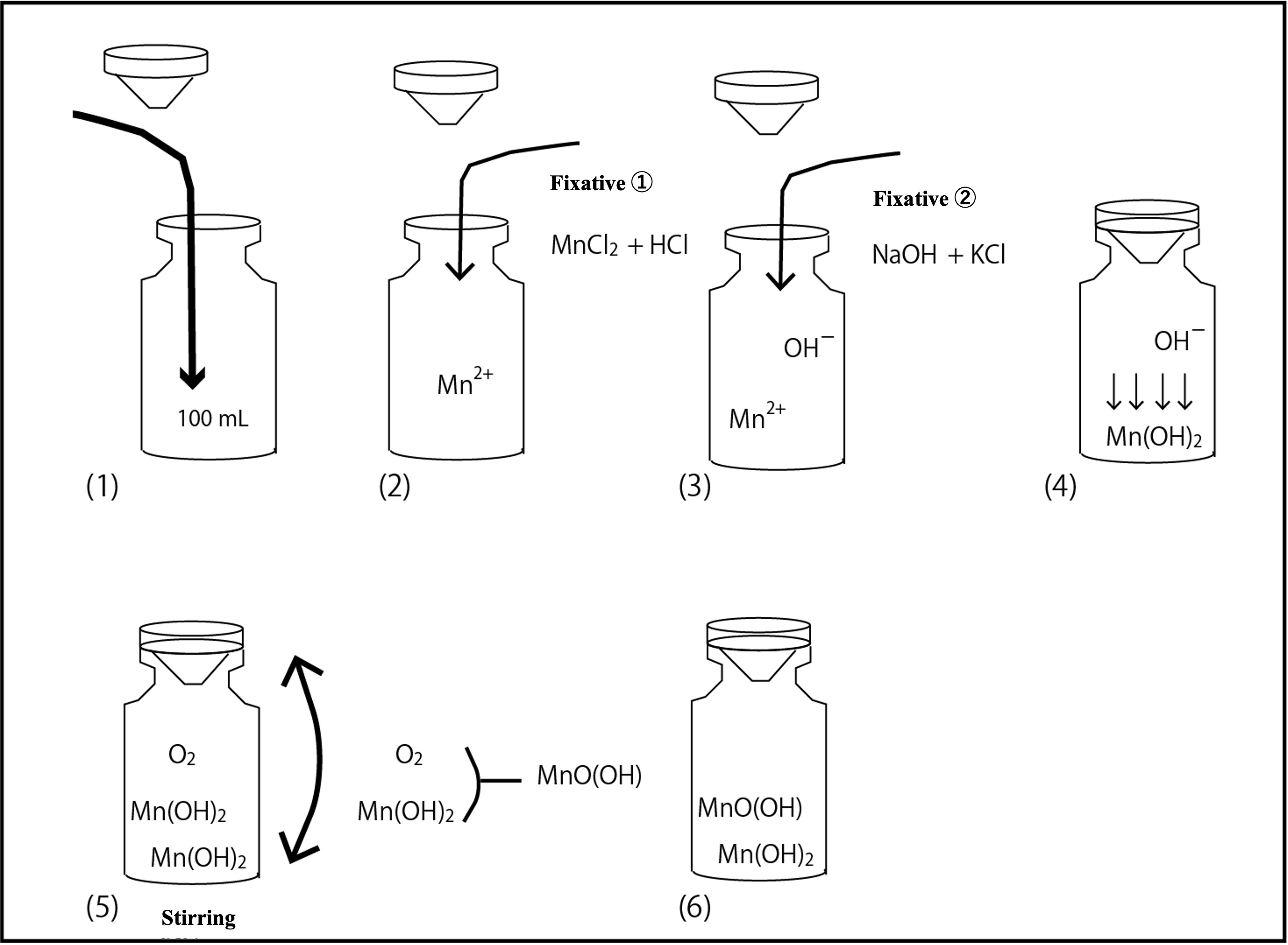
Find the condition (pH) under which Mn(OH)2 precipitates when sodium hydroxide is added to seawater when processing samples using the Winkler method.
【Answer】
The reaction in which a solid of Mn(OH)2 in water dissolves to form Mn2+ and two OH- is expressed as follows. Dissolution equilibrium is reached if enough time elapses while the solid remains in water. The standard Gibbs energy of formation is noted below each substance.
【Original form】 【Product form】
Mn(OH)2 ⇆ Mn2+
+ 2OH-
Gf0 (kJ/mol) -615.4 -228 -157.2×2
Mn(OH)2 before the reaction is called the original form, and Mn2+ and 2(OH-) after the reaction are called the product form. The total standard Gibbs energy of formation for the original form (ΣGf0 [original form]) is -615.4 (kJ/mol), and the total standard Gibbs energy of formation for the product form (ΣGf0 [product form]) is -228 + 2 × (-157.2) (kJ/ mol). The difference between the total standard Gibbs energy before and after the reaction (ΣGf0 [product form] - ΣGf0 [original form]) is denoted as ⊿∑Gf0.
The total difference in standard Gibbs energy of formation for this reaction is as follows.
⊿∑Gf0 = ΣGf0[product form]-ΣGf0[original form] = 73×103
( J/mol )
Substitute a numerical value into the conditional equation for chemical equilibrium ( ΔGf0 = -R・T・lnK ).
73×103 ( J/mol )
= -8.314・298.15・ln(【Mn2+ mol/L】・【OH- mol/L】2/【Solid activity (=1) 】)
(Because two OH- ions are produced,【OH-
mol/L】・【OH-
mol/L】=【OH-
mol/L】2)
ln【Mn2+】・【OH-】2 = -29.45
【Mn2+】・【OH-】2 = e-29.45 = 1.6×10⁻¹³
Therefore, the solubility product of manganese hydroxide is theoretically 1.6 x 10⁻¹³. The equilibrium constant for the dissolution equilibrium of a poorly soluble substance (when the activity (concentration) of the solid is set to 1) is called the solubility product (Ksp). The smaller this value is, the more insoluble the substance is.
In the dissolved oxygen measurement operation, Mn2+ is added to seawater in Fixing solution ①, and then sodium hydroxide solution is added in Fixing solution ② solution to increase the excess OH-. Substituting the concentration of [OH-] corresponding to the amount added into the above equation, the concentration of [Mn2+] that can be dissolved in the solution can be calculated.
For example,
If the pH of seawater remains at pH 8,
【OH-】= 10-6 mol/L, so 【Mn2+】= 1.6・10-1
mol/L
If we set alkaline pH 10,
【OH-】= 10-4 mol/L, so 【Mn2+】= 1.6・10-5
mol/L
If pH 12 is set, 【OH-】= 10-2
mol/L, so 【Mn2+】= 1.6・10-9 mol/L.
The concentration of Mn2+ in the fixing solution ① is 1.26 mol/L and the amount added is 6.3 × 10⁻⁴ mol (0.5 mL of solution ① is added), so the concentration in the DO bottle (0.1 L) is 6.3 × 10⁻³ mol/L.
The dissolution equilibrium concentration at pH 8 (1.6 × 10⁻¹ mol/L) is sufficiently high compared to the added Mn2+ concentration. In other words, all added Mn2+ is still dissolved.
If the water is slightly more alkaline than seawater (pH 10 or higher), the equilibrium concentration of manganese ion dissolution (1.6 × 10⁻⁵ mol/L) will be much lower than the added Mn2+ concentration (6.3 × 10⁻³ mol/L). Of the added Mn, only 6.3 × 10⁻³ mol/L × 0.1 (L) = 6.3 × 10⁻⁴ mol can be dissolved, and the remaining 5.67 × 10⁻³ mol (= 6.3 × 10⁻³ -6.3 × 10⁻⁴ mol) cannot be dissolved and precipitates as Mn(OH)2.
The actual DO measurement will show that most of the Mn will precipitate out as the excess NaOH is added to bring the pH to about 12.
Then, just before titration, hydrochloric acid is added to the precipitate that has accumulated at the bottom of the oxygen bottle to dissolve the precipitate. The addition of hydrogen ions by hydrochloric acid decreases the OH- concentration in the bottle. It can be calculated how much HCl or how low pH is needed to dissolve the Mn(OH)2 precipitate in the bottle.