Garis besar topik

    • Introduction of Akkeshi Marine Station.


    • In 1931, it was established in Akkeshi-cho as Japan's only subarctic coastal laboratory focusing on cold-water organisms. In 1949, the adjacent former military land and natural forest land were added to the total area of approximately 400,000 square meters, and the facility was developed as a more comprehensive marine biology research and education facility, being used as a research site not only for marine organisms but also for birds, animals, and other natural life in general. In April 2001, the Center was integrated with seven experimental forests, farms, ranches, and botanical gardens affiliated with the Faculty of Agriculture, the Faculty of Fisheries, Usujiri Fisheries Station, Toya Lake Station, and the Nanae Fish Farming Training Facility, all affiliated with the Faculty of Science, and the Muroran Seaweed Research Station, all affiliated with the Faculty of Science. The Akkeshi Marine Station belongs to the "Aquatic Station" of the Center, together with Muroran Marine Station, Usujiri Fisheries Station, Toya Lake Station, and Nanae Freshwater Station. The site also houses the Aikappu Museum of Natural history, which is open to the public free of charge from May through October each year.




    • Located in the Akkeshi-Do Nature Park, the Akkeshi Coastal Research Station conducts research and education in marine ecology, making the most of its natural surroundings. In addition to the sea trial for students of the Faculty of Science, open sea trial for university students from all over Japan and other universities are held every year, and researchers in various fields from Japan and abroad use the laboratory for their research. Two faculty members and two technical staff members are stationed here to conduct research on biodiversity and ecosystem changes in Akkeshi Bay and Lake Akkeshi, interactions between plant and animal species over seagrass and seaweed, and interactions between terrestrial and coastal ecosystems. In addition, they are working on the prediction and assessment of changes in marine ecosystems associated with global warming, which is feared to be progressing in recent years, through wide-area and long-term observations that make integrated use of field surveys and remote sensing.

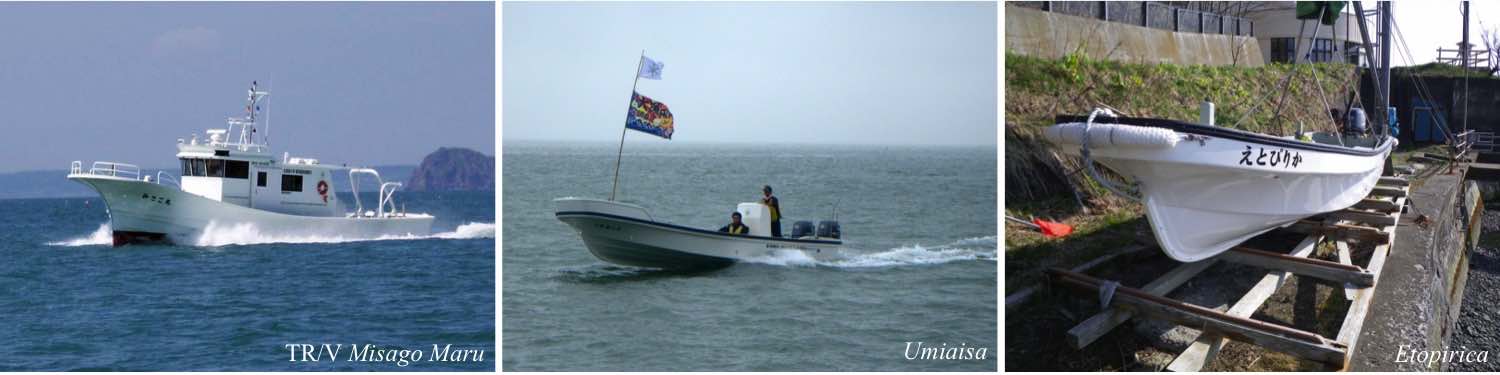
    • The following vessels are used for research and training at the Akkeshi Coastal Research Laboratory.

      • Misago Maru (9.7 tons, diesel 540 kw, capacity 30, equipped with GPS, fish finder, radar, and radio)
      • Umiaisa (2 x 80 HP outboard motors, capacity 11)
      • Etopirika (40 HP outboard motors, capacity 5)