Section outline

    • Succeed the analysis of the horizontal community structure of harmful red tide algae on the Pacific coast of Hokkaido during the fall season of 2021.

      Estimated the mechanism of red tide occurrence in the east Hokkaido sea area based on a literature survey of past red tide occurrence.

      Pointed out the importance of early detection by satellite algorithms and preparation of control measures to reduce damage from red tide.

    • A research group led by associate professor YAMAGUCHI Atsushi and assistant professor MATSUNO Kohei of the Faculty of Fisheries Sciences, Hokkaido University, and assistant professor IIDA Takahiro of the Training Ship Ushio-Maru attached to the Faculty of Fisheries Sciences, has successfully analyzed the community structure of harmful red tide algae in the Pacific coast of Hokkaido in the autumn season of 2021. Surface water samples were taken at 32 points along the Pacific coast of Hokkaido last October by the Ushio-Maru, and phytoplankton communities were observed. The communities were divided into four groups, and the cell count density of the community dominated by the red tide-causing algae Karenia selliformis was higher. A significant positive relationship was observed between chlorophyll a, an indicator of phytoplankton abundance, and cell number density of K. selliformis. Analysis of the relationship between environmental factors and cell number density of K. selliformis showed a significant positive relationship with nutrient phosphate concentration.

      Red tides have been reported along the Pacific coast of Hokkaido in the fall of 1972, 1983, 1985, and 1986. The common factor in the occurrence of red tides in each year was the depletion of nutrients in the surface layer under conditions where the water temperature was 1-3°C higher than usual and a thermocline*1 had developed. Phytoplankton needs both nutrients and light for photosynthesis to proliferate, but under these conditions, it is difficult for phytoplankton such as diatoms, which do not have the ability to move, to proliferate because of the lack of nutrients in the light-rich surface layer.

      On the other hand, because K. selliformis has the ability to move by flagellum, it is able to dominate by moving to the lower layers at night to replenish nutrients and then proliferate by photosynthesis in the surface layer during the daytime. The subsequent collapse of the density dynamic layer was thought to have resulted in the supply of nutrients from the lower layers, causing a large-scale harmful red tide. This study points out the importance of early detection by satellite and control measures while K. selliformis is still at low density in order to reduce the damage caused by red tides.


      The results of this research were published in the May 25, 2022, issue of Bulletin of the Japanese Society of Fisheries Oceanography.


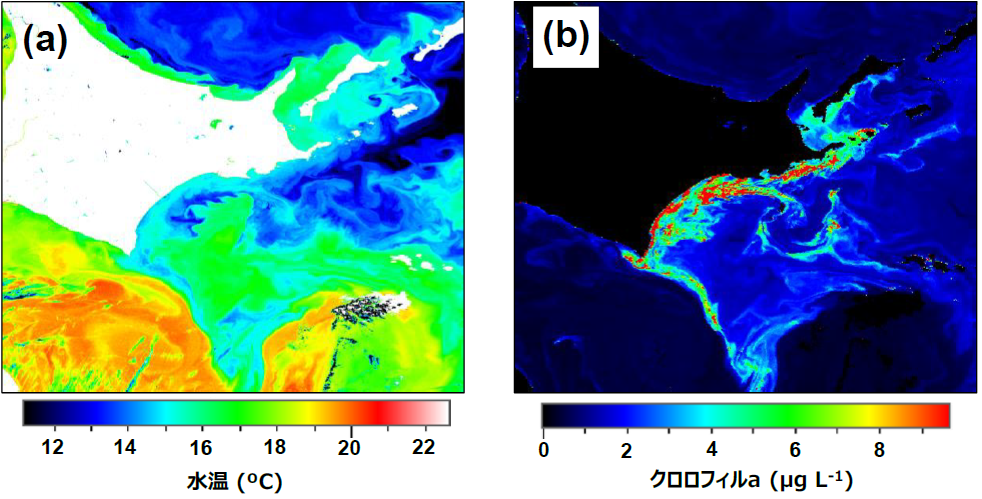
    • (a) Sea surface water temperature at the time of the survey. Low-temperature Oyashio water existed in the eastern area of Hokkaido.

      (b) Sea surface chlorophyll a at the time of the survey. It was higher in the low-temperature Oyashio waters of the east Hokkaido and coincided with the horizontal distribution of K. selliformis.

    • The “large-scale harmful red tide” that occurred in the Pacific coastal area of Hokkaido in the fall of 2021 caused the death of salmon in fixed nets and the mass mortality of short-spined sea urchins. The damage amounted to 27,900 salmon and 2,800 tons of sea urchins, and the total amount of fishery damage in the entire Hokkaido region was reported to be 8.19 billion yen as of February 28, 2022.

      The dinoflagellate Karenia selliformis is believed to be the causative algae of this large-scale harmful red tide. So far, red tides caused by Karenia species in Japan have been reported mainly in the Seto Inland Sea and Kyushu coastal areas of western Japan, where damage was caused by Karenia mikimotoi. The occurrence of this K. mikimotoi in Hokkaido has been reported in Hakodate Bay in southern Hokkaido and is believed to have been transported by the Tsushima Warm Current water moving northward in the Japan Sea. On the other hand, K. selliformis, the algae causing the large scale harmful red tide of 2021, is a species described from the South Island of New Zealand in 2004. Red tide formation has been reported in the Gulf of Mexico, New Zealand, Australia, Tunisia, and Kuwait, suggesting that K. mikimotoi and K. selliformis probably have a pan-global distribution.

      For the 2021 large harmful red tide, genetic analysis and cell size of K. selliformis, as well as estimation oceanographic characteristics of the red tide formation area and of the origin area using particle tracking models, are being conducted. For the large-scale harmful red tide K. selliformis, a red tide caused by a genetically identical strain was reported to have occurred on the eastern coast of the Kamchatka Peninsula, Russia, in the fall of 2020. In the coastal areas of east Hokkaido, outbreaks of red tides caused by dinoflagellates have been reported in 1972, 1983, 1985, and 1986. The mechanism of these red tide outbreaks in the coastal areas of east Hokkaido is considered to be a “rainfall-type red tide”. However, the large-scale harmful red tide outbreak in 2021 is not confined to one particular area of ocean, and the damage area covers a wide geographical area from off Nemuro to Cape Erimo, so it is necessary to reconsider the cause of its formation and the mechanism of its occurrence.

      In this study, we clarified the cell number density of K. selliformis and the horizontal distribution of phytoplankton communities that appeared in samples collected from the west coast of Cape Erimo to offshore Akkeshi over a wide area from October 6-12, 2021, and summarized previously reported red tides in the east Hokkaido coastal area, and discussed conditions under which large-scale harmful red tides occur.


    • From October 6-12, 2021, 1 L of surface seawater was sampled by the Training Ship Ushio-Maru (179 tons), which is attached to the Faculty of Fisheries Sciences of Hokkaido University, at a total of 32 points between the west coast of Cape Erimo and offshore Akkeshi. Water samples were fixed by adding glutaraldehyde to reach a final concentration of 1%, and the number of phytoplankton cells was counted. Chlorophyll a, a pigment contained in phytoplankton, was also measured. To clarify the conditions for high density of the red tide-causing algae K. selliformis in the field, a generalized linear model was used to analyze environmental factors: water temperature, salinity, nitrate, nitrite, ammonium, phosphate, and silicate concentrations as independent variables, and K. selliformis cell number density as the objective variable. After creating a similarity matrix based on cell number density data for each species or genus of unicellular organisms, a dendrogram was created using the mean linkage method, and phytoplankton communities were separated by arbitrary similarity levels. The GCOM-C "Shikisai," a climate change observation satellite provided by JAXA, was used to evaluate the horizontal distribution of sea surface temperature and chlorophyll a during the study period.

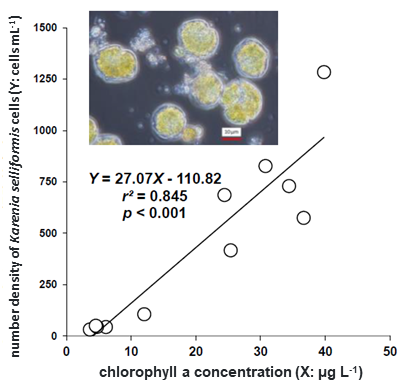
    • High densities of K. selliformis were distributed at fixed sites except off Hiroo, along the Kushiro coast, and near the shore of Akkeshi. In situ sea surface chlorophyll a concentrations (X: µg L-1) ranged between 3.6-39.8 µg L-1 and the cell number density of K. selliformis (Y: cells mL-1), Y = 27.07 X -110.82, a significant positive relationship with a contribution of 85%. Using the slope of this regression equation, the intracellular chlorophyll content of K. selliformis was estimated to be 37 pg cell-1. A generalized linear model analysis with cell number density of K. selliformis as the objective variable and environmental factors as explanatory variables revealed a positive relationship with phosphate among the various nutrients.

      Throughout the study area, sea surface phytoplankton densities ranged from 38-9033 cells mL-1. Cluster analysis based on cell count densities for each species divided the phytoplankton communities into four communities, A-D. Of the four phytoplankton communities, 18 of the 32 stationary sites were in community A, which had the highest number of stationary sites, and community A was dominated by the dinoflagellate K. selliformis, which accounted for 92% of cell count density, with an average cell count density of 999 cells mL-1, outperforming the other communities (77-152 cells mL-1). Sea surface temperatures in the study area ranged from 13.9-18.1°C and salinities from 27.6-33.7. The sea surface temperature and chlorophyll a concentration based on satellite data during the survey period also indicated that high chlorophyll a concentrations were found in the low-temperature water mass east of Cape Erimo and beyond.

      Red tides have been reported to have occurred along the east coast of Hokkaido in the fall seasons of 1972, 1983, 1985, and 1986. Although the period of the red tides varied from year to year, they were reported to have occurred from September 3 to October 1, in the Tokachi coast as the sea area, with dinoflagellates as the causative algae, and with reduced catches of salmon in set nets as the damage. It is noteworthy that whenever red tides occur in these eastern Hokkaido waters, there is always a description that the water temperature is higher than usual.

      The genus Karenia has the ability to move by means of two flagella. Karenia mikimotoi can move vertically around the water depth of 20 m per day at a speed of 2.2 m h-1, while K. brevis can move at a speed of 1 m h-1. Karenia selliformis has also been observed to have extremely high locomotion under the microscope. The cell size of K. selliformis is about twice as large as that of K. mikimotoi and K. brevis, suggesting that the diurnal vertical migration capacity of K. selliformis is high.

      The specific gravity of seawater becomes lighter under high water temperature and low salinity conditions. This means that when the sea surface is warmer than usual in the low-salinity Oyashio region, the thermocline will develop strongly. When the water temperature dynamic layer develops, nutrients in the shallow areas below the layer are depleted, making it difficult for phytoplankton (diatoms, etc.), which do not have the ability to move, to proliferate. On the other hand, dinoflagellates of the genus Karenia, which have high mobility, so enabling diurnal vertical migration which distributed in the surface layer during the daytime for photosynthesis, and dive to the depths below the thermocline at night to replenish nutrients. In 1972, 1983, 1985, and 1986, red tides are explained as a “rainfall-type red tide” that when the water temperature was higher than usual and the thermocline developed, only dinoflagellates with high mobility were able to increase for a long time  causing the species composition was simple, and increased river flow after rainfall provides nutrients to the coastal zone, which allows a single species to proliferate and form a red tide.

      Large-scale harmful red tides of K. selliformis in 2021 were observed extensively in the open ocean, and it is difficult to interpret them as transient “rainfall-type red tides” along the coast. Considering these factors, the mechanism of K. selliformis red tide in the Pacific coast of Hokkaido in the autumn of 2021 is as follows: “Seawater temperature rises → Thermocline strengthens → Diatoms (competing organisms) decrease → Karenia selliformis with the ability to migrate increase by supplying nutrients through diurnal vertical migration →Surface community dominated by K. selliformis passage of low pressure → weakening of stratification / vertical mixing / increase in nutrients in the luminous layer → red tide by K. selliformis” is a possible scenario.

    • Satellite monitoring of ocean surface chlorophyll a has shown that high concentrations of chlorophyll a had already begun in late August in the case of the large toxic red tide of 2021. The genus Karenia, due to its auxiliary pigment, has been reported to be detectable based on satellite data for K. mikimotoi on the Seto Inland Sea and the south coast of Ireland, and K. brevis on the west coast of the Florida Peninsula. Based on the algorithm using these satellite data, detection of Karenia spp. in the east Hokkaido area should be possible. Control measures for red tide include the promotion of diatom (competing organisms) germination by seabed cultivation, algal bed creation (microbiological control), and the application of active clay (coagulation removal). What is effective as a control measure for K. selliformis awaits further research and evaluation. However, it is important to detect water masses dominated by K. selliformis using an auxiliary dye algorithm on satellite data and to apply some control measures prepared in advance before the density becomes as high as a red tide.

    • Title: Horizontal distribution of harmful red-tide Karenia selliformis and phytoplankton community along the Pacific coast of Hokkaido in autumn 2021

      Authors: YAMAGUCHI Atsushi1, 3, HAMAO Yusuke2, MATSUNO Kohei1, 3, and IIDA Takahiro4

      (1 Faculty of Fisheries Sciences, Hokkaido University, 2 Graduate School of Fisheries Sciences, Hokkaido University, 3 Arctic Research Center, Hokkaido University, 4 Training Ship Ushio-Maru, Faculty of Fisheries, Hokkaido University)

      Journal name: Bulletin of the Japanese Society of Fisheries Oceanography (Refereed Japanese journal published by the Japanese Society of Fisheries Oceanography)

      DOI: Scheduled to be granted one year after the print media is published.

      Date of publication: Wednesday, May 25, 2022 (Online publication will be available one year later)


    • Fig. 1 Relationship between chlorophyll a concentration (X: µg L-1) and number density of Karenia selliformis cells (Y: cells mL-1).

      This equation indicates that the amount of chlorophyll a in the cells of Karenia selliformis is 37 pg cell-1. Using this formula, it is possible to estimate the cell number density of K. selliformis from the chlorophyll a concentration that can be detected from satellites.


    • *1 Themocline: The specific gravity (density) of seawater is mainly determined by water temperature and salinity, and the specific gravity of seawater with high water temperature and low salinity is light, while that of seawater with low water temperature and high salinity is high. When the ocean surface becomes warmer due to solar radiation, a discontinuous layer of density due to the difference in water temperature develops between the warmer water and the cooler water of the deep sea. This pyconocline caused by the difference in water temperature is called the “thermocline”. The fact that when you heat a bath, the surface is warm while the bottom remains cold is an example of the density difference in water caused by the difference in water temperature.

      The area shallow of the thermocline is called the mixing layer, where seawater mixing occurs, but the density difference between the shallower and the deeper the thermocline prevents the mixing of seawater beyond the thermocline. Due to this difference in the mixing of seawater between the shallower and the deeper the thermocline, the concentration of nutrients such as nitrogen and phosphorus, which are essential elements for phytoplankton to carry out photosynthesis, differs greatly between the depths below the thermocline and the depths above the thermocline.

      Nutrient concentrations in the shallow part of the thermocline are low because phytoplankton consumes nutrients through photosynthesis, while nutrient concentrations in the deep part are high because phytoplankton consumes less nutrients and bacteria decompose organic matter.

    • Red tides