
Industrial applications of dulse
セクションアウトライン
-
-
Kelp has been used in Japan since ancient times and is one of the foods that Japanese people should be proud of. Currently, 80-90% of its domestic production takes place in Hokkaido, of which approximately 30% is produced in the Hakodate area, where the Graduate School of Fisheries Science, Hokkaido University is located. One of the main features of this area is the vigorous and stable aquaculture production, mainly of Japanese kelp.
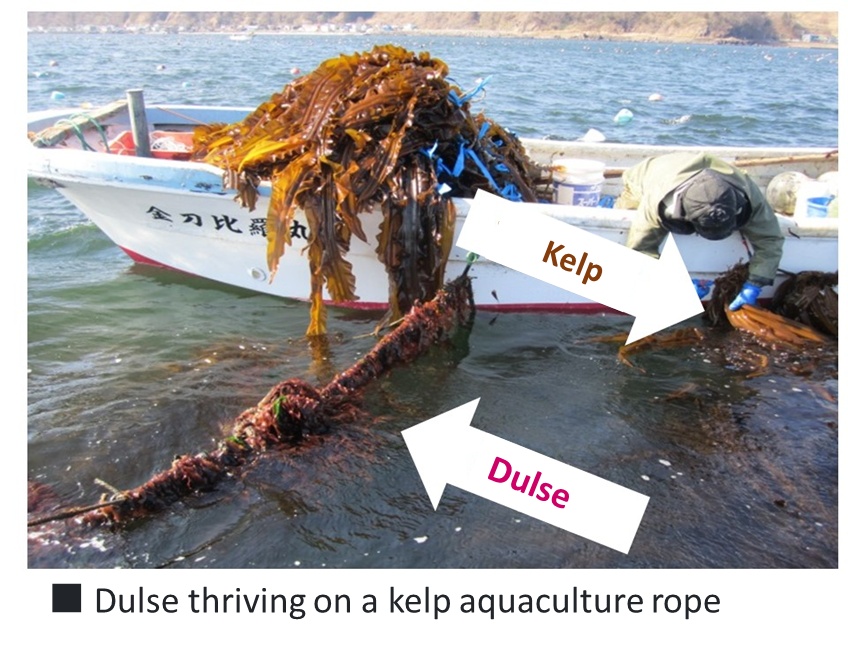
The largest production in this region is in the Minami-Kayabe area, where seaweeds of the genus Palmaria (called dulse) are known to thrive naturally in kelp aquaculture facilities. However, so far in Japan, it has not been harvested dulse and there are no examples of its industrial use.
Dulse is said to grow wild in Japan, mainly in Hokkaido and northern Honshu and northward, and is known to be eaten in some areas under the name “akahada” or other names. It is estimated that the annual amount of its resources in this region alone is approximately 1,000 to 2,000 tons, and the development of utilization technology is strongly desired, as well as the utilization as a new industrial species is expected. Therefore, with the support of professor YASUI Hajime, director of the Graduate School of Fisheries Sciences, Hokkaido University, and other professors, we have been studying the characteristics of dulse, an underutilized resource, and developing new applications for its use.
-
-
-
Dulse is a type of cold-sea seaweed classified in the same red algae family as laver, and has a reddish-purple color immediately after harvesting. It is said to be widely distributed along the Atlantic coast of North America and in northern Europe. In Ireland and Canada, dulse has long been eaten fresh as a salad, and its dried form has been used as a seasoning. Thus far, the use of dulse has been limited to fresh or dried products. Perhaps for this reason, academic research seems to be almost entirely limited to nutritional findings on the raw algae or on their drying characteristics. On the other hand, Japan has a technology for boiling and salting seaweeds, which is rare in the world, and we have excellent knowledge and much experience. Therefore, as a new direction for the development of new applications, we have attempted to explore the characteristics of the material and its suitability for use from a new, uniquely Japanese perspective.
As mentioned above, dulse has a reddish-purple color when raw, but it is not known what tint it develops when boiled. We first observed the color change of dulse when it was heated in boiling seawater. We found that dulse changed from the reddish-purple color of the raw algae to a greenish-green color. However, there are many green-colored seaweeds such as sea mustard and kelp, and vegetables such as chives and leeks, which are commonly used in our daily lives. Therefore, we further investigated to obtain a characteristic that is unique to dulse. As a result, we found that the green color of dulse, which is produced by boiling and heating, has a characteristic of being heat-resistant.
Only some of the results are shown here, though, boiling commercially available boiled and salted kelp and sea mustard in artificial seawater at 95°C for 4 hours causes grayish-browning and color degradation, but a similar experiment conducted on boiled and salted dulse confirmed that the beautiful green color was retained even after 4 hours of boiling. Next, in order to determine the extent to which this green color is resistant to heat, we observed the color tone after retort heating. Although the results are not shown here, it was confirmed that the green color of dulse, which had been once turned green by boiling in artificial seawater at 95°C, was not significantly degraded even after heating, when it was packed in packaging materials with 20 times the amount of the same solution and retorted at 120°C for 10 minutes. These results indicate that the green color of dulse can be retained even after retort heating, indicating that dulse has excellent heat resistance.
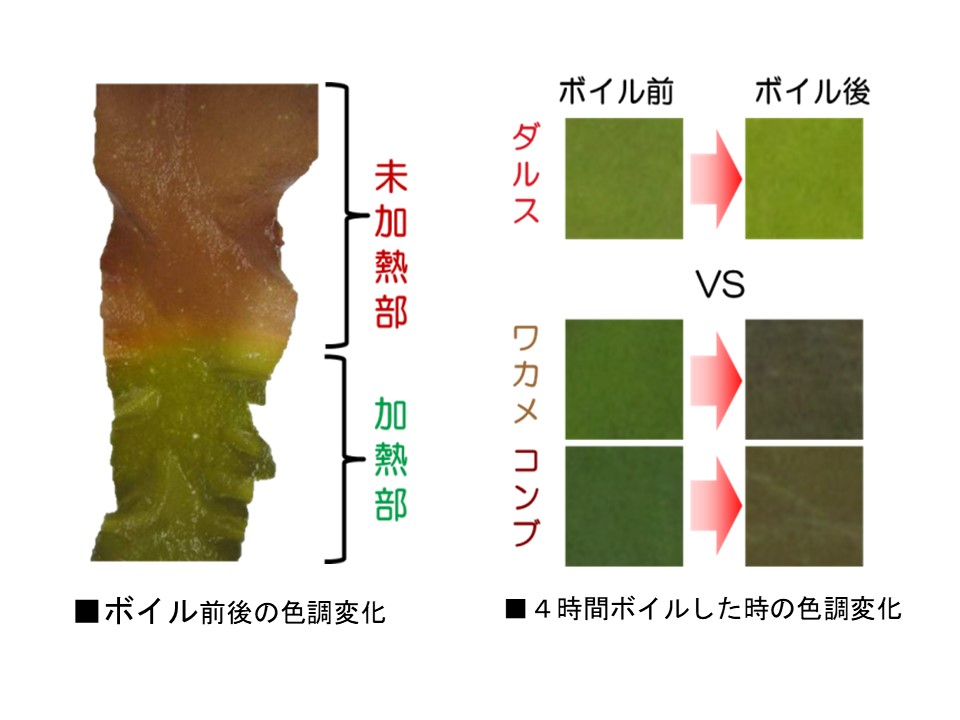
■left figure ボイル前後の色調変化: Color change before and after boiling
未加熱部: unheated part 加熱部: heated part
■right figure4時間ボイルした時の色調変化: Color tone change after boiling for 4 hours
ボイル前: before boiling ボイル後: after boiling
ダルス: dulse ワカメ: sea mustard コンブ: kelp
-
-
-
Our efforts to date have revealed that dulse has characteristics that are not easily found in other foodstuffs. However, unless their taste and texture are widely accepted by consumers, it is difficult to use them as food products. Therefore, in February 2014, dulse harvested in the Minami-Kayabe area of Hakodate were boiled and salted processed, and they were sold on a trial basis to gather comments from general consumers. As a result, the dulse was highly praised for its laver-like aroma and crispy texture not found in other seaweeds. We believe these comments are significant in accelerating the industrial use of dulse.
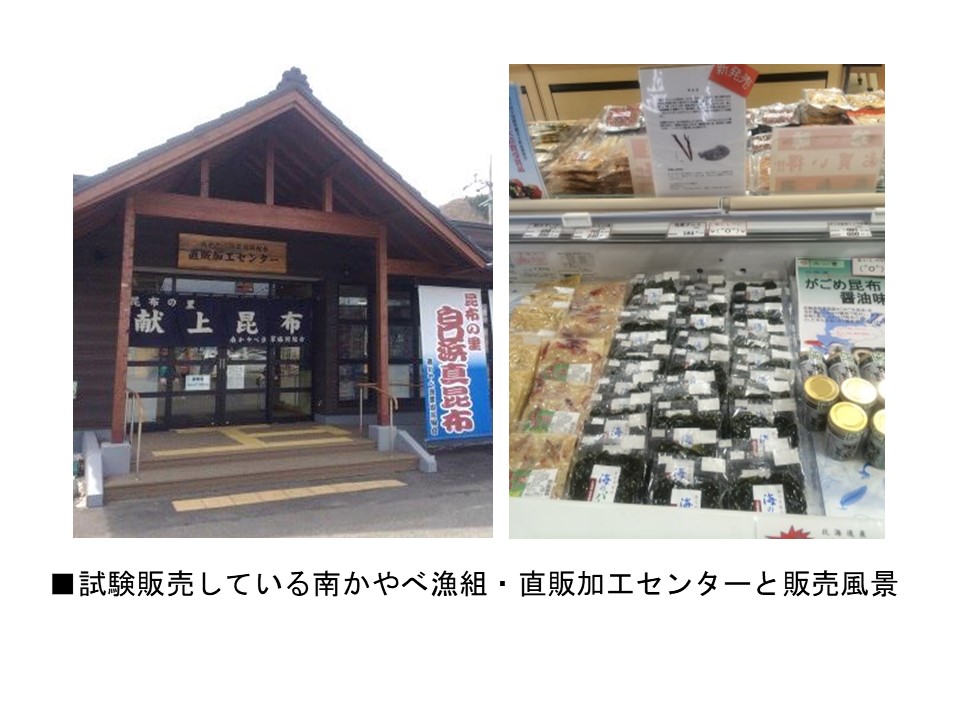
figure: Minami-Kayabe Fisheries Cooperative direct sales and processing center, where test sales are being conducted, and a view of the sales scene
In recent years, sales of retort pouch foods and chilled foods are said to be growing steadily as consumers become increasingly convenience conscious.
Retort heating is an excellent sterilization technology that enables long-term storage and distribution at room temperature, even for foods with high moisture content. However, the Food Sanitation Act requires that retort pouch foods produced by this method undergo a severe heat treatment with a central temperature of 120°C for 4 minutes or more. Chilled foods, which are often found in prepared foods, are often packaged and then subjected to secondary sterilization at 100°C or lower for several minutes to several dozen minutes to ensure a certain level of shelf life. Because of the constant heat treatment applied to all of these products, it is said to be difficult to maintain their vivid colors. In particular, it is said that retaining the green color in retort pouch foods is considered to be an eternal challenge.
The results of this study confirmed that the color tone (green color) of dulse, which has been turned green by boiling and other heat treatments, is sufficiently resistant to retort heating. We therefore believe that dulse is a very interesting material that offers new business opportunities for the food industry, which is seeking to create high value-added products that focus on color tones. We would like to develop meaningful applications for industrial use in the future with suggestions from people in related industries.
-