
About the protein component of dulse
Perfilado de sección
-
-
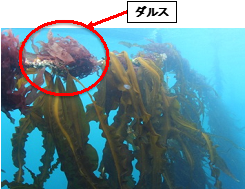
In the Minami-Kayabe area of southern Hokkaido, red algae of the genus Palmaria (hereafter referred to as “dulse”) naturally thrive on kelp culture ropes during the winter. The dulse is regarded by growers as a nuisance because it hinders the growth of cultivated kelp by preventing it from being exposed to sunlight. However, recent component analysis has revealed that dulse is rich in nutrients such as protein, dietary fiber, potassium, and B vitamins.
Against this background, we have been conducting research on structural characterization of pigment proteins abundantly contained in dulse and their health functionality with the aim of effectively utilizing this underutilized resource. In this page, we briefly introduce the results obtained to date.
■Photo by Dr. YASUI Hajime (Sho 55 Zo)
ダルス:dulse
-
-
-
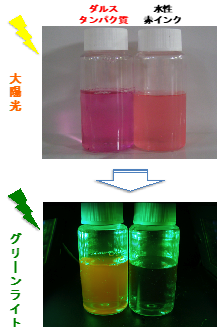
When water is added to a dried dulse sample, the red component is easily extracted. The color of the extract is bright red in sunlight and fluoresces strongly when illuminated by green light. These characteristics are attributed to “phycobiliprotein”, the major protein in the dulse phloem. In red algae, phycobiliprotein acts as an auxiliary pigment for photosynthesis, efficiently absorbing light at wavelengths that chlorophyll cannot.
ダルスタンパク質:dulse protein
水性赤インク: aqueous red ink
太陽光:sunlight
グリーンライト: green light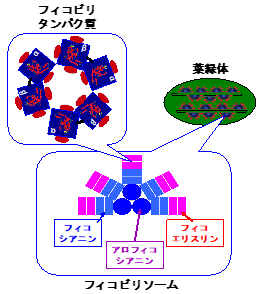
In general, phycobiliproteins of red algae are mainly composed of two types of subunits, α- and β-chains, which form circular doughnut-like assemblies consisting of three each of them. These doughnut-like structures are then further assembled to form a large aggregate called a phycobilisome. Phycobilisomes are arranged in large numbers on the surface of the chloroplast thylakoid membrane. The major phycobiliproteins of red algae are phycoerythrin (red), phycocyanin (blue), and allophycocyanin (purple). Their coloration is determined by the type of the pigment (phycoerythrobilin, phycocyanobilin, or phycourobilin) that bound apoprotein of α- and β-chains and number.
Protein extracts prepared from dulse were subjected to spectral analysis, which revealed that the main component of phycobiliproteins from dulse is red phycoerythrin, followed by phycocyanin and allophycocyanin. Therefore, dulse phycoerythrin was purified and crystals were prepared, and its three-dimensional structure was determined by X-ray crystallography. As a result, dulse phycoerythrin had the same three-dimensional structural characteristics as those of other red algae. In addition, to elucidate the genetic structure of phycobiliproteins from dulse, chloroplast DNA encoding the genes of phycobiliproteins was analyzed by a next-generation sequencer. As a result, the gene structures and primary structures of three phycobiliproteins (phycoerythrin, phycocyanin, and allophycocyanin) were clarified.
フィコビリタンパク質:phycobiliproteins
葉緑体:chloroplast
フィコシアニン:phycocyanin
アロフィコシアニン:allophycocyanin
フィコエリスリン:phycoerythrin
フィコビリソーム:phycobilisome
-