
Perfilado de sección

    • Elution of divalent iron ions (Fe2+) from iron hydroxide (Fe(OH)3)

       In oxygenated seawater, iron ions (Fe2+) are quickly oxidized and precipitated as iron hydroxide (Fe(OH)3) particles. Iron hydroxide deposited on the seafloor is reduced and leached as Fe2+ ions when placed under anoxic conditions in the sediment. The Fe2+ released from the sediment into the water directly above the sediment is oxidized relatively quickly, but if it encounters high molecular weight organic matter such as humic acid before being oxidized, it forms a complex and can remain dissolved as organic complex iron (II). The iron thus supplied to the water directly above and dissolved as organic complex iron is considered important for the marine iron cycle. In this course, we seek to determine the conditions under which iron hydroxide dissolves in sediments and is eluted as Fe2+.


    •  The half-reaction equation for the leaching of Fe2+ from iron hydroxide and the standard Gibbs energy of formation for each component (per mol) are shown below.


                            Fe(OH)3   +   3 H+   +    e-   = Fe2+   +     3 H2O   

      GF0 (kJ/mol)      696.9        0                  78.9       237.18


      The total difference in standard Gibbs energy of formation ⊿Gf0 between the product and the original form is,

      Gf0  = (3(273.18)+(78.9))(696.9) = 93.54×10³


      We calculate the standard electrode potential E0 for this half-reaction equation.

      E0 =-⊿GF0 / (nF)  = (93.54×10³) / 96485 / 1 = 0.969 (V)


       Using Nernst equation, given a certain Fe2+ concentration, pH (H+ concentration), and temperature (T = 273+25 K), find the redox potential E for this half-reaction. 

      E = E0 -RT/(F)Ln {  [Fe2+] / [H+]3 }

        =  0.969 0.024387Ln [Fe2+] + 0.0243873Ln [H+]

        =  0.969 0.024387Ln [Fe2+] + 0.073161(1/Log e)(pH)

        =  0.969 0.024387Ln [Fe2+] 0.168459pH


       When a colloid of Fe(OH)3 is suspended in seawater with a pH of 8.1 and a redox potential of 0.45 (V), the concentration of Fe2+ in dissolution equilibrium with that Fe(OH)3 must be very low, 0.0003 pmol/L (picomole: 10-12 mole). In other words, Fe(OH)3 particles are almost insoluble in seawater.

       The particles adsorb onto the organic particles as they settle and are deposited on the seafloor surface. In the fluffy layer on the sediment surface (0 to 1 cm above the sediment surface), there is a struggle between oxygen consumption by the decomposition of organic particles and oxygen supply from the water directly above, so that barely any oxygen remains. In such layers, the redox potential approaches zero. At E = 0.04 (V) and pH = 7.5, the dissolved equilibrium concentration of Fe2+ is 0.17 μmol/L. Although a concentration of Fe2+ of 0.17 μmol/L may seem low, the dissolved iron concentration (including colloidal iron and organic complex iron ) in seawater is about 10 nmol/L, so this is an order of magnitude higher. Once Fe2+ dissolved from Fe(OH)3 forms complexes with humic organic matter in the sediment surface layer, dissolution of Fe(OH)3 continues. In fact, measurements of dissolved iron concentrations in pore water in the 0 to 1 cm layer at the sediment surface have been found to reach several tens of μmol/L.

      (Most of the high concentrations of dissolved iron accumulated in the sediment surface layer are thought to be organic complex iron. The formation pathway is thought to be both the leached Fe2+ from Fe(OH)3 particles forming complexes with humic organic matter and the leaching of organic complex iron from the organic particles into seawater as a result of decomposition).

    • Again, we note the half-reaction equation and Nernst equation for the dissolution of iron hydroxide.


      Dissolution of iron hydroxide ( half-reaction equation): Fe(OH)3   +   3 H+   +    e-   = Fe2+   +     3 H2O      

      Nernst equation

       E = E0 -RT/(F)Ln {  [Fe2+] / [H+]3 [Fe(OH)3]

         =  0.969 0.024387Ln [Fe2+] / [Fe(OH)3]} - 0.168459pH


      (As a physical chemistry promise, in a solution reaction of a solid (Fe(OH)3), the solid concentration = 1, given that there is a sufficient amount of that solid.)


      The condition for separating the Fe2+ and Fe(OH)3 abundance ratios [Fe2+] / [Fe(OH)3] = 1,

      ([Fe(OH)3] = 1 (mol/L), so when [Fe2+] = 1 (mol/L))

       E = 0.969 - 0.168459pH.


      Taking pH on the horizontal axis and E on the vertical axis, this relational equation is depicted in the figure below.
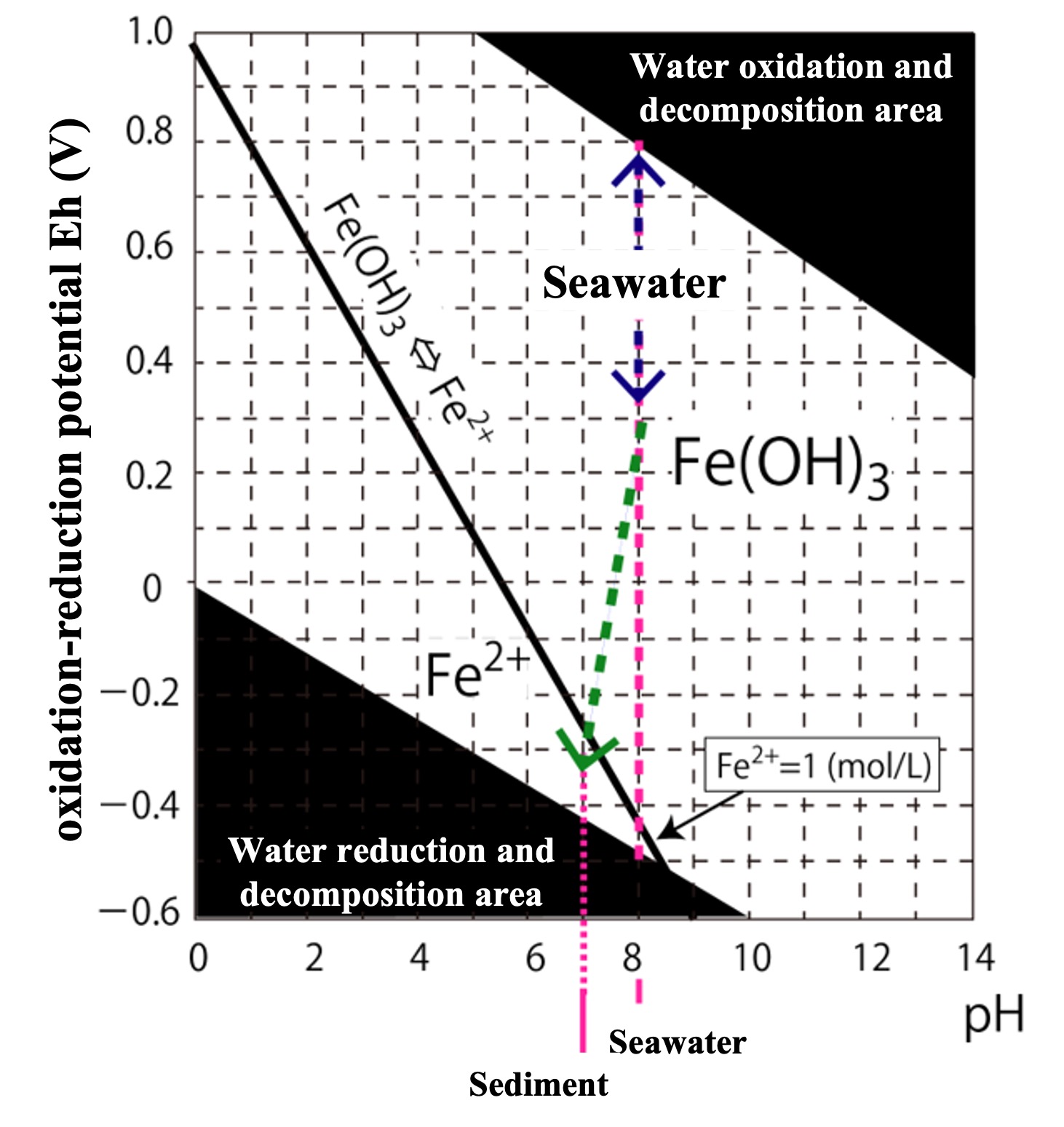
      Fig. 1

       The area above the black bold line in the boundary condition (Fe(OH)3 ⇔ Fe2+) means that solid Fe(OH)3 is present, and Fe2+ has reached dissolution equilibrium at less than 1 mol/L.

       So what would the line be for [Fe2+] < 1 mol/L?

       The line at the dissolution equilibrium concentration [Fe2+] = 1 µmol/L is added to the figure below. You can see a large shift.
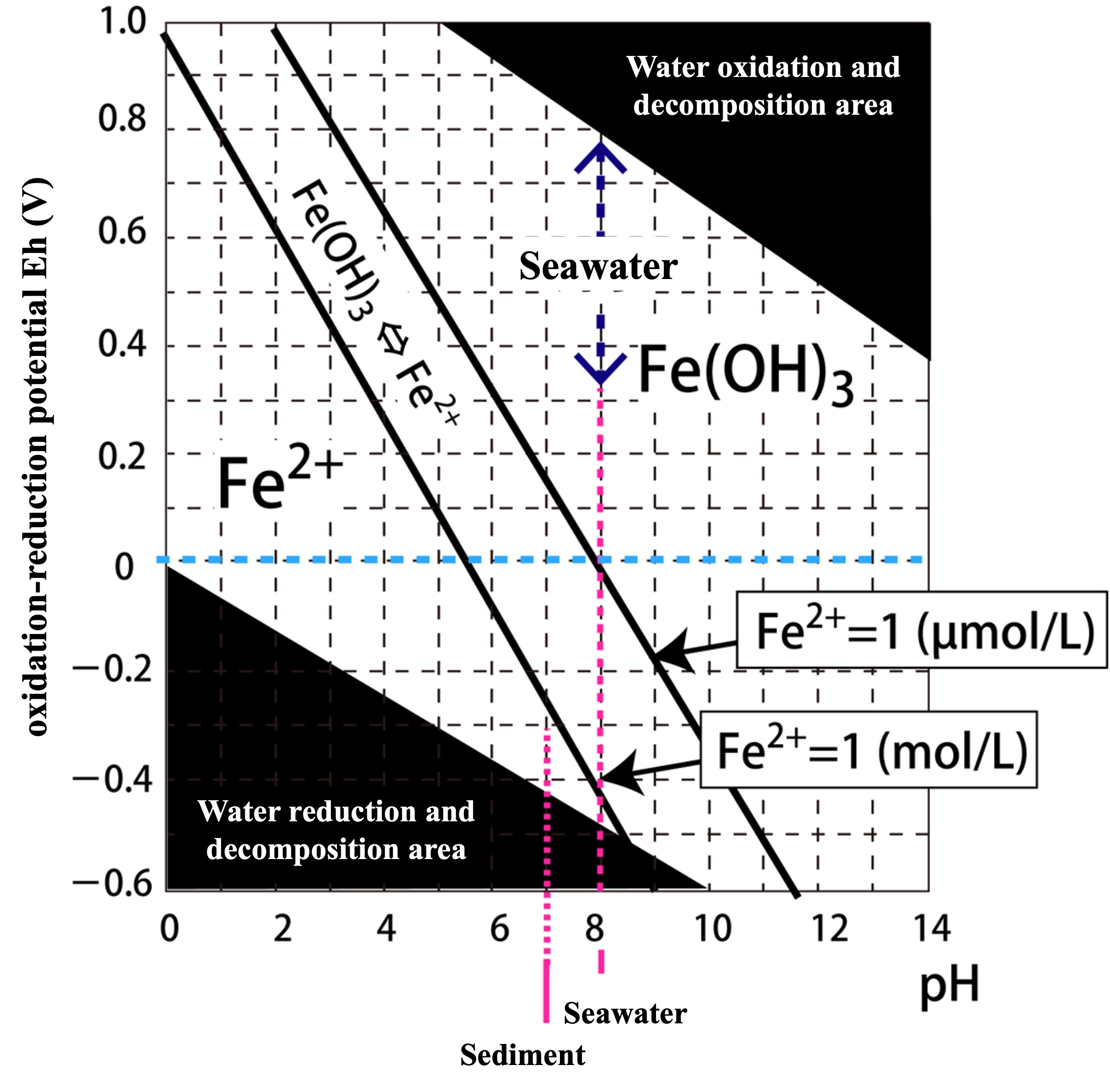
      Fig. 2

    •  If anoxic conditions exist near the sediment surface, the redox potential drops to near 0 (V). This causes a rapid dissolution of iron hydroxide (Fe(OH)3) precipitated on the sediment surface, and the concentration of Fe2+ reaches a dissolution equilibrium of several tens of µmol/L. This is a thousand times higher than the dissolved iron concentration in the seawater immediately above. In deeper sediments, hydrogen sulfide is produced by the action of sulfate-reducing bacteria when the concentration drops to -0.1 (V).
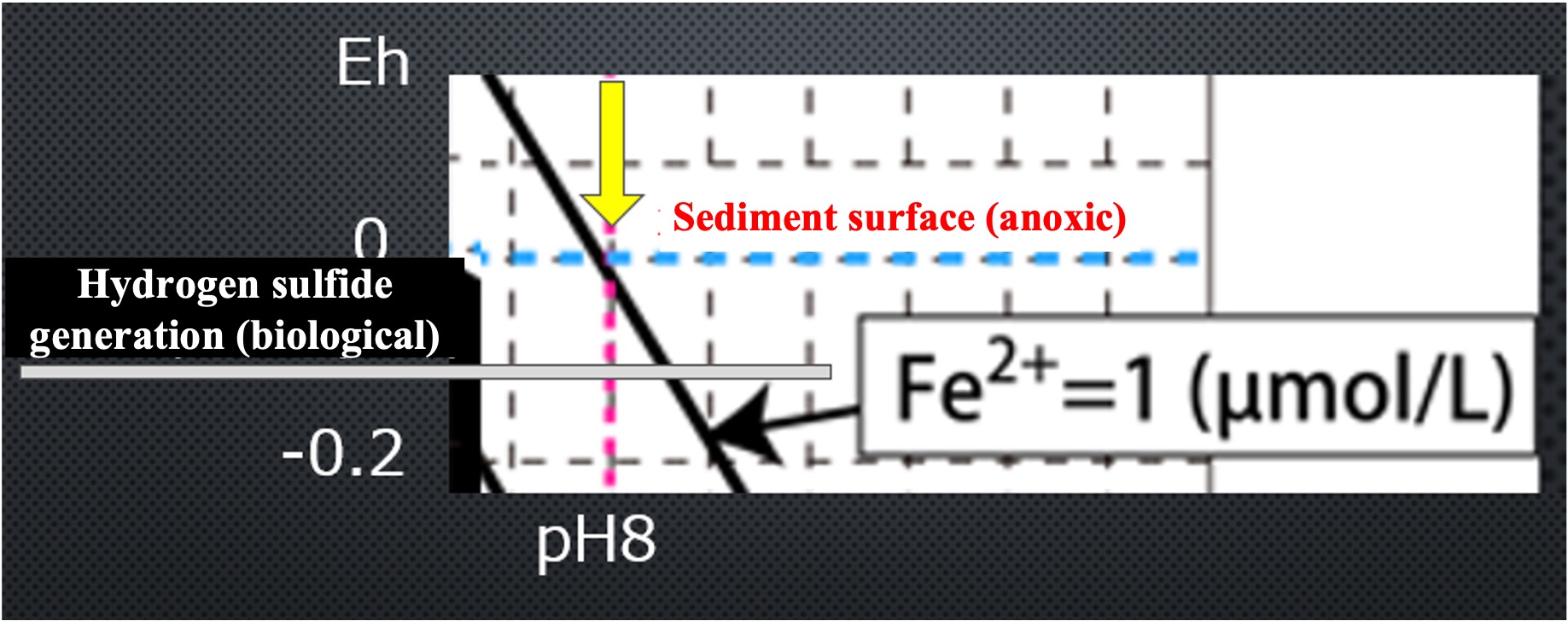
      Fig. 3

    •  Where hydrogen sulfide ions occur, the presence of previously leached Fe2+ causes a reaction between the two, resulting in the black precipitation of iron sulfide FeS. FeS (which eventually becomes FeS2) does not dissolve easily, so it will be buried deep beneath the seafloor, creating iron deposits of pyrite (FeS2) in a few tens of millions of years . Thus, in sedimentary layers that have progressed to sulfate reduction, the concentration of dissolved Fe2+ ions in the pore water will be significantly lower. HS- ions that occur relatively deep in the sediment and escape reaction with Fe2+ are transported by molecular diffusion to the upper part of the sediment. HS- ions are oxidized when they encounter oxygen, so HS- ions are affected only up to a redox potential near zero (anoxic layer). If the water directly above the marine sediments is anoxic for some reason, HS- ions may be affected up to near the surface of the sediments. Of course, if the bottom waters of the ocean are anoxic and the redox potential of seawater falls below -0.1 (V), sulfate reduction occurs in the seawater and HS- ions are generated. This can happen when bottom water stagnates in a closed system inner bay.