
Section outline

    • Total and half-reaction equations for respiratory responses


       Respiration is an oxidation-reduction reaction. Redox reactions can be divided into reactions in which an oxidizing agent receives electrons, and reactions in which a reducing agent gives electrons. The divided reaction equation is called a half-reaction equation. Write down the total reaction and half-reaction equations of oxygen respiration.


       All reactions of oxidation of formaldehyde (oxygen respiration)

      CH2O + O2  →  CO2 + H2

       In its original form (before the reaction), the reducing agent is CH2O and the oxidizing agent is O2. Considering the electron transfer between the oxidizing and reducing agents, the half-reaction can be written as follows. Since there is plenty of water (2H2O) in the surroundings, when creating a half-reaction formula, H2O and 4H+ should be added so that the number of hydrogen atoms and oxygen atoms match.  

       CH2O + H2O   → CO2 + 4H+ + 4e-   

      O2 +  4H+ + 4e-  →  2H2


       The redox reaction can also proceed in the opposite direction depending on the conditions. For example, reverse the entire reaction of oxygen respiration.

      CO2 + H2O   →  CH2O + O2

      This is the production of organic matter through photosynthesis.

      The oxidizing agent in the left side is CO2 and the reducing agent is H2O.

      Originally, it is not possible to determine which way to proceed with only the reaction formula of the oxidation-reduction reaction. Since we don't know which way it will go, it is a chemical rule to put the oxidizing agent in the original form (left side) and connect it with an equal sign (=).

      CO2 + 4H+ + 4e- =   CH2O + H2

      O2 +  4H+ + 4e-  =  2H2O   


       I will explain how to make a half-reaction formula in LASBOS Moodle's analytical chemistry (to be provided by Ohki). Please wait. It is described in detail in general chemistry textbooks, so please study there.


    •  Below, I wrote out the half-reaction formula of the respiration reaction that oxidatively decomposes organic matter (formaldehyde) with each oxidizing agent. ① is a half-reaction of organic substance oxidation common to each respiratory reaction.

       I have also noted the total difference between the standard Gibbs energies of formation of substances (excluding electrons) in the original and product forms of the half-reactions. As we will see in the next course, the electrons are given negative energy so that the energies of the original and product half-reaction equations are equal. The electron energy is [charge amount]*[potential], so the potential specific to each half-reaction is determined.
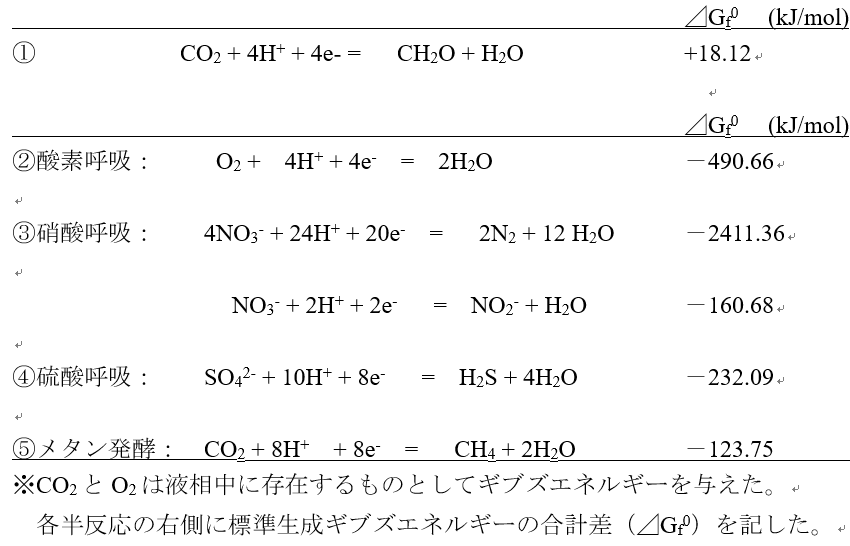


      ②酸素呼吸:oxygen respiration

      ③硝酸呼吸:nitrate respiration

      ④硫酸呼吸:sulfuric acid respiration

      ⑤メタン発酵:methane fermentation

      CO2O2は液相中に存在するものとしてギブズエネルギーを与えた。

      Gibbs energies are given for CO2 and O2 as they exist in the liquid phase.

      各半反応の右側に標準生成ギブズエネルギーの合計差(ΔGf0)を記した。

      The total difference in standard Gibbs energies of formation (ΔGf0) is noted to the right of each half-reaction.