

Alkalinity and Dissolution of Calcium Carbonate Particles in the Ocean
섹션 개요
-
-
Alkalinity is defined as the difference in charge between the cations and anions of the strong electrolytes in seawater, and weak electrolytes (mainly carbonate ions) are added to seawater to keep it electrically neutral.
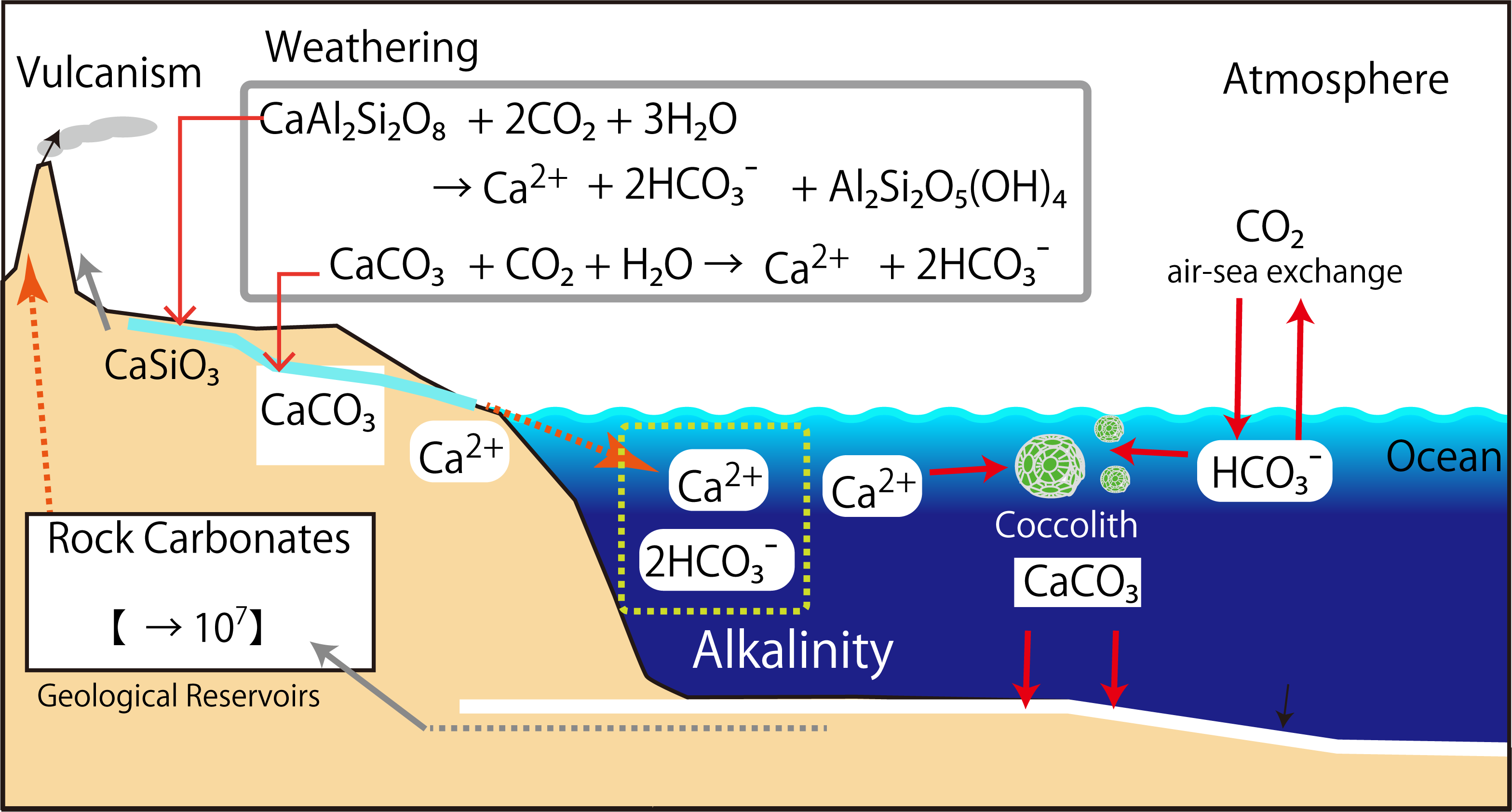
How does alkalinity occur? The following picture illustrates the causes of alkalinity.
Minerals exposed on the ground surface (basaltic and carbonate rocks) come into contact with rainwater. Since rainwater contains carbonic acid, the mineral components are dissolved by the reaction equation enclosed in "Weathering" below. This river water dissolved with calcium ions (Ca2+) is fed to the ocean. In the ocean, coccoliths and other organisms absorb hydrogen carbonate ions (HCO3-) and Ca2+ to form calcium carbonate (CaCO3) shells deposited on the sea floor. In the ocean, the supply of Ca2+ from mineral weathering is balanced by the formation of CaCO3 by marine organisms. Therefore, a slight excess of calcium ions is maintained in the ocean. This is the cause of the alkalinity.
-
-
-
The formation and dissolution of calcium carbonate particles is a major determinant of the alkalinity in the ocean. The conditions under which calcium carbonate particles dissolve in seawater are described below. Calcium carbonate particles in surface seawater do not dissolve permanently. This is because surface seawater is supersaturated with calcium carbonate. In deep seawater, under some conditions, it is undersaturated for calcium carbonate and the particles will dissolve.
Why was this found to be the case? It is because it is clear that the compositional distribution of marine sediments differs greatly between the Atlantic and Pacific Oceans.
Compositional distribution of marine sediments
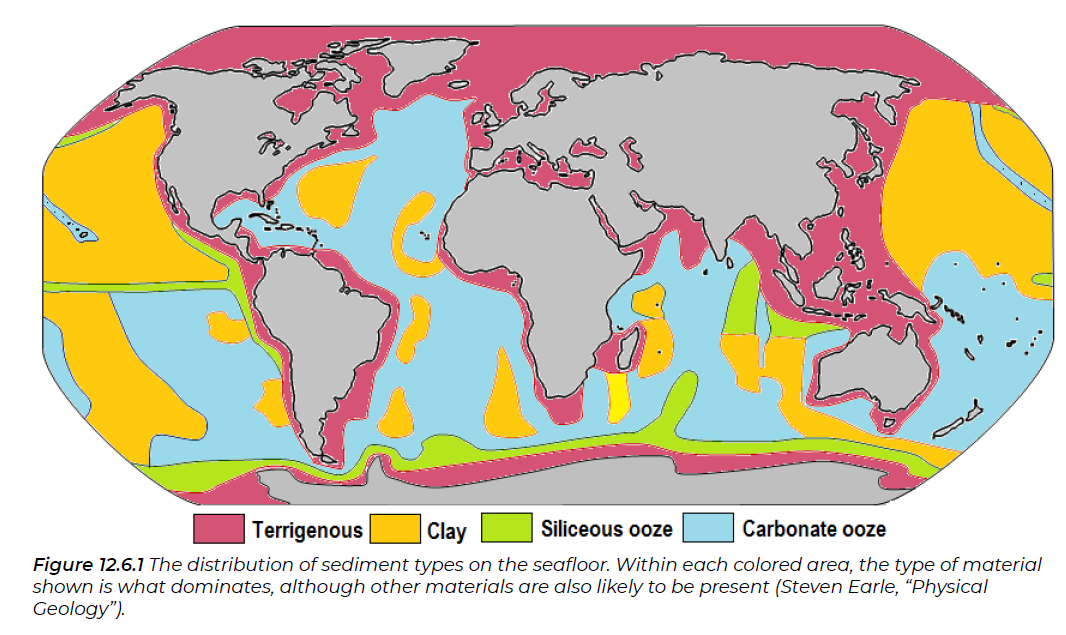
Introduction to Oceanography by Paul Webb, figure 12.6.1 used under a CC-BY 4.0 international license.
Download this book for free at http://rwu.pressbooks.pub/webboceanography
The figure 12.6.1 was referred from Steven Earle, “Physical Geology” open access text book) -
Dissolution of calcium carbonate particles proceeds when the concentration of carbonate ions in seawater decreases (pH drops) and pressure increases. The figure below illustrates how biogenic calcium carbonate particles produced in the ocean surface layer settle out and are deposited on the seafloor. It is divided into three layers.
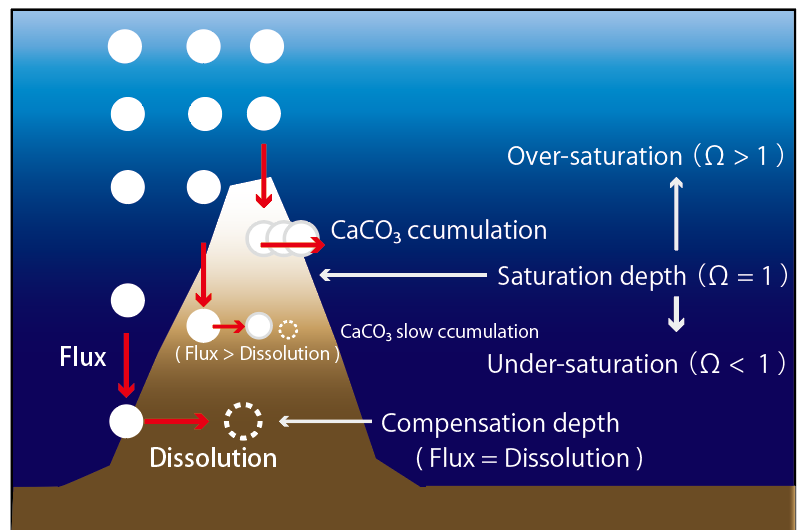
The depth at which carbonate particles are deposited and dissolved
-