Section outline


    • View of collecting a sediment trap placed in the Chukchi Sea (Pacific Arctic Ocean land shelf area) (LASBOS youtube video)

       Sediment traps were installed in the land shelf area of the Chukchi Sea (north of the Bering Strait) in the Arctic in July 2017 by the research voyage of the training ship Oshoro Maru of the Faculty of Fisheries of Hokkaido University. The purpose of the trap is to capture (trap) particles that accumulate on the bottom of the Arctic Ocean for one year. In July 2018, one year after the trap was installed, the Oshoro Maru headed back to the Chukchi Sea to collect the sediment traps. The sediment traps are connected to a weight (about 500 kg) that is dropped to the seafloor. The weight is connected to the sediment trap by a disconnecting device. The first step is to send an ultrasonic command to the detachment device. The first nerve-wracking part is to see if we get a response. If there is no reply, the detachment device has either malfunctioned or has been swept away and lost. We then send the detachment signal and detach. The next nervousness is, "Will it really float? If the weight and the rope of the sediment trap are entangled, it will not float. If the float is damaged, it will not float. The surveyor, the crew, and the entire crew will be watching the situation.


      The sediment trap was successfully recovered. Dr. Sanpei is analyzing the sample and analyzing the results.

    • Sediment trap observation to capture settling particles

       The only way to capture particles settling in the ocean is to submerge a large roto in seawater and collect particles falling from above. A cup is placed under the large rote to collect the particles and is rotated by a timer device. The particles that settle in each season can be collected in the cup. This is called a sedimentation trap. Every year, we have to go out to the distant ocean by observation ship to set up and collect the sedimentation traps. Currently, JAMSTEC is actively conducting sediment trap observations in Japan. Although it requires considerable effort and expense, it has provided valuable data for understanding the global environment, such as seasonal changes in sedimentation particles, factor analysis through component measurements, and long-term trends that can be captured by continuing the program for many years.


       Sediment traps moored in the ocean can become unrecoverable due to some malfunction. Not only is the observation data lost, but the loss of expensive equipment is also a major economic blow. When we throw in a trap, we pour sake over it to purify it before throwing it in. (I'm not kidding.) After the trap has been deployed, it is up to God to take care of it.


      ① We transport the sediment traps by observation vessel to the area where we observe the settling particles
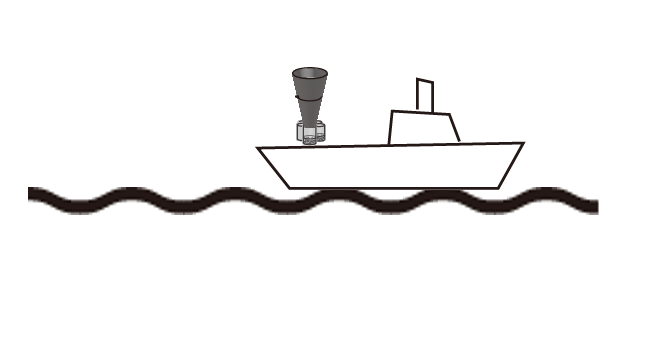

      ② Sediment traps are moored in the ocean and sedimentation particles are collected in sample cups for one year. The 24 sample cups are strung together so that they can be collected twice a month for one year.
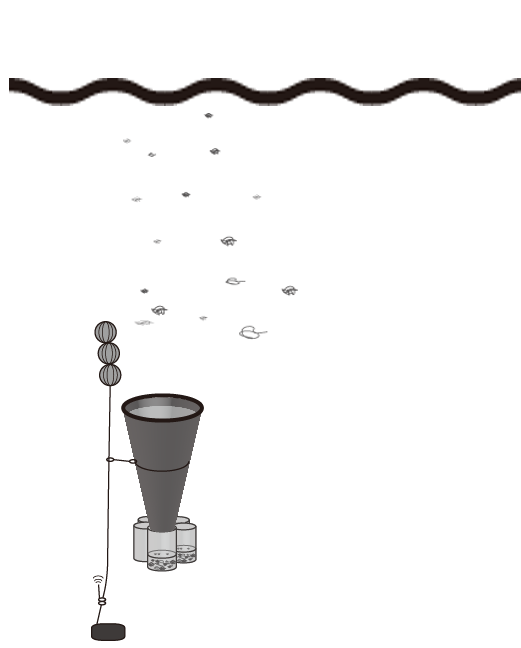


      ③ A year later, an observation ship will be in the same area, the sediment traps and weights will be detached, and the sediment traps will be floated.
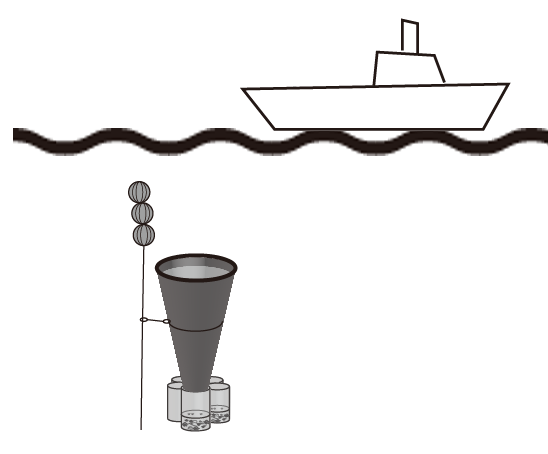


      ④ On board, the sample cup is removed from the sedimentation trap and the settled particles are processed.
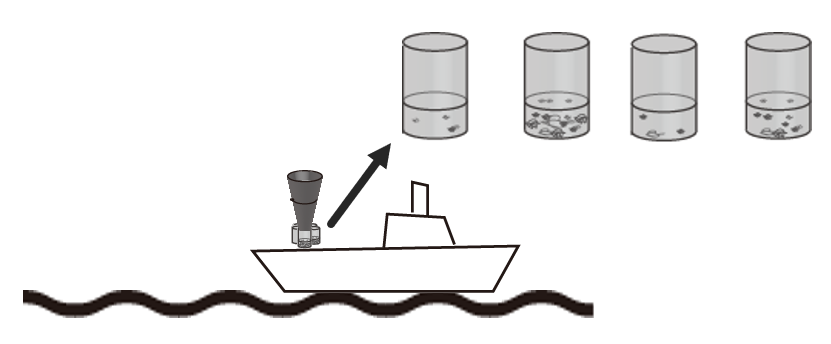


       In the past, the School of Fisheries Sciences at Hokkaido University also continued to conduct sediment trap observations, but no longer does so. We sometimes send out the Training Ship Oshoro-Maru to conduct sediment trap observations for large-scale research projects, such as the Arctic Research Project.
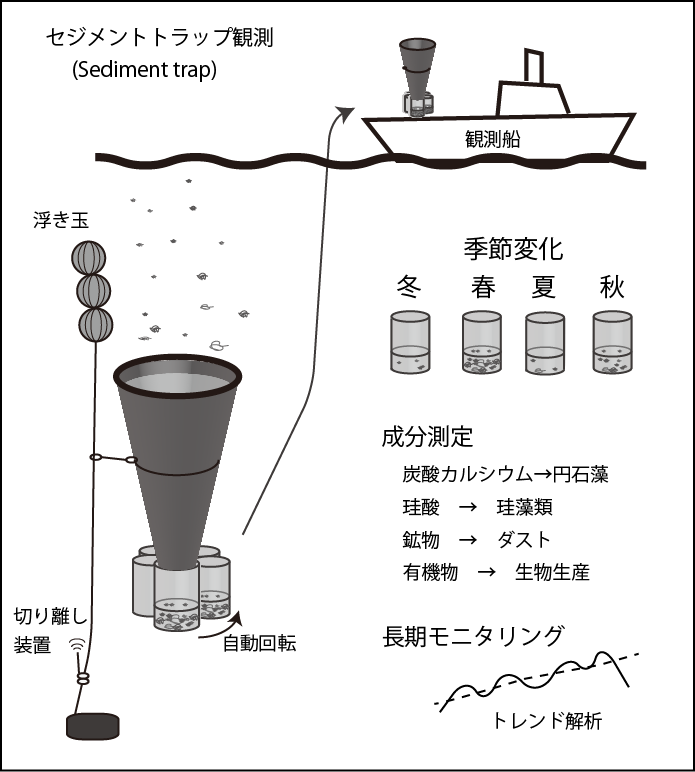


      セジメントトラップ観測 Sediment Trap Observation

      浮き玉 floating ball

      切り離し装置 Detachment device

      自動回転 Automatic rotation

      観測船 Observation Vessel

      季節変化 Seasonal change

      冬 Winter

      春 Spring

      夏 Summer

      秋 Autumn

      成分測定 Compositional Measurements

      炭酸カルシウム→円石藻 Calcium carbonate → circular calcareous algae

      珪酸→珪藻類 Silicic acid → diatoms

      鉱物→ダスト Minerals → dust

      有機物→生物生産 Organic matter → biological production

      長期モニタリング Long-term monitoring

      トレンド解析 Trend analysis


  • Thank you for your hard work.


    • "Research begins with believing!"


       When I (the author) was a doctoral student, I participated in a research voyage of the Tansei-Maru (淡青丸) (then the University of Tokyo) and waited for the arrival of DSS in the Pacific Ocean. I wanted to investigate the mixing state of DSS particles and anthropogenic pollutants. My advisor, Dr. Uematsu, had a bold statement to make: "Whenever I get on a ship, something always happens." This "something" could be a natural phenomenon that I expected to observe or a sudden natural phenomenon that I did not predict. I have a vague recollection that during the voyage in which Dr. Uematsu participated, an eruption occurred on a volcanic island upwind of the ship, and a Siberian forest fire plume was captured in the Pacific Ocean. Although it is partly coincidental, Dr. Uematsu has a keen sense of smell to catch these phenomena and is agile enough to turn them into research results.


       Now, as we were waiting for the DSS attack on the ship, the chemical weather forecasting system (CFORS;Research Institute for Applied Mechanics Kyushu University) revealed that a large-scale DSS was about to hit the area. Dr. Uematsu was very proud of his work, saying, "It's like I said!"  "Touch the air outside, and you'll feel the roughness on your cheeks, Mr. Oki! The yellow dust is here. "I said calmly, "Sir, that's not yellow sand, it's just sea salt particles sticking to you and making you sticky. Or maybe you just haven't shaved your beard. "The doctor said, "Idiot! Research begins with believing!!" At that time, I felt uneasy as the one being instructed, "Oh, really, that's okay?" I remember feeling uneasy as the one being instructed.

       More than 15 years have passed since then. I have come to realize that when conducting research with nature, the only way is to "believe" in something and continue observation. When I am observing, I do not always get results one after another, and in many cases, I do not get results until I have been doing it for more than a year. In such cases, we have no choice but to believe that the results will be excellent or as expected. However, more often than not, after a year or more has passed and the data is available, we are betrayed by what we believed. That is where we have to step up to the plate. We must think about the reasons for the betrayal and believe again that this is where the real research begins and leads to new discoveries.


       Belief is important not only in research against nature, right? Everyone, even if you are betrayed, even if you are betrayed, don't be chastened, but believe. Everything begins with believing!! (Motto: Oki)


  • The Arctic Ocean