セクションアウトライン

    • KEIRI Imai, KENJI Oguma, and KOUKI Sawada, Oshoro-maru Marine Science Department, School of Fisheries Sciences, Hokkaido University

      Piston corers are a type of columnar sampler that can collect very long undisturbed columnar samples (cores) up to 20 meters below the seafloor without causing disturbance.

       Sediments record global activities (events) such as glacial and interglacial periods, changes in the global environment and climate, and traces of the flourishing of certain organisms, starting from the oldest to the youngest. Therefore, the deeper the sediments are collected, the older the age of the environment can be estimated, and knowledge of past global environmental changes can be used to predict future environmental changes. The piston corer is equipped with a piston mechanism that allows the corer tube to penetrate to a greater depth, making it the deepest gravity free-fall type corer capable of collecting sediments. It is said that samples collected by the piston corer can estimate the Earth's environment from several hundred to several hundred thousand years ago. Sediment samples collected using the piston mechanism have the advantage of being more accurately dated than other types of core samplers because the core is less compacted.


       In this course, the equipment configuration and mechanism of the piston corer and the actual mud sampling process will be explained in detail.


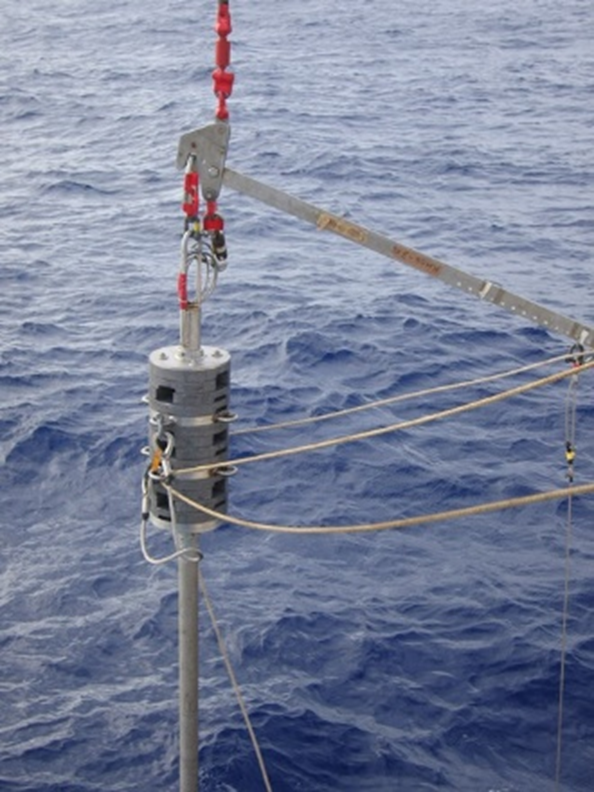
    • Fig. 1 Piston corer

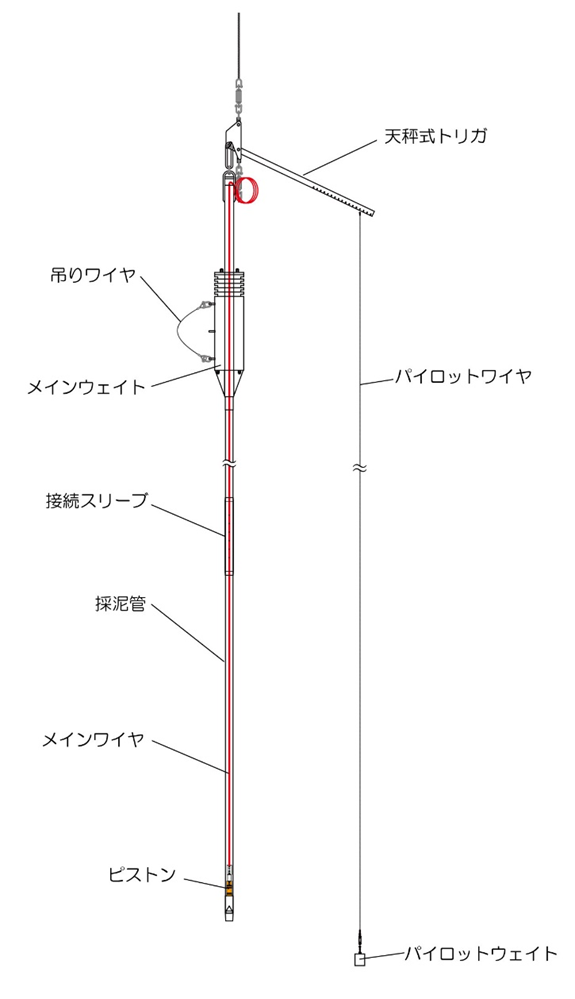
    • A schematic diagram of the bottom sampler is shown in Figure 2.

       The part that collects sediments by free-falling through the water (hereinafter referred to as "bottom sampler") consists of a metal pipe (bottom sampler tube), a weight (main weight) weighing several hundred kilograms, and a piston, from which the name "piston corer" is derived. The trigger part for operating the bottom sampler consists of a balance trigger, pilot wire, and pilot weight. The mechanism of each part of the operation is described in detail in a later chapter.


    • Fig. 2 Schematic diagram of piston corer

      吊りワイヤ Suspension Wire

      メインウェイト Main Weight

      接続スリーブ Connecting Sleeve

      採泥管 mud sampler pipe

      メインワイヤ Main Wire

      ピストン Piston

      天秤式トリガ Balance Trigger

      パイロットワイヤ Pilot Wire

      パイロットウェイト Pilot Weight

    • The mud sampler pipe can be adjusted to the length of the desired sample by connecting several pipes together with a metal fitting (connecting sleeve). In some cases, a vinyl chloride inner tube of the same length may be attached to the inside of the mud sampler pipe to facilitate extraction and division of the sampled material. A main weight corresponding to the length of the mud sampler pipe is used to push the mud sampler pipe into the ground, because the longer the pipe is, the more force is required to push it into the ground.

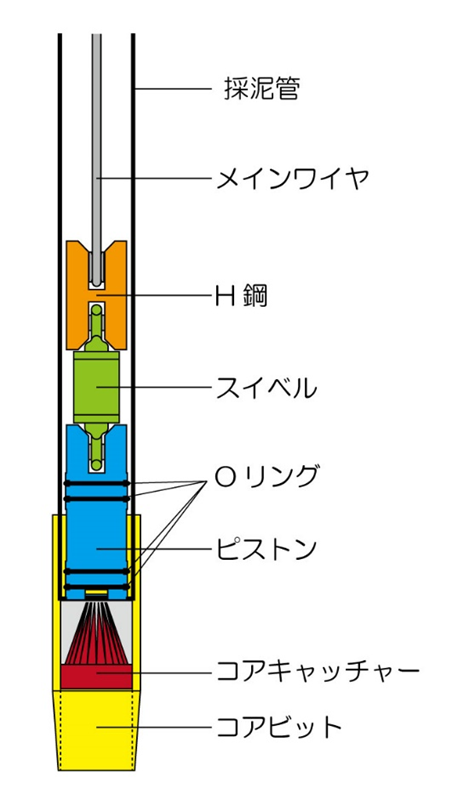
       A schematic of the end of a mud sampler pipe is shown in Figure 3. The piston is connected to the balance trigger by a wire rope (main wire) that passes through the mud sampler pipe (Figure 2). The piston incorporates a rubber packing (O-ring), which adheres to the mud tube to maintain a watertight seal. A core bit with a pointed tip is attached to the bottom end of the mud sampler pipe to facilitate penetration of the mud sampler pipe into the sediment. In addition, a check valve (core catcher) is built into the core bit to prevent sediments in the core bit from falling out of the mud sampler pipe.

    • Figure 3 Schematic drawing of the tip of a mud sampler pipe

      採泥管 Mud sampler pipe

      メインワイヤ Main Wire

      H鋼 H Steel

      スベイル Sveil

      Oリング O-ring

      ピストン Piston

      コアキャッチャー Core catcher

      コアビット Core bits


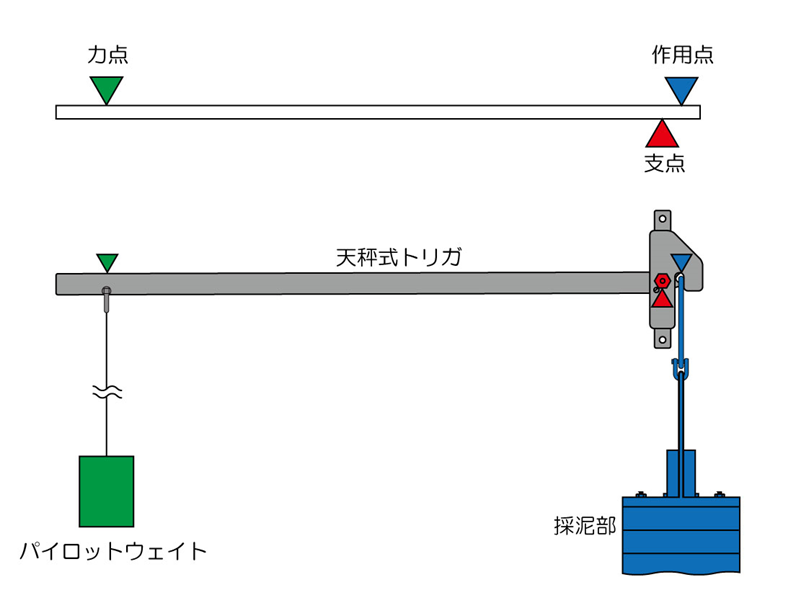
    • The mud sampling section is suspended by a special metal fitting that functions as a free-fall trigger. This metal fixture uses the principle of leverage to suspend the mud sampling section, and is called a "balance trigger" because it moves like a balance. In the balance trigger, a pilot weight is suspended from a force point far from the fulcrum, and the mud sampling section is suspended from a point of action very close to the fulcrum (Figure 4). The pilot weight is about one-tenth the weight of the mud sampling section, but because it is suspended far enough from the fulcrum, the balance is tilted toward the pilot weight.

    • Fig. 4: Balance trigger mechanism (1)

      力点 point of effort

      作用点 Point of load

      支点 fulcrum

      天秤式トリガ Balance trigger

      パイロットウェイト Pilot weight

      採泥部 Mud Collecting Section

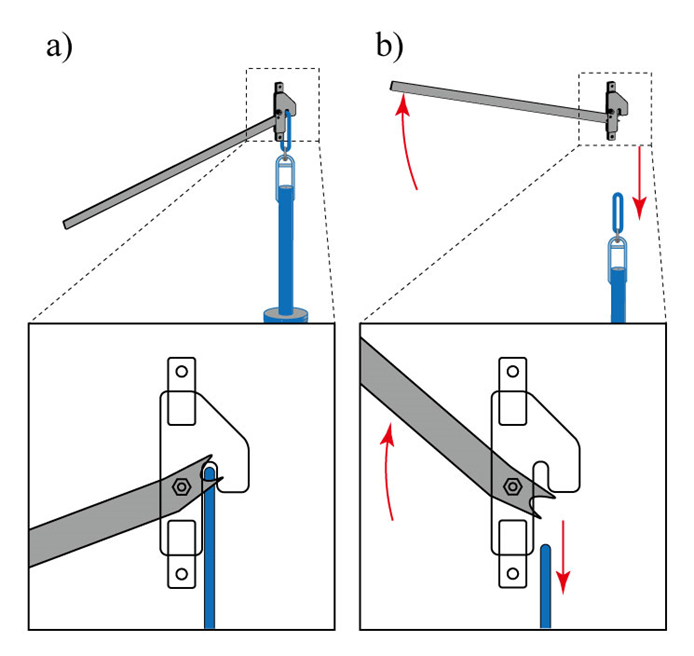
    • When the balance is tilted toward the pilot weight, the mud sampling section is held suspended by the balance trigger (Figure 5-a). When the pilot weight reaches the seafloor or the force applied to the force point weakens, the balance tilts toward the mud sampling section and the sampling section is detached (Figure 5-b).

    • Fig. 5 Mechanism of the balance trigger (2)

      a) State before trigger activation b) State when trigger is activated


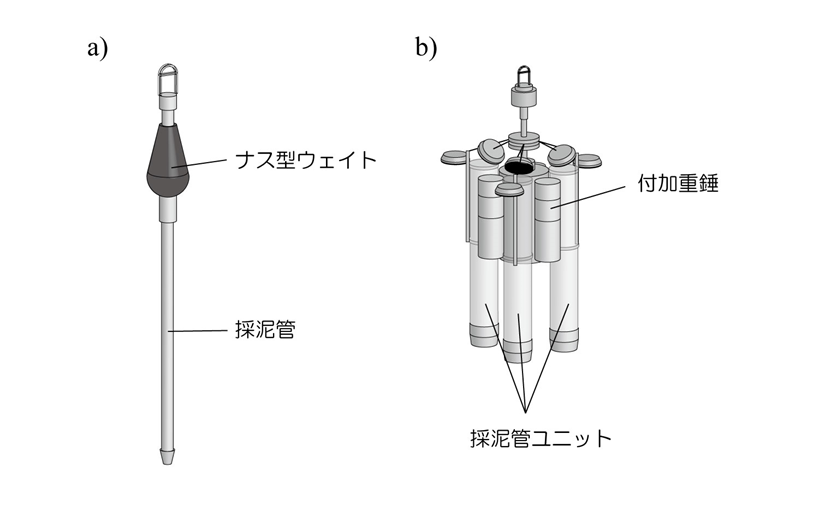
    • When the piston corer lands on the bottom, the impact often blows away the surface sediment. A small columnar corer, as shown in Figure 6, can be used in place of a pilot weight to collect surface sediments separately. The Frager corer (Fig. 6-a) is a mud sampler with a weight attached to the top of the mud sampler pipe, which penetrates the seafloor under its own weight to collect surface sediments several tens of cm below the surface. A check valve attached to the lower part of the collecting pipe and a lid on the upper part, which closes when collecting, hold the sediment and prevent it from falling out. The Ashlar Mud Collector (Fig. 6-b) uses the same mud collection tube unit as the Multiple Coaler and is a surface sampler that collects undisturbed, high-quality surface sediment samples by sealing the top and bottom of the collected cores with a lid.

    • Figure 6 Pilot corer

      a) Frager corer

      b) Ashlar corer (G.S. type surface corer)

      ナス型ウェイト Eggplant type weights

      採泥管 Mud sampling pipe

      付加重錘 Additional Weights

      採泥管ユニット Mud sampling pipe unit


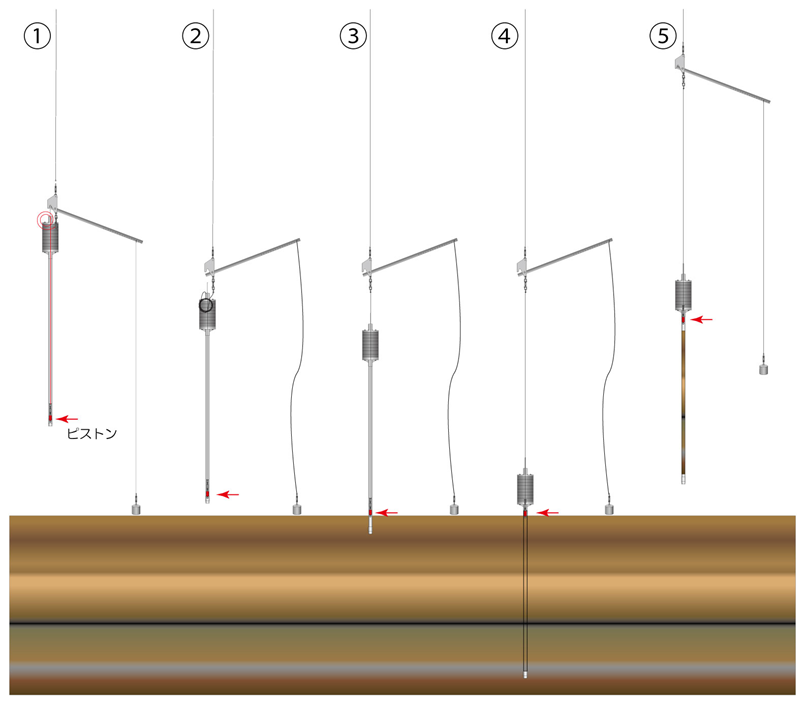
    • As shown in Figure 2, the piston corer is prepared in the sea, and when it is lowered to the seafloor, the mud sampling part is detached from the balance trigger and thrust into the seafloor surface. Figure 7 shows the sequence of this operation.


       As the piston corer set on the balance is lowered to the seafloor, the pilot weight reaches the bottom before the mud sampling section (Figure 7-①). When the pilot weight is unloaded, the balance trigger is activated, and the mud sampler is free-fallen toward the seafloor (Figure 7-2). Eventually, the mud sampling pipe reaches the seafloor surface and begins to penetrate, while the piston remains near the seafloor surface. This is because the length of the main wire is adjusted so that the piston is positioned just above the seafloor (Figure 7-3). (Figure 7-3). The piston rises relative to the mud sampler as the mud sampler tube penetrates into the seafloor, generating a suction force that does not destroy the sedimentary layer. The weight of the mud sampler and this suction force cause the mud sampling pipe to penetrate into the seafloor (Figure 7-④). The winch is slowly wound up and the mud sampling pipe is pulled out from the seafloor (Figure 7-5). The suction force generated by the piston acts as a lid for the mud sampling pipe, preventing the sample from falling out during lifting.

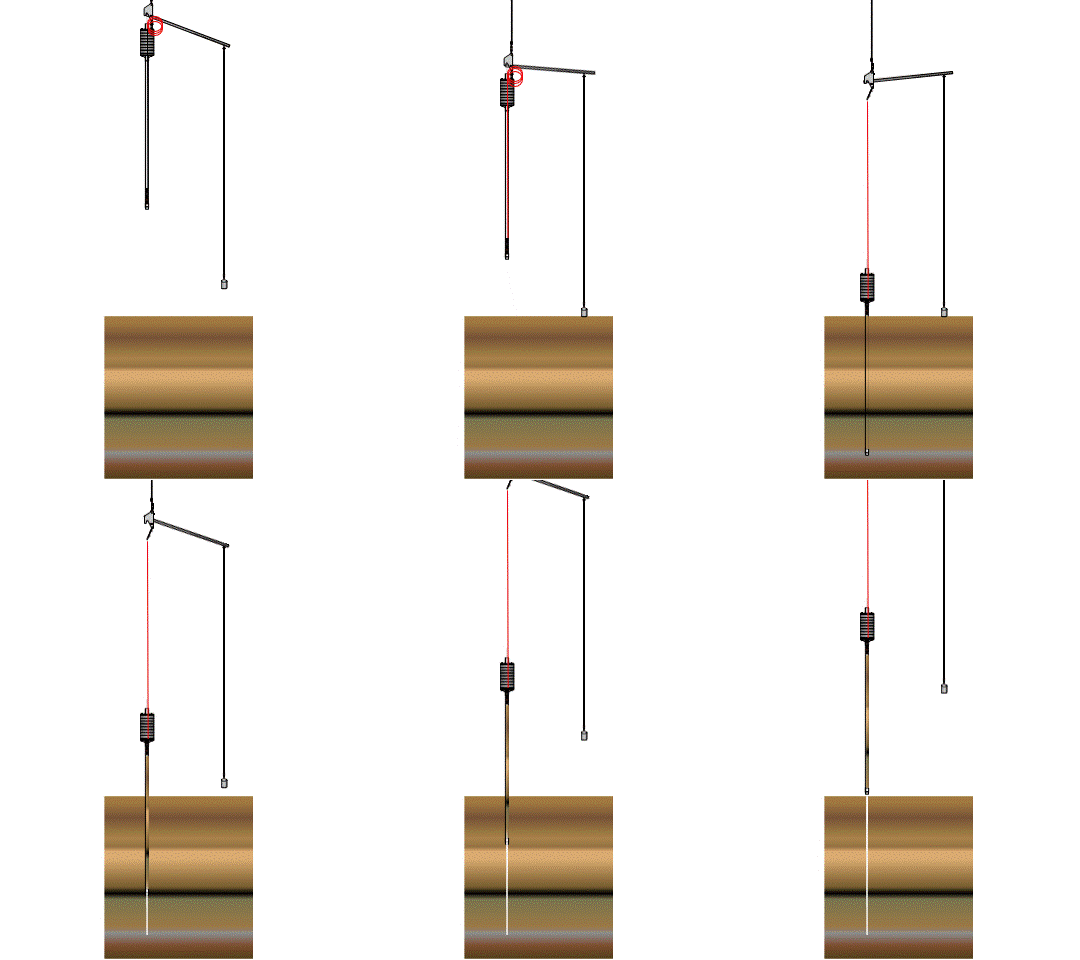
       The sequence of operations shown in Figure 7 is shown in Figure 8 as an animated sequence. In actual operation, the penetration of the sampling tube is completed within a few seconds after the start of free fall.


    • Fig. 7 Piston corer operation (1)


    • Fig. 8 Piston corer operation (2)


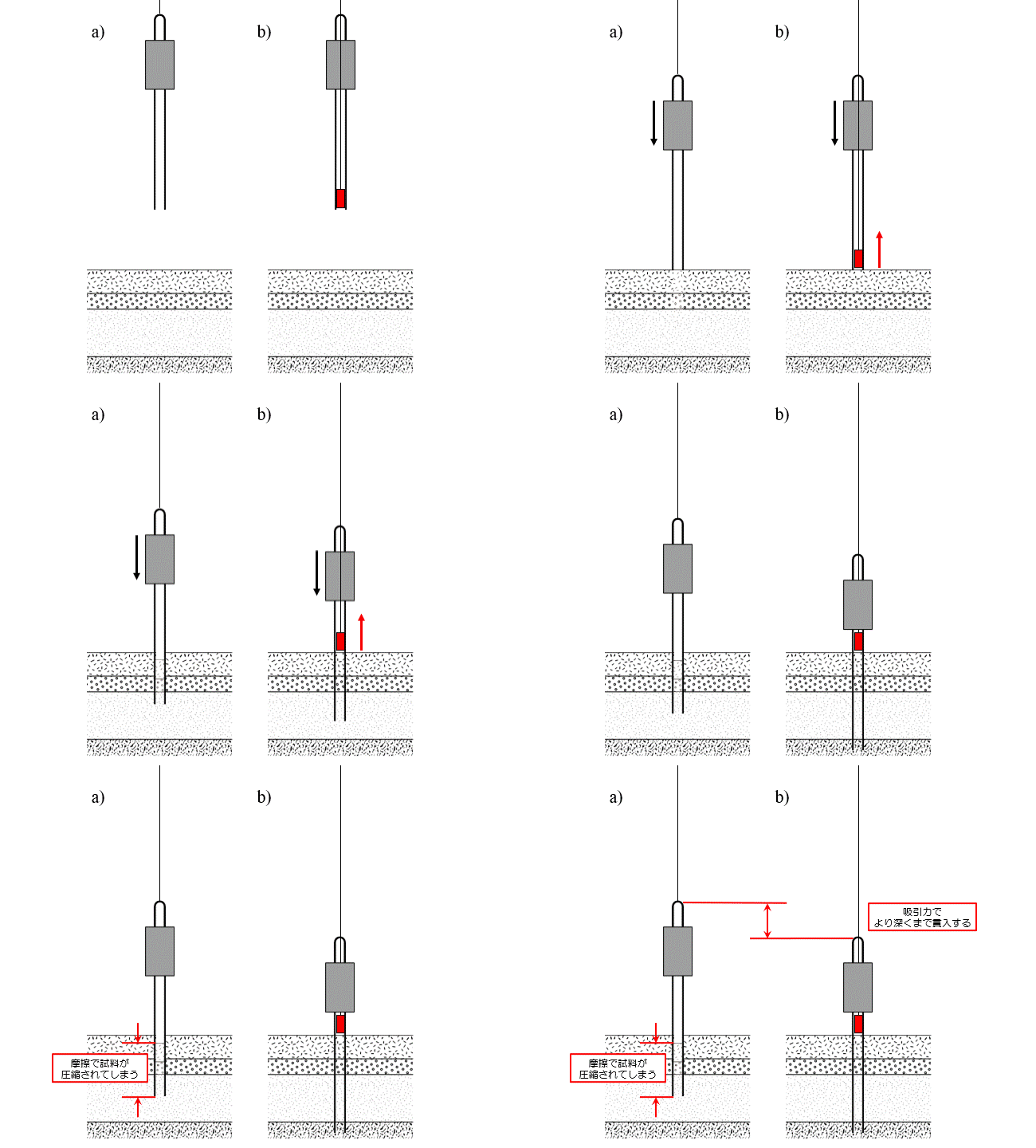
    • A similar type of corer to the piston corer is the gravity corer. Gravity corers are designed to penetrate a mud sampling pipe only by the weight of the main weight. Figure 9 shows a schematic representation of the difference between the two. In the gravity corer, the sample is compressed by the friction between the sediment and the mud sampling pipe as mud sampling pipe is penetrated, whereas in the piston corer, the internal friction is reduced by the suction force. The suction force also pulls up the sediments, allowing the mud sampling pipe to penetrate to a greater depth.


    • Figure 9 Comparison of piston corer and gravity corer

      a) Gravity corer b) Piston corer

    • This section introduces the mud sampling procedure using a piston corer. Although there are some differences in the procedures depending on the equipment installed on each vessel, the piston corer is a large, heavy, and long instrument, so it must be handled with great care on board a vessel that is subject to turbulence. In addition, it is necessary to have a good understanding of how to prepare the coring equipment and how to process the collected samples in order to obtain high-quality samples and data. Therefore, we will explain each of the mud sampling operations using a piston corer in the following order: (1) preparation for observation, (2) feeding operation, (3) landing on the bottom, (4) lifting operation, (5) sample collection, (6) sample handling, and (7) recording observations and operations.

    • 1. Preparation for observation


       Connect the mud sampling tube to the main weight, and connect the mud sampling tube to the length of the core to be sampled. If an inner tube is used, insert it together here. Next, connect the piston to the end of the main wire that has been passed through the mud sampling tube. The piston is then pushed into the mud sampling pipe from the lower end, and a core catcher and core bit are attached to the end of the piston to complete the mud sampling section. Connect the main weight and main wire to the balance trigger. Insert a stopper pin into the balance trigger to prevent the trigger from coming off during operation.


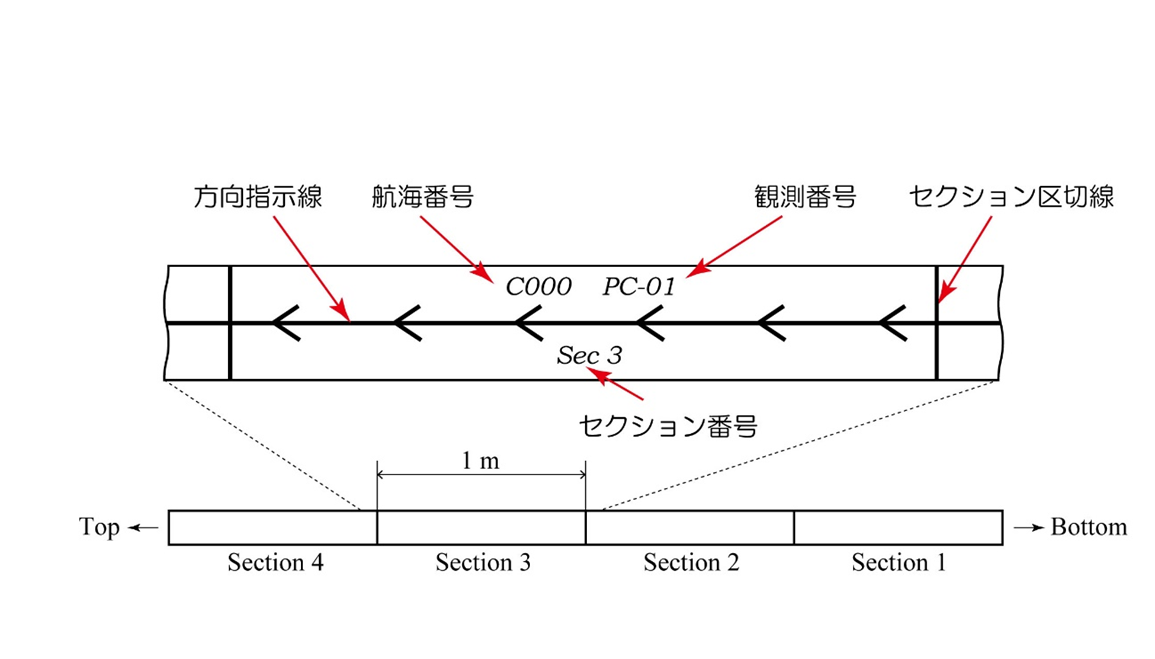
       The sample taken by the piston corer is cut into 1 m pieces for easy processing and storage. To ensure that the position and orientation of the sample is correct during this process, mark the mud sampling tube and inner tube in advance. Figure 10 shows an example of marking on the inner tube. The direction of the arrow indicates the direction of the surface layer of the sample, and the section numbers are assigned in order from the deepest sample.


    • Fig. 10 Example of marking on inner tube

      方向指示線 Direction Line
      航海番号 Voyage Number
      セクション番号 Section Number
      観測番号 Observation Number
      セクション区切線 Section Separation Line

    • 2. Feeding operation

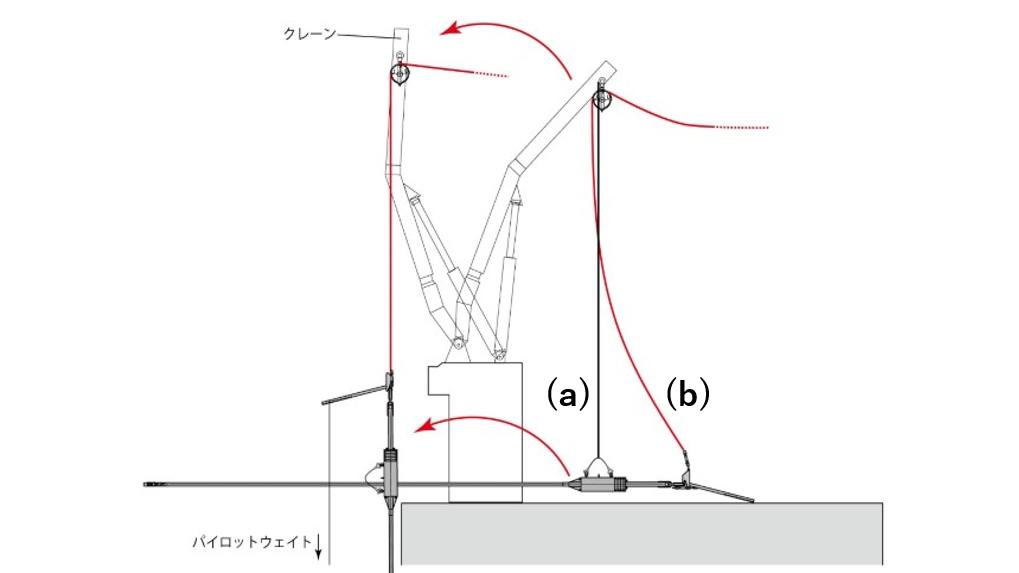
       Figure 11 shows the movement of the bottom sampler when it is placed from the stern of the vessel.

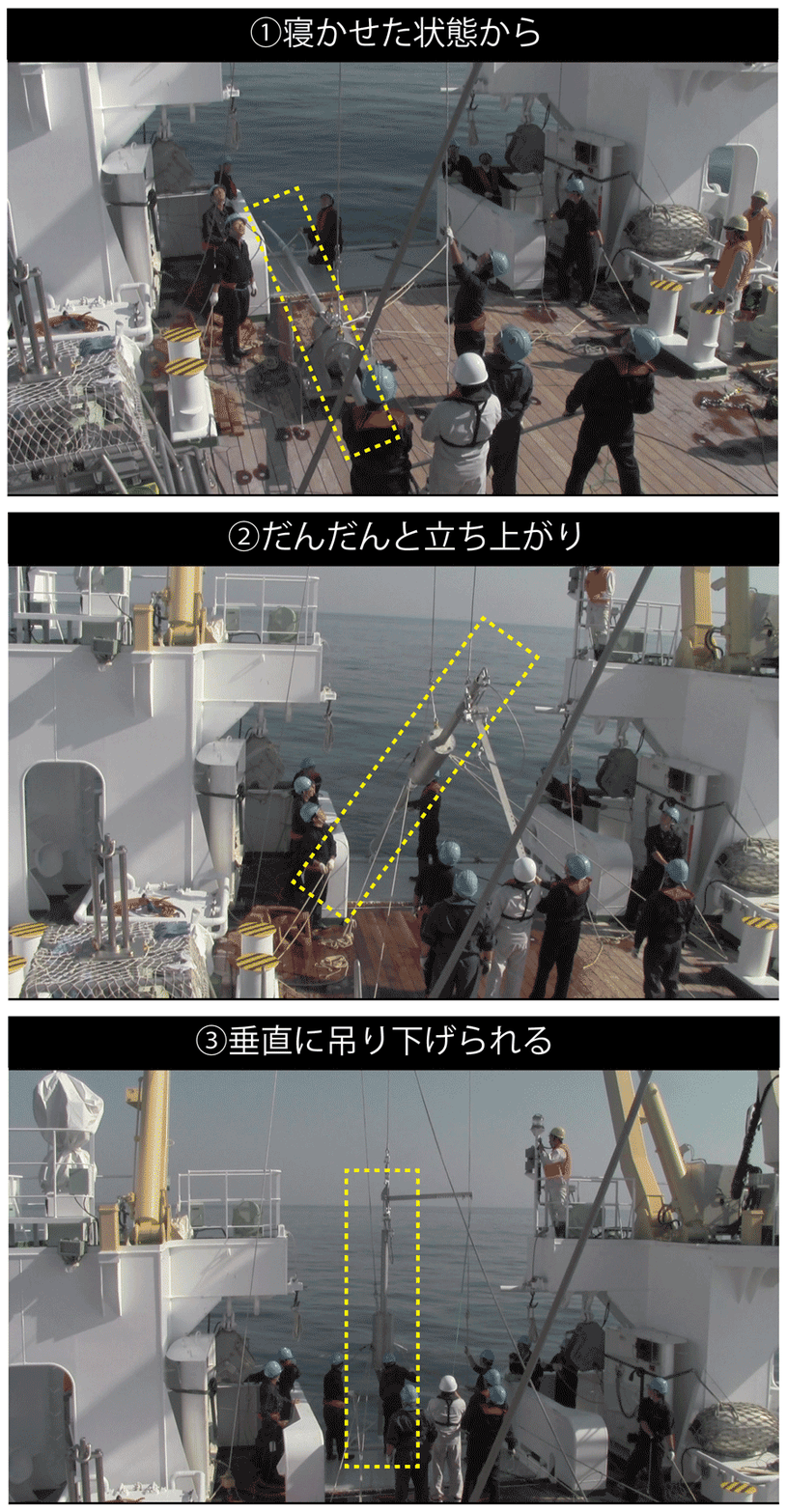
       First, the bottom sampler is lowered to the sea surface by swinging the crane. At first, a wire rope connected to the side of the main weight (Figure 11-a) is used to lift the bottom sampler while it is lying down. The winch wire (Fig. 11-b) is then wound up to gradually raise the mud sampler, and when it is completely lifted, the bottom sampler stands upright. Figure 12 shows how the bottom sampler is lifted in actual operation.

       Next, a pilot weight is suspended from the arm of the balance trigger. After the stopper pin of the balance trigger is pulled out, the winch wire is immediately released and the bottom sampler is put into the sea. If the balance trigger makes contact with the hull of the vessel, the bottom sampler may fall in mid-air, resulting in a serious accident. To prevent the bottom sampler and balance from swinging in the air due to the ship's motion, we use a rope to hold the bottom sampler down until it is just about ready to be placed in the water. Once the bottom sampler has been lowered to a depth of 50 m, the winch is stopped and a pinger*1 is attached to the winch wire. The winch wire is then unloaded and the bottom sampler is lowered to the seafloor.

    • Fig.11 Loading operation of bottom sampler (1)

      クレーン Cranes
      パイロットウェイト Pilot weight


    • Fig.12 Loading operation of bottom sampler (2)

      寝かせた状態から From a lying position

      だんだんと立ち上がり Gradually stand up

      垂直に吊り下げられる Suspended vertically

    • 3. Landing on the bottom

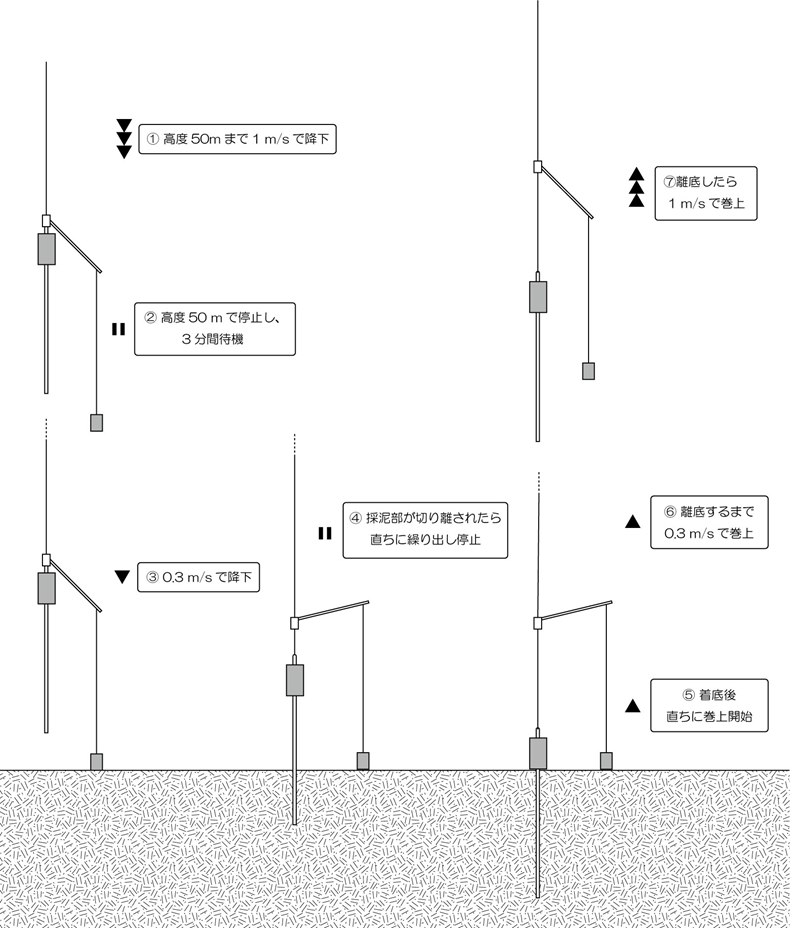
       Once the bottom sampler is in the water, follow the procedure shown in Figure 13. The wire is unrolled at a speed of 1 m/sec while checking the underwater altitude of the bottom sampler (distance to the seafloor), relying on the depth of the water, the length of the unrolled wire, and the pinger signal (Figure 13-①). When the bottom sampler reaches a height of 50 m above the seafloor, it stops unloading and waits for 3 minutes to stabilize its position (Figure 13-2). After waiting, the wire is restarted at a slow speed (0.3 m/second) (Figure 13-3). As soon as the balance trigger is activated and the bottom sampler begins to descend to the seafloor, the wire feed is immediately stopped (Figure 13-4). When the tension meter*2 detects a decrease in the tension applied to the wire, it is determined that the trigger has been activated. Within a short time after the trigger is activated, the mud sampling tube pierces the seafloor and the mud sampling section stops falling, so the wire starts unwinding without a pause (Figure 13-⑤). Since there is a risk of excessive tension due to frictional forces generated when pulling out the mud pipe, the winding speed should be slow (0.3 m/second) until the bottom is released (Figure 13-6). As the wire is wound up, the tension gradually increases, and when a constant tension is observed, bottom sampler release can be confirmed. The winding speed is then increased and the bottom sampler is quickly recovered on board (Figure 13-7).

    • 7

      Fig. 13 Winch operation at piston corer landing

      1 高度50mまで1m/sで降下 Descend at 1 m/s to an altitude of 50 m
      2 高度50mで停止し、3分間待機 Stop at 50m altitude and wait for 3 minutes
      3 0.3m/sで降下 Descend at 0.3 m/s
      4 採泥器が切り離されたら直ちに繰り出し停止 Stop unloading as soon as the bottom sampler is detached
      5 着底後直ちに巻き上げ開始 Starts hoisting immediately after landing
      6 離陸するまで0.3m/sで巻上 Starts winding up at 0.3m/s until takeoff
      7 離底したら1m/sで巻上 After the vessel leaves the bottom, it winds up at 1m/s.

    • If the bottom sampler is tilted at the time of landing, it cannot be penetrated deeply. Also, if the bottom sampler is subjected to oblique force when it is pulled out, the mud sampling pipe will be bent and damaged. Therefore, it is necessary to keep the bottom sampler right under the ship not only while lowering it, but also from the time it reaches the bottom until it leaves the bottom, taking into consideration the current and other factors to keep the wire pointing straight down.


      1 Pinger

       An acoustic device that emits sound signals at regular intervals and is used to measure seafloor altitude (the distance from the seafloor to the pinger). By using this device to measure the distance between the bottom sampler and the seafloor, it is possible to safely and reliably conduct mud sampling.

      Link: Pinger


      2 Tension meter

       This device measures the tension (weight) applied to the wire. By measuring the increase or decrease of the tension, it is possible to know when the bottom sampler leaves or arrives at the seabed.

    • 4. Lifting operation

       The lifting of the bottom sampler is almost the same as that of the feeding operation, but in the reverse order. However, the difference is that the distance between the balance trigger and the bottom sampler is far from each other. Since it is difficult to lift the balance trigger and the mud sampler together, the pilot weight and the balance trigger are usually removed first, and then the bottom sampler is lifted.

       The bottom sampler may swing greatly when it is lifted into the air due to the impact of waves on the bottom sampler or due to the ship's motion. Therefore, as when putting in the bottom sampler, the work is performed while holding it down firmly with a rope. If the bottom sampler is struck by the ship's hull, it may result in damage to the bottom sampler or loss of valuable samples.

    • 5. Sample Collection


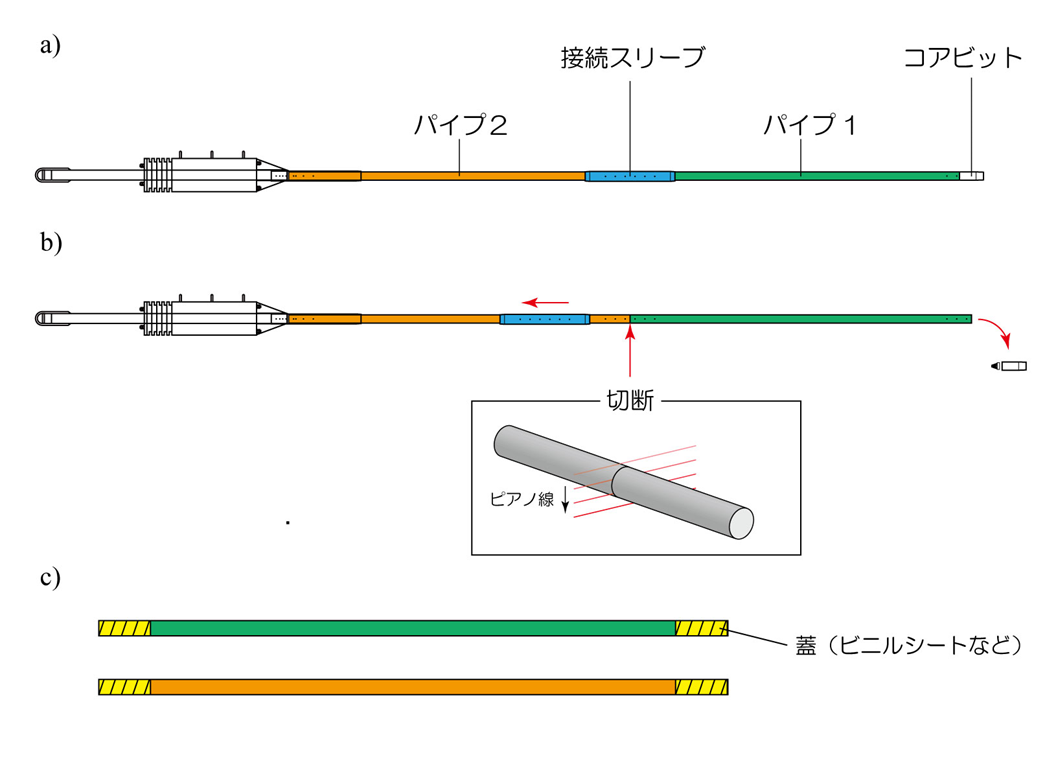
       Once the bottom sampler has been lifted, the sample (core) is cut apart at the joints of the sampling pipe (Figure 14). Remove the core bit and core catcher from the end of the mud sampling pipe. At the joints of the sampling pipe, slide the connecting sleeve and cut the sediment at the joints using a piano wire or nylon texs to separate the entire sampling pipe. The cut surface is then sealed with plastic sheeting or tape to prevent leakage or contamination of the sample. To prevent orientation and position from being lost after separation, mark the outside of the pipe according to the method shown in Figure 10. In the case of mud sampling using an inner tube, use a cutter to cut the inner tube at the pre-marked section-by-section line while pulling the inner tube out of the sampling pipe.


      Translated with DeepL


    • Fig. 14 Sample recovery

      a) Condition at the time of lifting b) Cutting off the pipe c) Sealing the pipe

      接続スリーブ Connecting Sleeves

      コアビット Core Bits

      パイプ Pipe

      切断 Cutting

      ピアノ線 Piano wire

      蓋(ビニルシートなど) Lid (e.g., vinyl sheet)

    • 6. Sample Processing

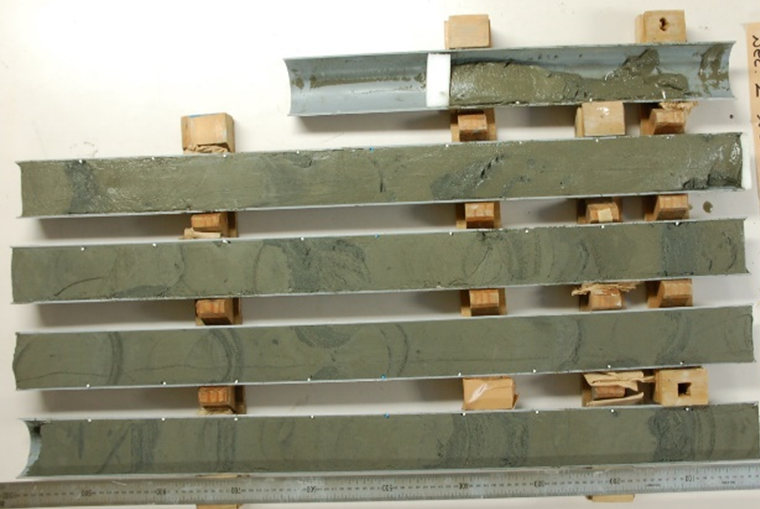
       The collected cores are further cut into 1 m lengths of pipe for easier handling. The core is then cut into semicircles to observe the thin layer of lamina found in the core and to further distribute the sample into smaller pieces (Figure 15). This operation is called the "core splitting process.

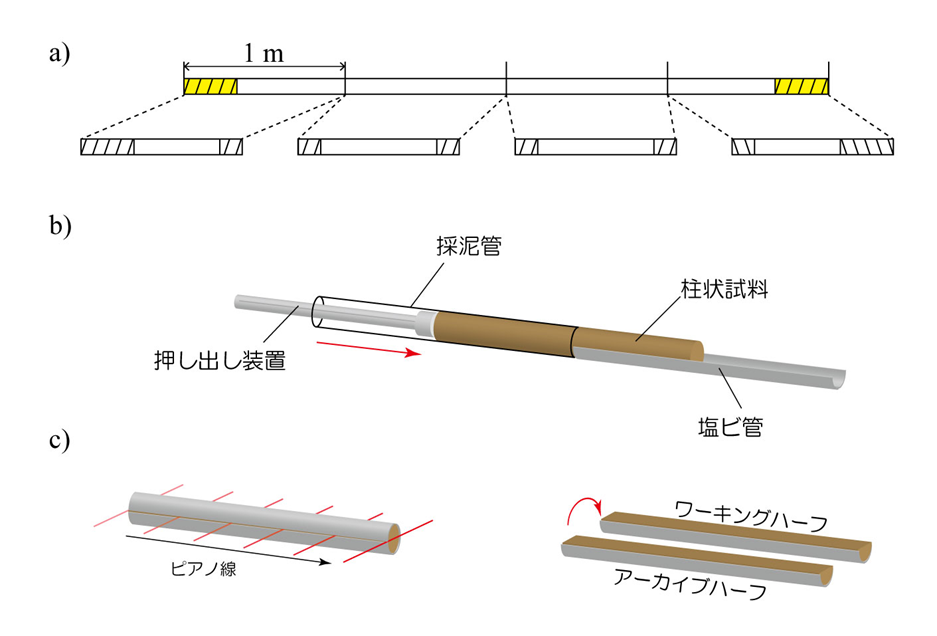
       Figure 16 illustrates the semi-circular sectioning process. First, the core is pushed out of the pipe and transferred to a PVC pipe. A hydraulic extruder is used to slowly extrude the core under constant pressure. After transferring the core into the PVC pipe, the core is further cut into two semi-cylinders. One half of the split core is called the working half and the other half is called the archival half.

       Since the seafloor core is a very valuable sample that contains information tens of thousands of years old, there is an international rule that samples for analysis are taken from the working half and the archive half is kept in cold storage as a semi-permanent sample for preservation. In Japan, the Kochi Core Center, a research facility jointly operated by Kochi University and the Japan Agency for Marine-Earth Science and Technology (JAMSTEC), serves as an integrated center for the storage and management of core samples collected in Japan and overseas, and for research using these samples.

    • Fig. 15 Semi-split sediment core


    • Figure 16. Half-splitting a core

      a) Cutting the pipe b) Extruding the core c) Splitting the core in half

      押し出し装置 Extruder

      採泥管 Mud sampling tube

      柱状試料 Pillar sample

      塩ビ管 Vinyl chloride pipe

      ピアノ線 Piano wire

      アーカイブハーフ Archival half

      ワーキングハーフ Working half

    • 7. Observation records

       In mud sampling as well as CTD observation, it is the most basic data and important information for research and survey to record the length of wire unrolled, outline of the sample taken, sample distribution, and destination, in addition to geographical information such as vessel level and water depth at the time of sample collection. Therefore, not a few institutions prepare observation field notebooks that specialize in recording the work done during mud sampling. It is also important to record the specifications of the bottom sampler, such as the weight of the main weight used and the length of the sampling pipe, as well as the length of the sample collected by the bottom sampler, as indicators for the next observation.


  • Reseach Methods Trainig Ship