Size Classification of Marine Organic Matter
Garis besar topik
-
-
Size classification of organic matter ~Let's start with biological matter~
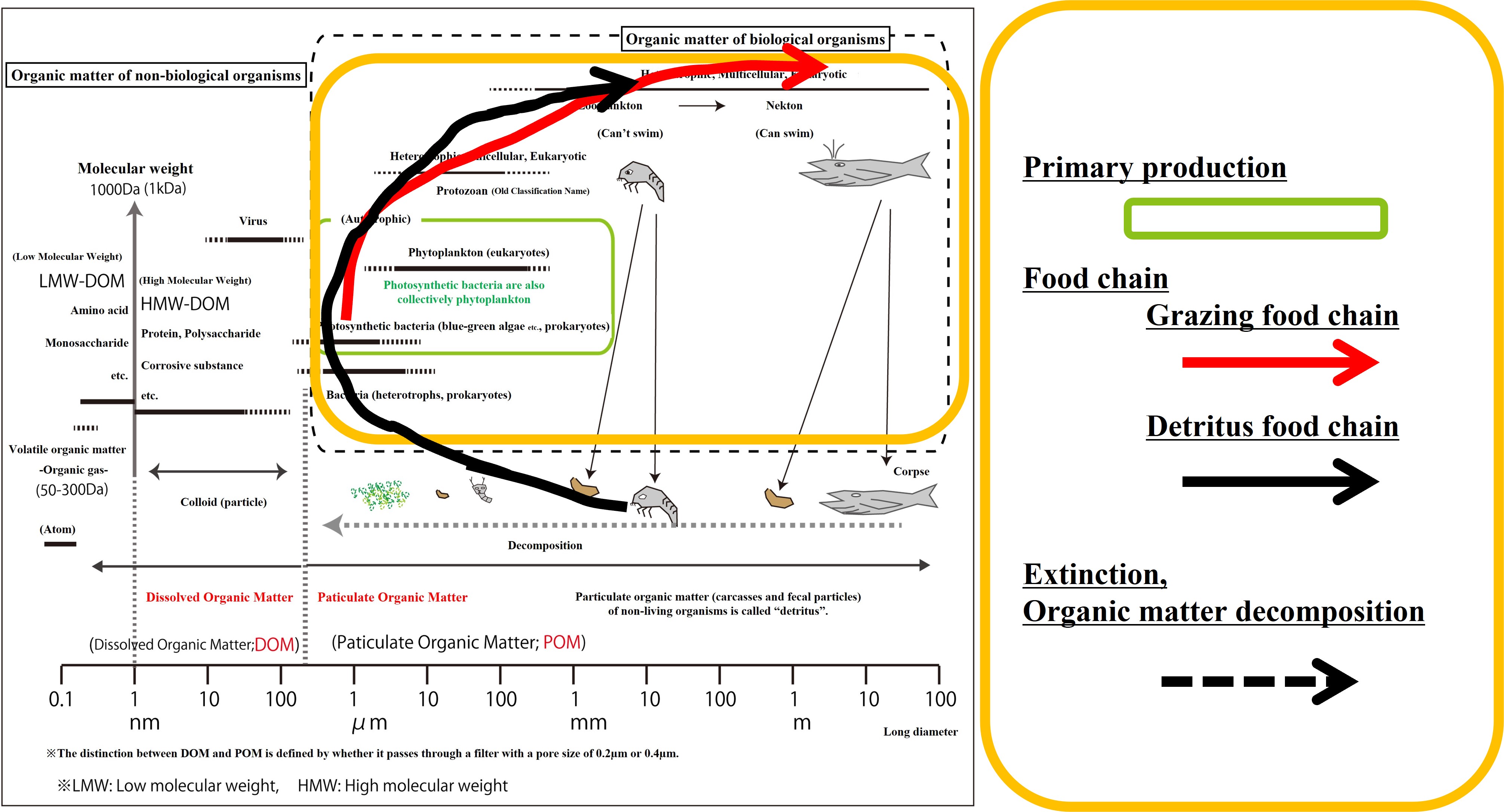
Prokaryotes were the first organisms on earth and later evolved into eukaryotes. Eukaryotes are living organisms that have a nucleus separated from the cell by a nuclear membrane. Prokaryotes do not have them. The mitochondria of eukaryotes have the function of generating energy through oxygen respiration, and their origin is thought to be due to the symbiosis of prokaryotes called alpha-proteobacteria (mitochondrial symbiotic theory; [The 3 billion year natural history of algae, by INOUE Isao, Tokai University Press, etc.]). Given this, you can imagine that prokaryotes are considerably smaller than eukaryotes. More primitive prokaryotes are about submicron (0 ~ 1 μm) to 10 microns (10 μm) in size, while eukaryotic cells are 10 to 100 times larger (several hundred microns) than prokaryotes. There are many exceptions, but in the figure below, the size of organic matter is represented by the thick solid and dotted lines.
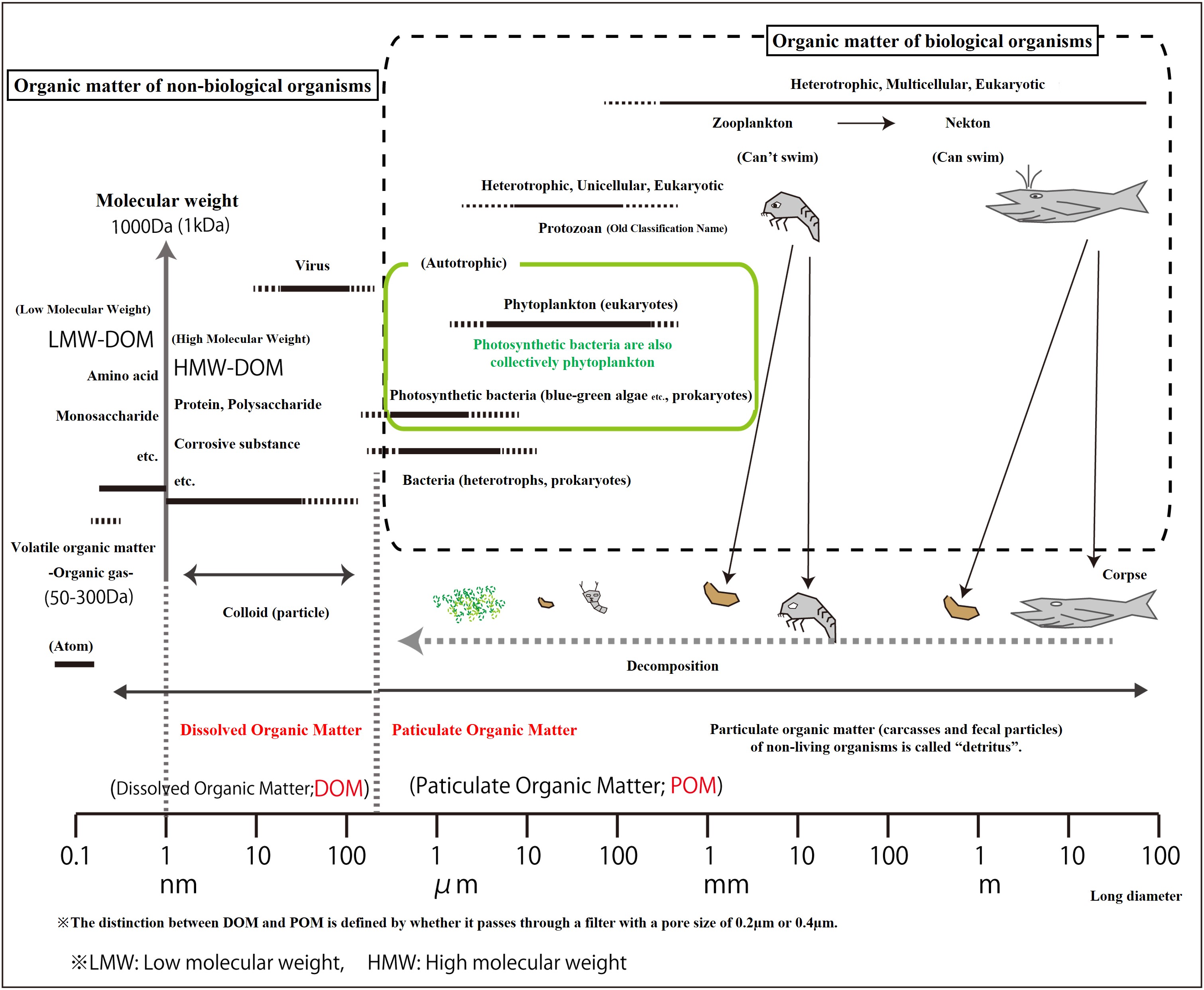
When classifying organisms in terms of energy acquisition, they can be divided into two categories: autotrophs and heterotrophs. In other words, the difference is whether they store energy through photosynthesis or obtain their energy source by feeding on other organic matter. (However, there are some mixotrophs.) Eukaryotes that photosynthesize are called plants, and unicellular plants floating in the ocean are called (marine) phytoplankton. There are also photosynthetic prokaryotes (e.g., blue-green algae), which are properly called photosynthetic bacteria, but in oceanography, eukaryotes and prokaryotes together are often collectively called "phytoplankton" for photosynthetic unicellular organisms (the part of the figure "Classification of Organic Materials" that is lumped under "autotrophs"). In contrast, heterotrophic prokaryotes are collectively referred to as "bacteria" or "bacteria".
Eukaryotic, unicellular, heterotrophic organisms are called "protozoa" like amoebas. (I heard that "protozoa" is no longer called "protozoa" these days; please refer to your biology textbooks for details). Eukaryotic, multicellular, and heterotrophic organisms are classified as "(multicellular) animals" (located at the top of the figure "Classification of Organisms"), and animals that are small and cannot swim are called zooplankton (even large jellyfish, which do not swim, are classified as plankton), and animals that can swim are called nekton. Some organisms intentionally move up and down by changing the density of fluid in their cells, but this alone is not enough to be considered a swimmer. Although the classification of animal size is not clear, animals several tens of millimeters in length can likely swim. Incidentally, the largest organic particles in the ocean are whales.
If we consider that marine animals swallow food approximately 1/10 the size of their own body and produce feces 1/10 the size of their own body, it is easy to imagine the transition in organic matter size due to biological activity.
(There are plenty of exceptions, like baleen whales feeding on plankton and squid eating food about their own size.)
Nonliving organic matter includes excreta (e.g., feces) and carcasses of living organisms, which have decomposed and transformed. Excreta (e.g., feces) and carcasses are called detritus in English. The size of detritus can be imagined as the size of the original organism or the size of feces (about 1/10 of the original organism). Detritus gradually decreases in size through microbial and physical decomposition. If the water flow is slow, detritus in the process of decomposition may aggregate to form fluffy organic particles.
-
-
Biological activity that alters the size of organic matter
Biological activity is important in changing the particle size of organic matter.
① Primary production produces organic particles.
② The predation of biological particles and their assimilation increase the size of organic particles.
It is an action of the food chain. A food chain that starts with organic matter produced in primary production is called a "grazing food chain".
③ Excretion or death causes the biotic particles to become nonbiotic particles.
Then, the decomposition of organic matter by microorganisms occurs. The size of organic particles decreases.
④ Organic matter size also increases in the food chain due to microorganisms feeding on nonliving organic matter.
A food chain that starts with rotten food is called a "detritus food chain".