

Winkler method
セクションアウトライン
-
Measuring dissolved oxygen (DO) in seawater is a basic requirement in oceanography. This section describes the measurement of DO using the Winkler method.
[Outline]
(1) Collect seawater in oxygen bottles and make oxygen in the seawater to combine with manganese hydroxide precipitate.
(2) Dissolve the manganese hydroxide oxide formed by the dissolved oxygen with hydrochloric acid. Iodine is generated in the sample water in proportion to the amount of bound oxygen.
(3) Titrate the amount of iodine with sodium thiosulfate solution. Convert the amount of iodine into the amount of dissolved oxygen.
The following is a more detailed explanation of the procedure and principle of DO measurement by the Winkler method.
(1) Collect seawater in an oxygen bottle and add Fixing Solution I (an acidic solution of manganese chloride) and Fixing Solution II (a strongly alkaline mixture of sodium hydroxide and potassium iodide) before putting the lid on.
(2) Put the lid on the oxygen bottle and invert it up and down 30 times.
The left side of the picture below is immediately after adding Fixing Solution I and Fixing Solution II and putting the lid on. The acidic manganese chloride solution (with Mn2+) becomes white precipitates of manganese hydroxide (Mn(OH)2) when it becomes strongly alkaline with solution II.
This white precipitate is mixed well by tipping the oxygen bottle up and down 30 times, then dissolved oxygen (O2) in seawater combines with manganese hydroxide (Mn(OH)2) to form brown manganese hydroxide (MnO(OH)2). These are a mixture of both white and brown precipitates. If the seawater contains more dissolved oxygen, the precipitates are darker brown (top of the lower panel). If seawater contains little or no oxygen, the precipitates will remain white (bottom).
After a few hours of standing in this state, the precipitates will accumulate at the bottom of the bottle.
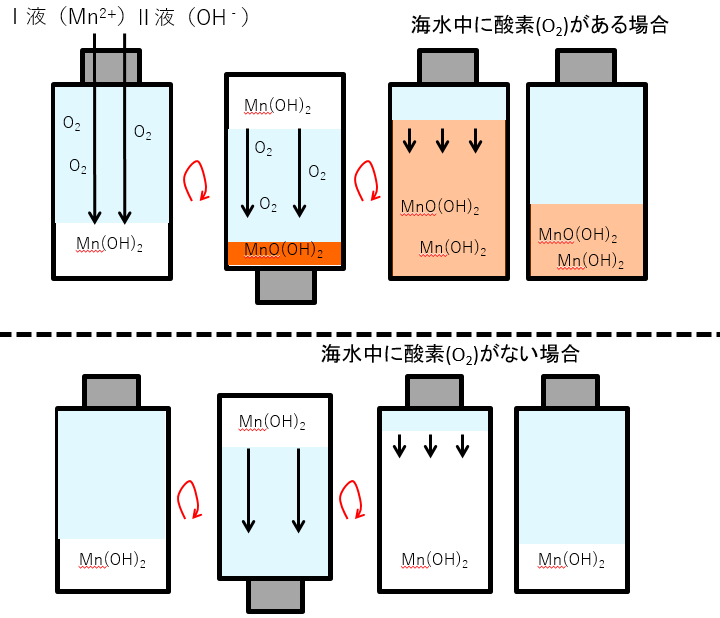
海水中に酸素(O2)がある場合: Seawater with oxygen
海水中に酸素(O2)がない場合: Seawater without oxygen
The below figure shows the acid-base reaction in which manganese ions (Mn2+) precipitate white manganese hydroxide under alkaline conditions, and the redox reaction in which manganese hydroxide and oxygen combine to produce brown manganese hydroxide oxide.
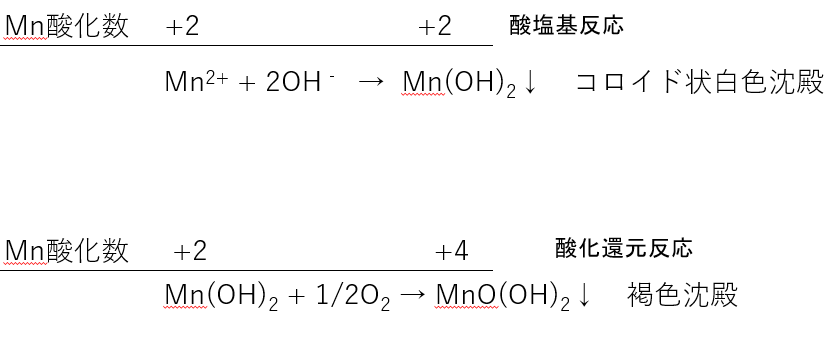
酸化数: Oxidation number 酸塩基反応: Acid-base reaction 酸化還元反応: Redox reaction コロイド状白色沈殿: Colloidal white precipitates 褐色沈殿: Brown precipitates
When the precipitates accumulate at the bottom of the bottle (right side of the above picture), open the lid of the bottle and add 6 mol/L of hydrochloric acid. Then the precipitates of manganese hydroxide (white) and manganese hydroxide oxide (brown) that have accumulated in the oxygen bottle will dissolve to produce manganese ions (Mn2+). At this time, the following acid-base and redox reactions occur.
Above equation: The oxidation number of manganese in manganese hydroxide (Mn(OH)2) is +2. Even if this dissolves to produce Mn2+, the oxidation number of manganese remains +2. Since the oxidation number does not change (no electron transfer), this is an acid-base reaction.
Below equation: The oxidation number of manganese in manganese hydroxide oxide (MnO(OH)2) is +4. When this dissolves to produce Mn2+, the oxidation number of manganese is +2. Since the oxidation number changes from +4 to +2 (transfer of electrons), this is a redox reaction.
Reductants to supply electrons (e-) to manganese in this redox reaction (the other half reaction) are needed. Iodide ion (I-), in the fixing solution I, is responsible. The iodide ion releases electrons (e-) (oxidized) to form iodine molecules (I2).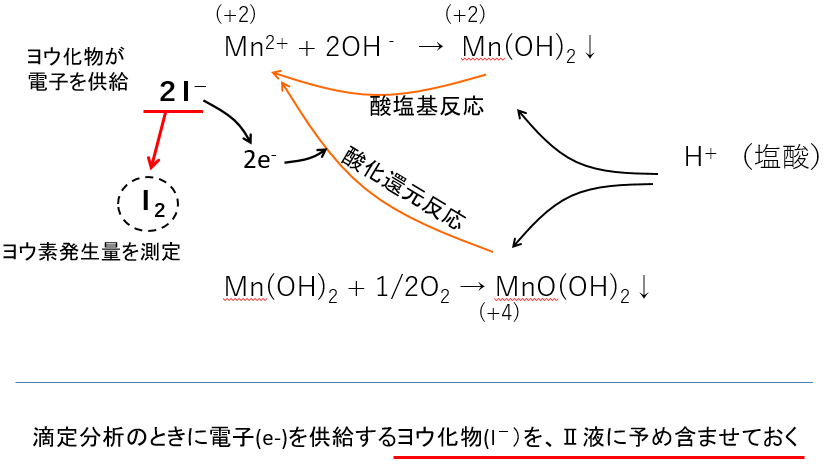
酸塩基反応: Acid-base reaction 酸化還元反応: Redox reaction ヨウ化物が電子を供給: iodide supply electrons ヨウ素発生量を測定: measure amount of iodide(I2) generation 塩酸: hydrochloric acid 滴定分析のときに電子(e-)を供給するヨウ化物(I)を、I液に予め含ませておく: Add Iodide (I-), which provides electrons (e-) during titration analysis, in fixing solution I beforehand.
When hydrochloric acid is added to the DO bottle to dissolve the precipitate, iodine molecules (I2) are generated in proportion to the amount of dissolved oxygen.
The amount of these iodine molecules (I2) is examined by titrating with a sodium thiosulfate solution of known concentration.
When iodine molecules are present in the solution (*), it displays brown to yellow in color.
Titrating thiosulfate to the iodine molecule, the iodine molecule (I2) is reduced to I-. The endpoint (the point at which the drops of thiosulfate necessary to eliminate I2 are completed) is the point where the color disappears.
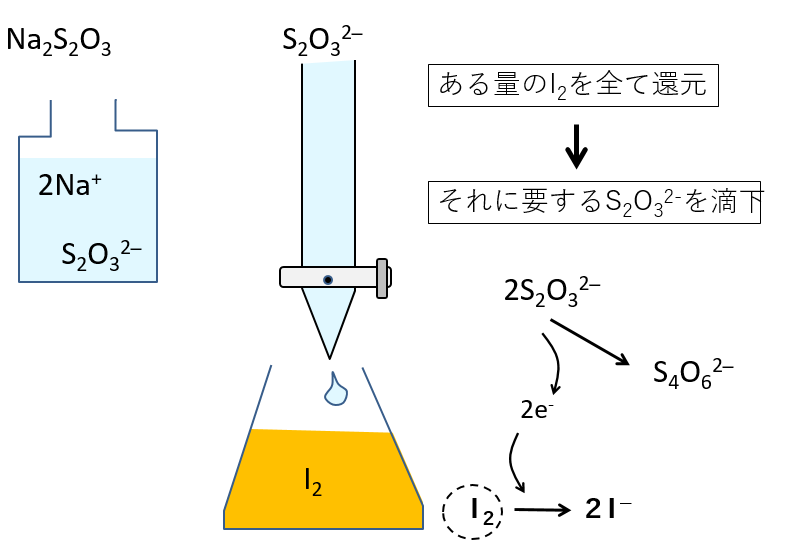
ある量のI2を全て還元: Reducing all I2 of a certain amount それに要するS2O32−を滴下: Titrating S2O32- required for it[note] It is important to note that the iodine molecule (I2) is an insoluble black solid. As shown in the figure below, I2 can combine with any surrounding I- and dissolve as triiodide ion (I3-). Since I2 and triiodide ion (I3-) are in equilibrium, I2 disappears as soon as triiodide ion (I3-) loses its color.
In manual analysis, add starch to the iodine solution (sample water), which has lost its brown color, and light purple color will be displayed due to the iodine-starch reaction. It is easier to determine the endpoint because the color shade is more pronounced.
An automatic device is also available to titrate sample water with thiosulfuric acid by potentiometric titration. The following is an overview of potentiometric titration.
In a potentiometric titration, monitor the redox potential in the sample water, titrating with c. The redox potential is different before the endpoint (when there are iodine molecules in the sample water) and after the endpoint (when thiosulfuric acid accumulates). The endpoint is the inflection point of the potential curve. By reading the inflection point, measure the amount of thiosulfate solution dropped to the endpoint.
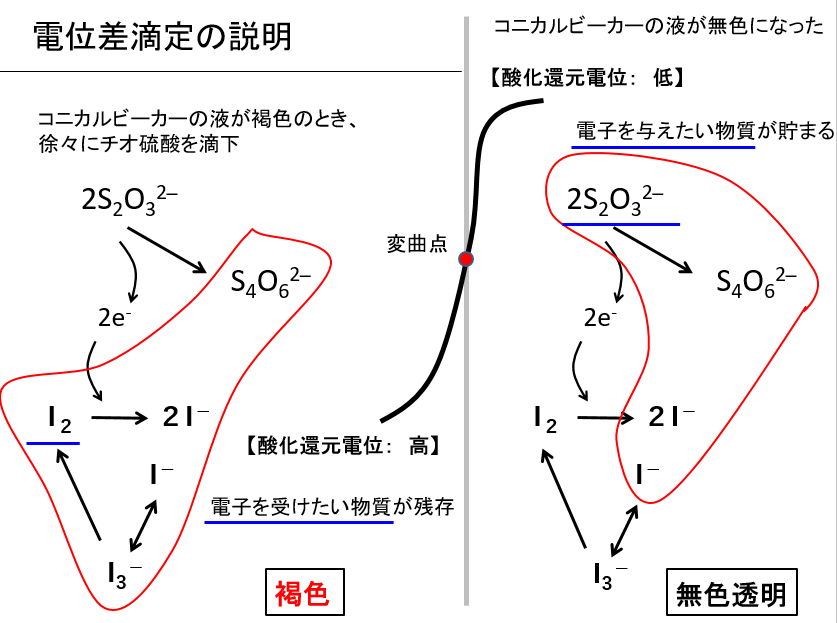
電位差滴定の説明: Explanation of potentiometric titration コニカルビーカーの液が褐色のとき、徐々にチオ硫酸を滴下: Add thiosulfate acid steadily until solution in the conical beaker is brown 電子を受けたい物質が残存: Remaining substances that are able to receive electrons コニカルビーカーの液が無色になった: Solution in the conical beaker turns colorless 電子を与えたい物質が貯まる: Accumulating substances that are able to give electrons 褐色: brown 無色透明: clear and colorless 酸化還元電位: Oxidation−Reduction Potential 高: high 低: low